Log in



There’s plenty of legitimate complaints about academia. I’ve made them myself. But is it too much to hope for that one day, just maybe, people will stop falling for the availability bias?
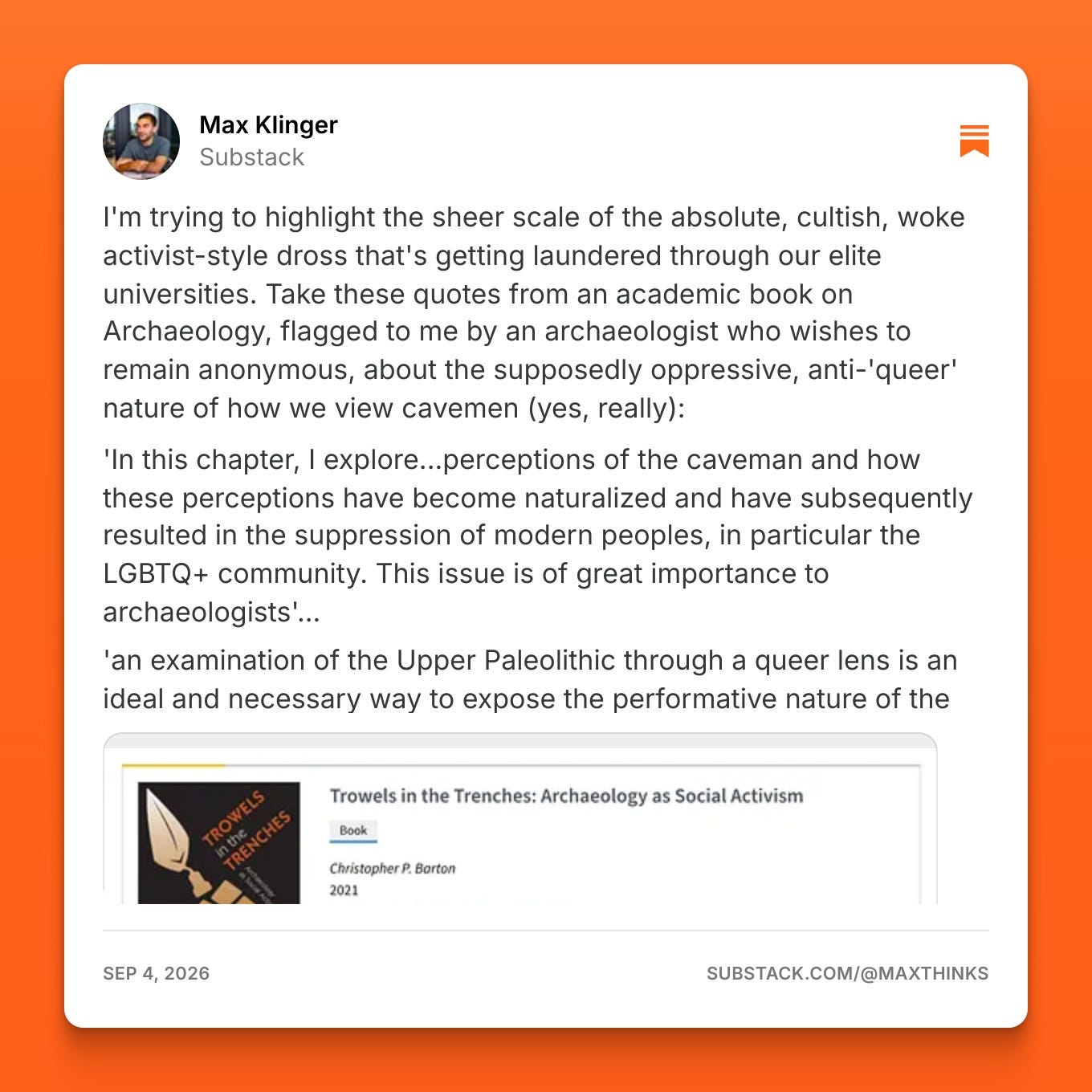
is all fired up about Christopher P. Barton. So let’s look into Mr. Barton: PhD Temple, author of Trowels in the Trenches (University of Florida Press), has no current academic affiliation that either I or Claude could find. He seems to have once been employed as an assistant professor at Francis Marion University in South Carolina, but is no longer on their website. Although his LinkedIn page says he an adjunct instructor at Widener University, the Widener website does not list him and I don’t know if LinkedIn is current. As far as I can tell, Barton is either not in the academy at all or just clinging on. His Google Scholar page says that in 14 years he has been cited all of 154 times. Absolutely no part of his story is “elite.” Not to be too snobby about it, but Barton barely reached the bottom rung of academia and seems to have slipped off of that.
Nevertheless, Barton’s LGBTQ+ cavemen take must surely be indicative of the whole woke activist cult field of archeology, right? Well, Antiquity is archeology‘s flagship journal. Here are all of the articles in the latest issue:
Understanding a first attempt at pottery: early fired containers at Çemka Höyük
Human maritime adaptation on Haitan Island, China, c. 7500 cal BP
A fortified Early Bronze Age settlement in the Southern Caucasus
The Pocó-Saladoid connection and the first widespread ceramic tradition in Tropical Lowland South America
Uncovering the lives of rock doves (Columba livia) in Late Bronze Age Hala Sultan Tekke, Cyprus
Reconnecting the dead in Iron Age Britain: funerary processing at Loch Borralie, Scotland
Failure or resilience? Community investments at ancient Roman Veii
Genetic relatedness, social status and cemetery organisation: the Xiongnu Tamir necropolis, Mongolia
The death jar: a new mortuary tradition at the Plain of Jars, Lao PDR
Radiocarbon dating of textiles preserved in late medieval helmets from Benicarló, Spain
Surgical anaesthesia in Ming China: aconitine residues on medical instruments
Mediterranean maritime visibility: old limits and new approaches
Hmmmm, I’m not sure which one of these is the absolute, cultish, woke activist-style dross that academia is apparently awash in. Probably all. But hey, that’s not my field. What’s happening with us philosophers? There’s only two articles (plus a bunch of book reviews) in the latest Philosophical Review, arguably our leading journal: “Could the truths of mathematics have been different?” and “Advancing the Boltzmann Brain skeptical challenge.” I’ve not read them, but based on the abstracts they don’t seem too political.
Wait, I thought this stuff was everywhere. No? Klinger is certainly looking for it:
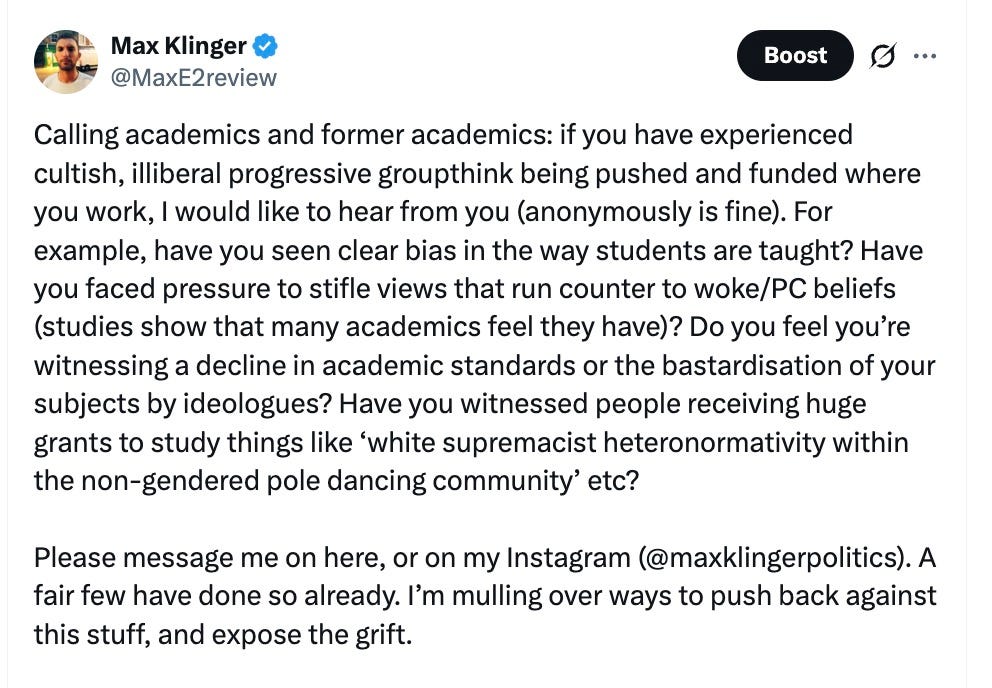
Let’s apply this methodology elsewhere. Pick a random company. How about Comcast/Xfinity? Is Comcast/Xfinity a terrible company? Send me all your horror stories about Comcast/Xfinity! Ok, a Google search of “Comcast is terrible” yielded some excellent results. Try it yourself. There’s whole Reddit groups devoted to why they are the worst, a Wikipedia page called “Criticisms of Comcast,” a Facebook group called “Comcast Customer Service Sucks,” and the list goes on.
Maybe they are particularly bad and I’m just cherry picking. Let’s look at, I dunno, McDonalds. I searched “McDonalds is terrible” and found a Reddit group called “When did McDonalds get so bad?”, articles on the downfall of McDonalds, how their food quality is declining, lists of things customers hate about McDonalds in 2026, and plenty more. There’s loads of complaints about McDonalds.
Wait, here’s an idea. Klinger’s Substack bio says he is a lawyer. Everyone loves lawyers, right? Let’s see… searching… Huh. “Lawyers contribute least to society, says US poll.” Who woulda thunk? That’s the US, though. What’s the UK take on lawyers? The IPSOS Veracity Index is a long-running UK survey on trust. Check out these results.
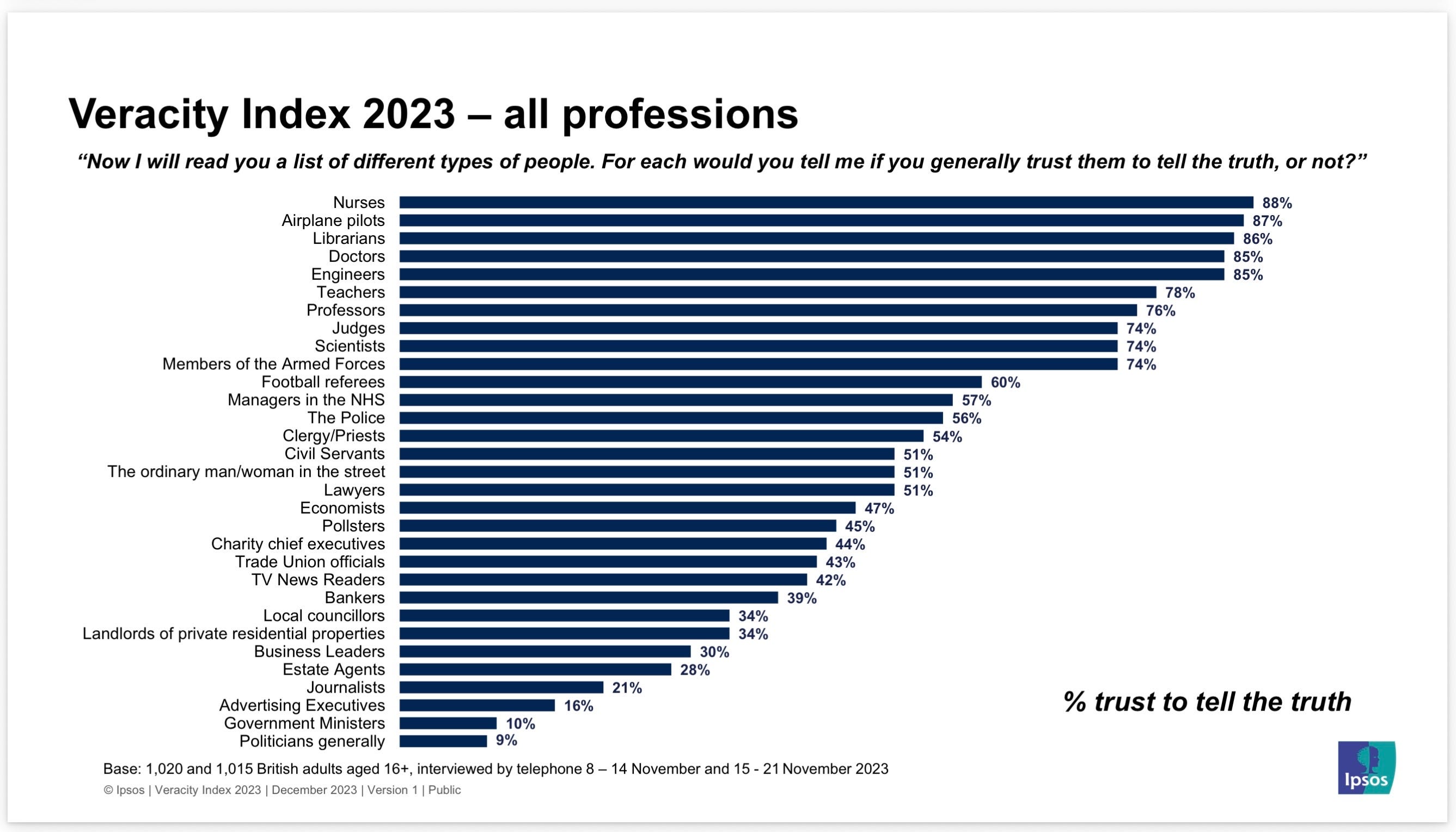
Lawyers are trusted much less than professors, even less than a random person on the street. Barely half of UK citizens would generally trust lawyers to tell the truth. As Steven Wright joked, 99% of lawyers give the rest a bad name.
My point is that it’s a big world out there, and if you go looking for something, you’re going to find it. You can probably find people who hate Dolly Parton. The very reason that researchers (eventually) came up with double-blind testing was to make sure that they didn’t merely see the results they were wanting to see. Previous scholars weren’t dishonest; they just didn’t know that their subconscious minds were putting a thumb on the scale of evidence.
A modern way social scientists inadvertently fool themselves is p-hacking. That’s when they root around in the data until they see something that looks like a suitably improbable correlation and presto, publication. After a while people realized this was just another way of finding spurious results when they were hoping for meaningful ones. The fix—hypothesis preregistration—is like double-blinding: a way to keep everyone honest and avoid cherry-picking chance correlations.
Is there dumb wokeness in the academy? Of course. But if we are truly interested in whether it is prominent, representative, isolated, confined to only some disciplines, ubiquitous, more management than faculty (or vice versa), student-driven, or we’d like to know its etiology and causal effects, we are going to need a more sophisticated methodology than repeated applications of the availability bias. Academia is not a monoculture, as much as those on the outside try to fit us into one.
I get that Klinger is mad that his alma mater ever hired Jason Arday, and it is understandable that people are still steamed about him, but those who are claiming Arday was lynched (e.g. here and here) are embarrassing themselves. In fact, I think an accusation of lynching is the real racism; it denies human agency to Arday, portraying him as a mere passive victim of others. In reality he was a successful con man who quit his job and (apparently) took his own life when his house of cards collapsed. Those are actions he took.
Con men succeed because they are good at what they do. They identify people’s blindspots and biases and exploit them. If we really want to improve the epistemic commons we have to employ better methods than continuing to fall for known biases and inferential fallacies. C’mon, can’t we ever grow out of being toddlers who think every emotion-generating story represents all of reality? If there is one thing I have learned as a philosopher, it is this: knowledge is hard. So let us do the hard work of lashing ourselves to the mast and sailing past the sirens as they sing the call of the availability bias.