1526 stories
·
2 followers

Effort -> Learning

1 Share

I think my most important goal as a teacher is for students to learn that effort leads to learning. This is one place where teachers need to show, not tell. I can tell students to put in their best effort as many times as I like. If students’ everyday experience is that when they put effort in, they don’t learn, they won’t believe me.
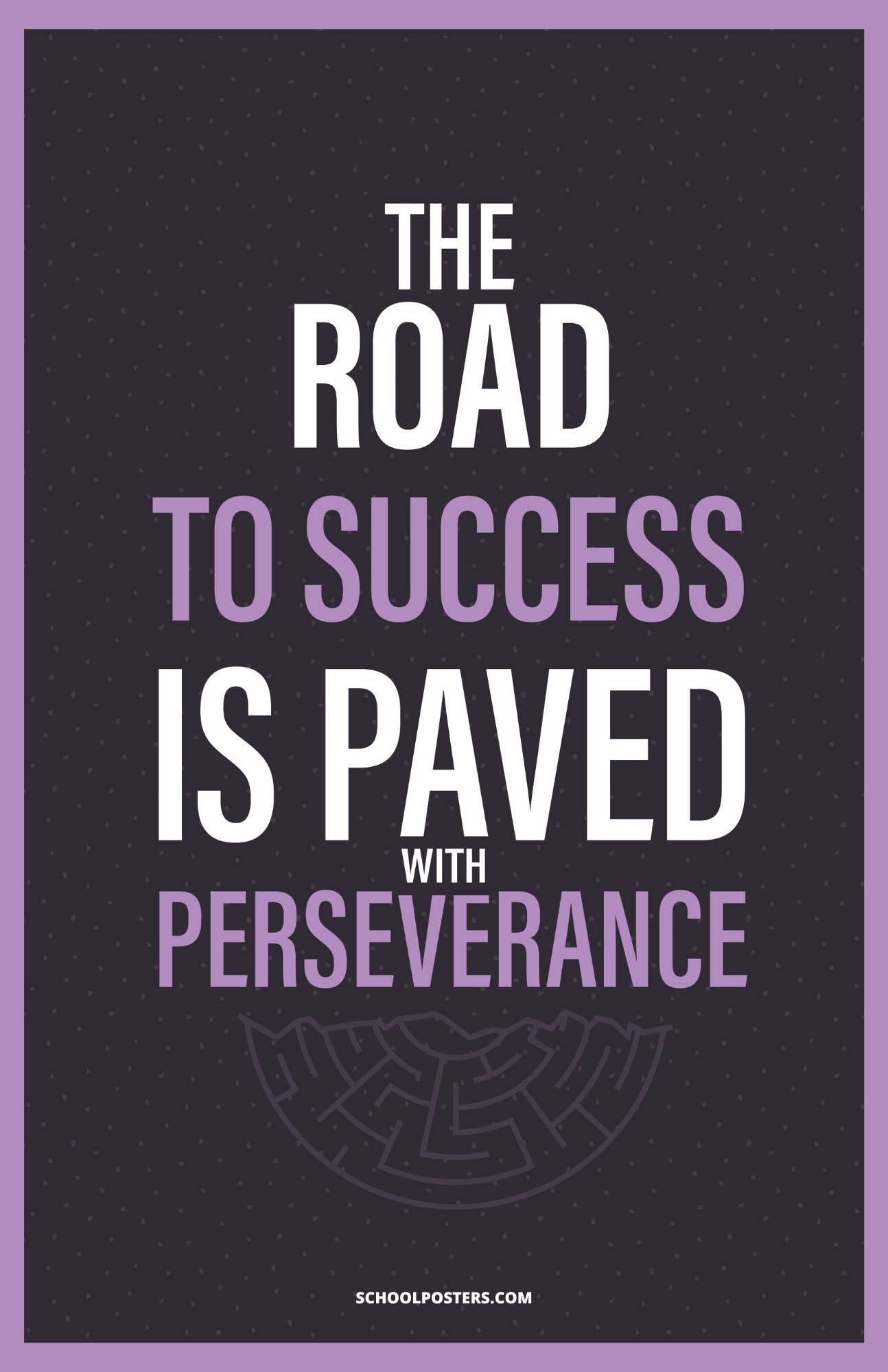
Perseverance Poster
This poster isn’t going to cut it

An Example

Here’s something I’ve done over the last few weeks.

I’m just beginning to teach circumference and area of circles. The area of a circle is especially tricky for 7th graders.1 One piece of notation students need to be fluent in is squaring numbers: knowing that 4² is 16, not 8. Students first learn this notation in 6th grade, but many forget, so it’s worth a review.

A few weeks ago I did a first round of review on squaring numbers. I modeled a few examples, had students try a few on mini whiteboards, gave feedback, and then handed out a worksheet for some practice.2 This whole thing was fast: maybe 5 to 7 minutes total.

Two days later I carved out about the same amount of time. This round I began with a quick assessment on mini whiteboards to see what students remembered. Much of the class did remember, and the assessment helped me figure out which students needed a bit of extra scaffolding. Again, we did some mini whiteboard practice and paper-and-pencil practice, this time with more targeted support based on the assessment data.

The next week we did it again. This time almost every student got it right the first time. Again, some assessment, mini whiteboard practice, and then paper-and-pencil practice.

At this point I started putting questions about perfect squares on our daily Do Now. I gave some extra support to the final few students who needed it. Then we had a bunch of days to improve fluency before we began circles.

All that didn’t take tons of time! A few 5 to 7 minute rounds of modeling and practice, then a few questions on our daily Do Now. That’s it.

Effort → Learning

My impression is that what I’ve just described is unusual. More common is a quick review of exponents just before teaching the area of a circle. I find that multiple rounds of spaced-out practice and feedback are the best way to get every student fluently squaring numbers. This is important! Fluently squaring numbers frees up mental space for all the other parts of finding area of circles that are hard.

This structure helps students learn the area formula. The extra rounds of practice will also help students when they get to more complex exponent and root problems in 8th grade.

But more important to me is the idea I mentioned at the start of this post: teaching students that effort leads to learning. Here is a place where I can take something that’s fuzzy for a lot of students, and get every student confident in that skill. I can show them that their effort leads to learning.

A Different Approach

Here’s a different approach to squaring numbers, an approach I’ve used before.

The first day of finding area of circles arrives. I do a quick reminder of how to evaluate exponents. Some of my students remember right away and have no problem. Others have a faint idea that they’ve been taught this before, but they keep telling me that 4² is 8. I try to address it, but there isn’t much time. We need to move on to circles. We dive into the area formula, and some students keep getting questions wrong because they evaluate the exponent incorrectly. They feel frustrated. They’re trying, but they just can’t get it right. Even when they get the exponents right, they seem to mix up something else in the formula. These students are putting in effort, but the learning doesn’t stick.

I have seen this over and over again in my teaching career. I’m not describing all students. Much of my class will be successful with this type of teaching! But I’m describing a group who is consistently in the bottom 20%. They learn a clear lesson from school: even when they try their best to learn, that effort does not reliably lead to learning. Many stop trying altogether, or adopt an attitude of learned helplessness. Teachers put some nice posters on the wall and we repeat the message that perseverance is important. But it can all feel pretty useless. Those messages are outweighed by the sum of students’ everyday experience.

Don’t Leave Students Behind

Leaving a bunch of students behind is hardwired into many approaches to teaching. I often hear people say that teachers should aim for 80% mastery before moving on. If you’re happy with 80% mastery, great. Ignore this post. This post is about how to support that final 20%. If we accept 80% success, we teach that final 20% a very clear lesson: even when they put in the effort, that effort is unlikely to lead to learning.

Taking the time to teach squaring numbers well is just one little example of how I try to help students see that effort leads to learning. Show, don’t tell. Take the time to help every student learn. Don’t stop at 80%. Assess students. Give a bit more feedback. Provide more practice. Structure regular retrieval practice to remind students of what they’ve learned. I do stuff like this all the time, with all sorts of little micro-skills that matter in math.

There’s more to learning math than making sure every student knows how to square numbers. In a few weeks my students will take the state test, and they’ll see questions like this one:
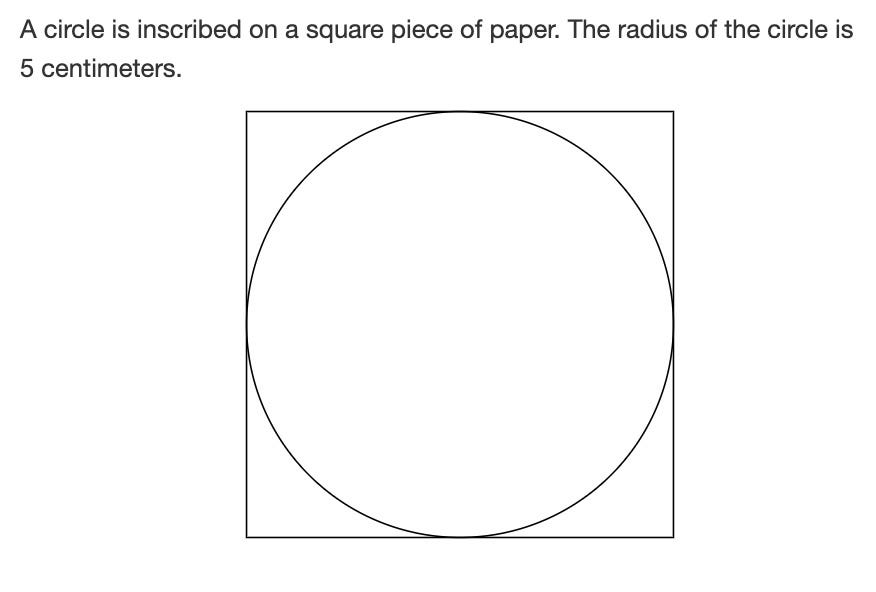
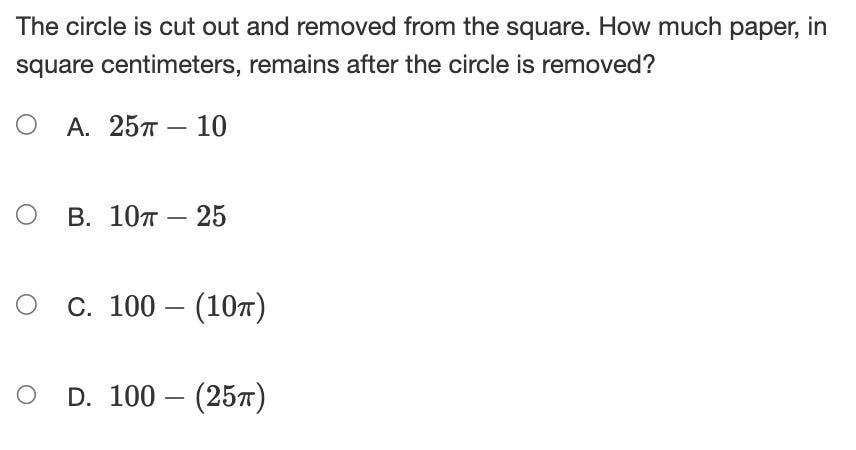
That’s a hard question! I’ll do my best to teach my students how to solve questions like it. I can’t guarantee every student will be able to solve tough questions like this one.

What I can do is guarantee that every one of my students knows how to square numbers accurately, and lots of other similar micro-skills. Those micro-skills are the foundation. If students can’t square numbers, they don’t have much of a chance of getting that tougher question right. Lots of math teachers look down on skills like squaring numbers. It’s rote learning, it’s not relevant, it’s boring. I disagree. Math is worth learning.

But maybe more important, getting those micro-skills right shows students that they can learn math. Successful learning builds confidence, so students are willing to try harder problems like the circle cutout problem above. I’ve taught lots of students who simply don’t believe they can learn. They’ve tried in math, and years of experience have taught them that despite that effort, they just aren’t very likely to learn. My goal is to show students that they can learn, that I’m here to help them, that I’m not going to move on as soon as most of the class gets it.

I’m not a perfect teacher. I’m not successful with every student, every day. But I try, as often as I can, to pick out specific skills and provide a bit of extra practice and a bit of extra feedback, until every student learns. That extra time sends a message to the students who often feel unsuccessful in math class: they, too can learn, and I am here to make sure that happens.

1

I find that it’s often hard for adults to understand why finding the area of a circle is challenging for students. Here are a few reasons. First, area and circumference of a circle are some of the first formulas students learn. Sure, there are other formulas earlier on for the area of rectangles and triangles or the volume of rectangular prisms. The area formulas are different because this number pi comes out of nowhere. Finding the area of a rectangle makes sense: there are two numbers that delineate the rectangle, we multiply them, that’s it. But with circles, where does the pi come from? Do we use diameter or radius? Why? Why is something squared? There are reasons for all of these things, sure, but that’s a lot for students to keep track of. It all adds up to a much more abstract skill than the formulas students have seen before.

2

One note about this worksheet: my goal is for all students to complete the left side, which is focused on squaring numbers. The right side has some tougher problems with larger exponents, negative numbers, and equations to solve. Those problems are there to provide an additional challenge. Practice is good for everyone. For students who are already confident, they get to apply their knowledge in a few new ways to stay challenged.

Read the whole story
mrmarchant
1 hour ago
reply
Share this story
Delete

The Math That Explains Why Bell Curves Are Everywhere

1 Share

No matter where you look, a bell curve is close by. Place a measuring cup in your backyard every time it rains and note the height of the water when it stops: Your data will conform to a bell curve. Record 100 people’s guesses at the number of jelly beans in a jar, and they’ll follow a bell curve. Measure enough women’s heights, men’s weights, SAT scores, marathon times — you’ll always get the…

Source


Read the whole story
mrmarchant
1 day ago
reply
Share this story
Delete

“Just because it’s consistent doesn’t mean it’s consistently right.”

1 Share

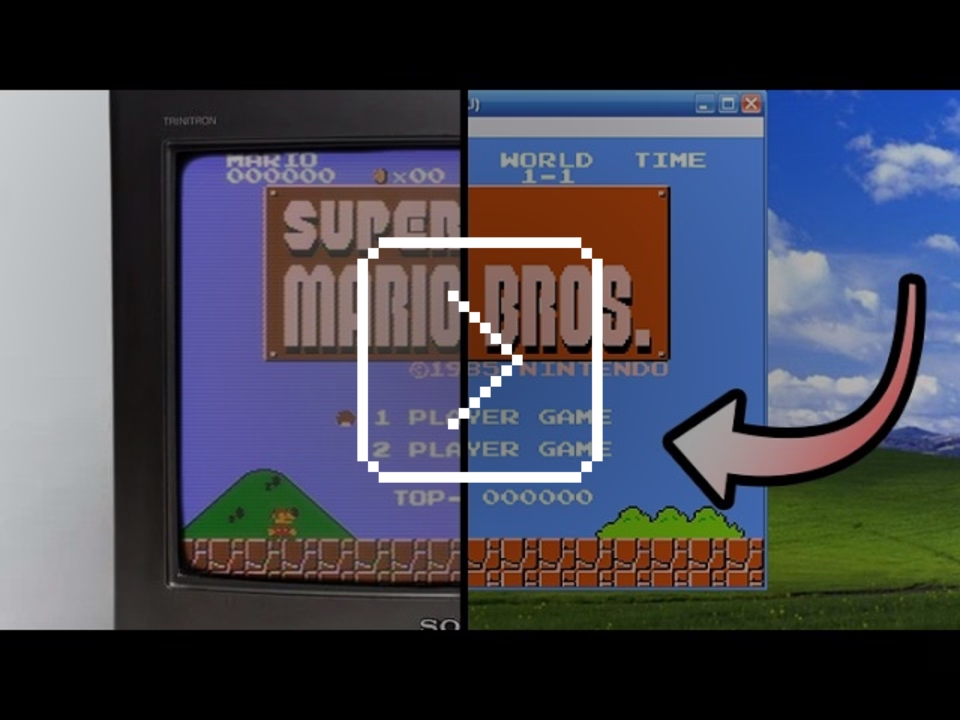
I mentioned before how the old-fashioned pixels on CRT screens have little in common with pixels of today. The old pixels were huge, imprecise, blending with each other, and requiring a very different design approach.

Some years ago, the always-excellent Tech Connections also had a great video about how in the era of analog television, pixels didn’t even exist.

But earlier this month, MattKC published a fun 8-minute video arguing that for early video games it wasn’t just pixels that were imprecise. It was also colors.

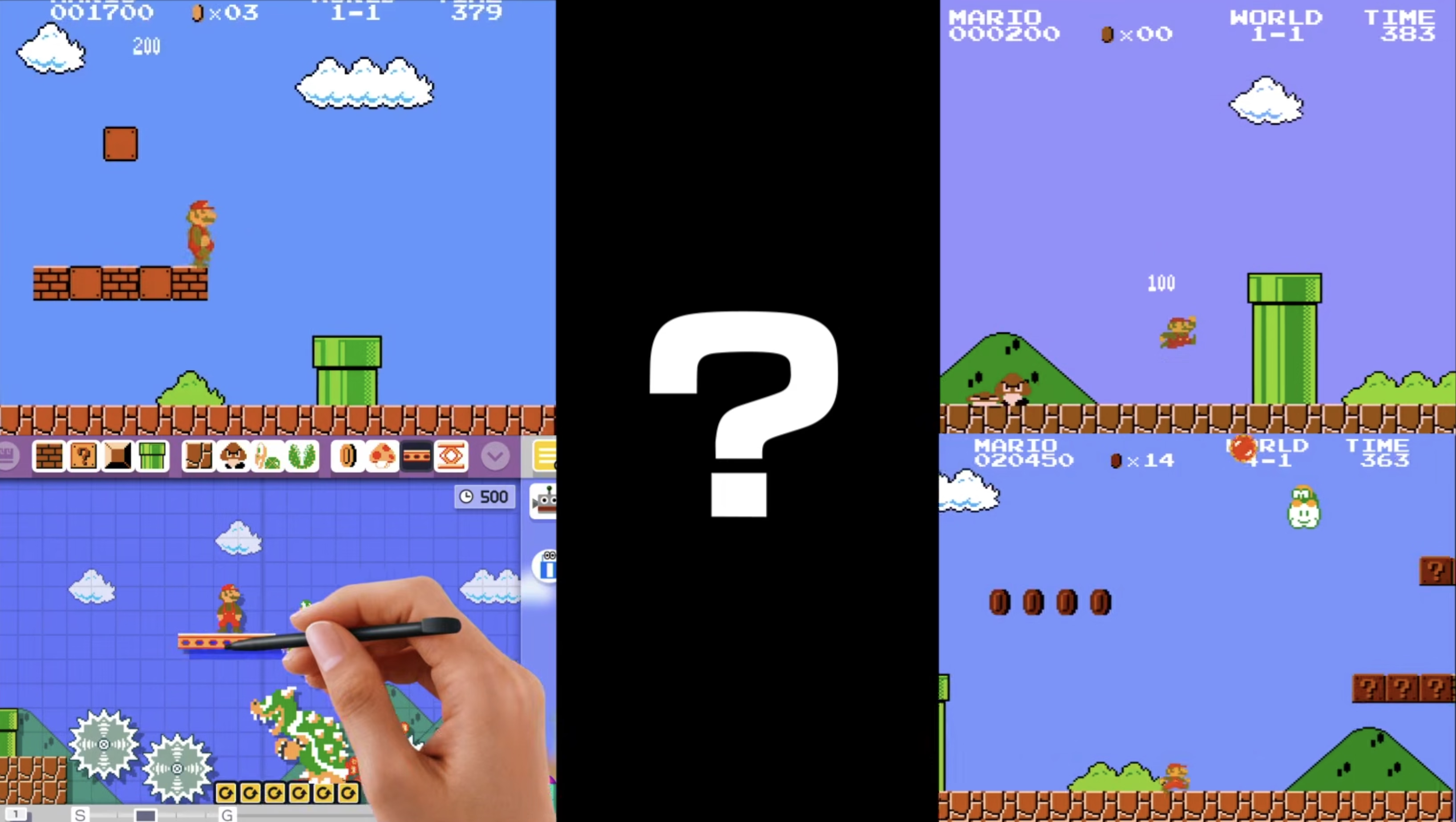
What was Mario’s original reference palette? Which shade of blue is the correct one? Turns out… there isn’t one.

Come to learn some details about how the American NTSC TV standard (“Never The Same Color”) worked, stay for a cruel twist about PAL, its European equivalent.

Read the whole story
mrmarchant
1 day ago
reply
Share this story
Delete

Researchers Asked LLMs for Strategic Advice. They Got “Trendslop” in Return.

1 Share

When prompted for help on seven key strategy questions, LLMs recommended the same buzzy solutions—even when the context changed.

Read the whole story
mrmarchant
1 day ago
reply
Share this story
Delete

Where is The Raccoon Hole?

1 Share

For years (two of them), I have been making jokes about going to The Raccoon Hole, a mysterious and indeterminate landmark that a few friends have alluded to.

(For context: The Raccoon Hole is the hole where the raccoons are.)

Having made so many references to The Raccoon Hole, it came to a point where it felt morally impermissible to continue to refer to it without actually “walking the walk” and taking a pilgrimage there myself.

Now here’s where the lore gets interesting: where exactly is The Raccoon Hole, and how did its legend come to be? You see, I thought I learned about it from my friend Mason, but although he was familiar with the assembly points of raccoons in Golden Gate Park, he did not know of The Raccoon Hole. Mason asserted it was Mackenzie who knew the truth of The Raccoon Hole. So I turned to Mackenzie, and she claimed it was a third party that brought her to that sacred land, and she only had a vague memory of its whereabouts. Like other ancient mythos, the origins of The Raccoon Hole are unclear. But as modern historians, we can gather evidence and form educated hypotheses.

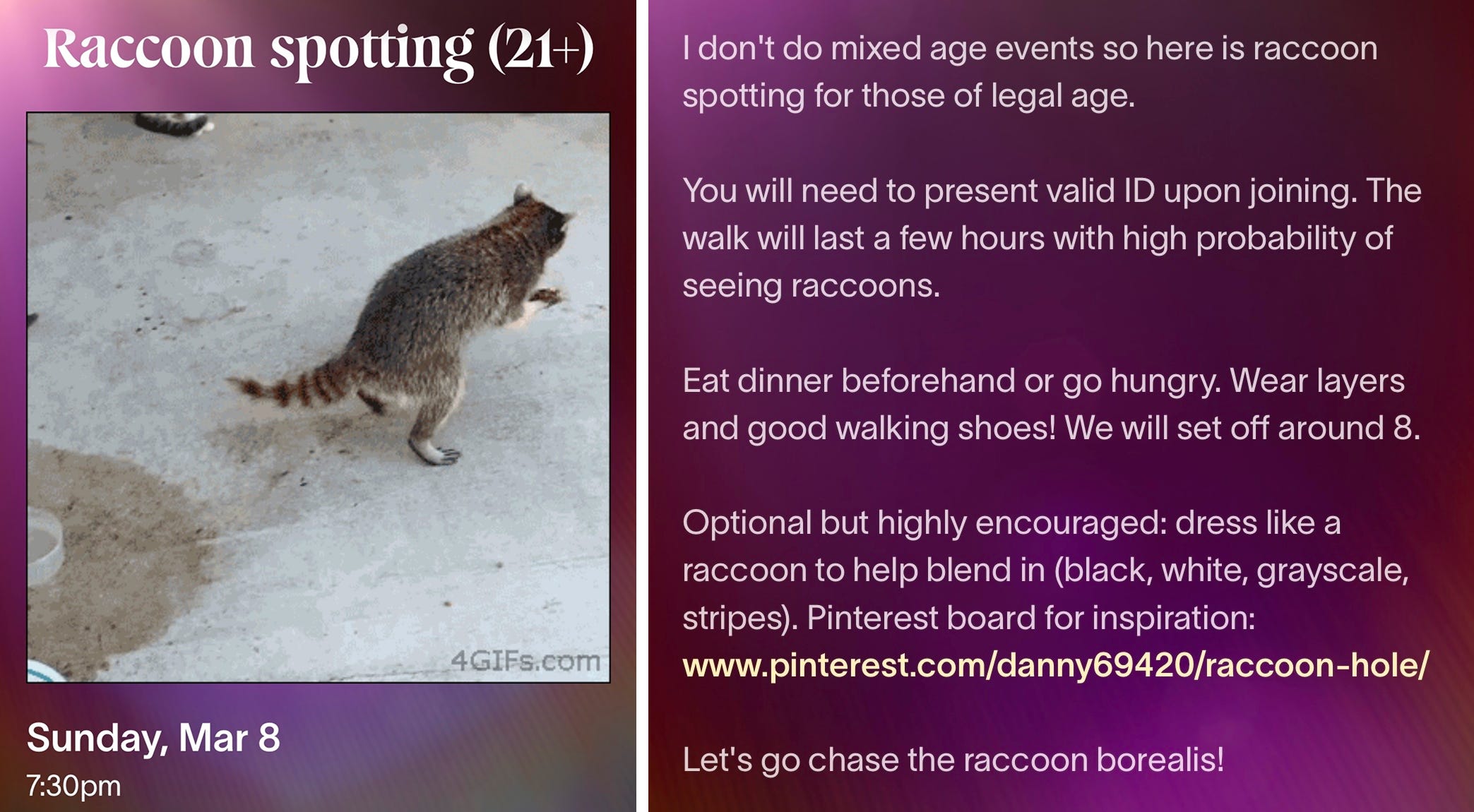
Now part of the reason I thought Mason was the informant behind The Raccoon Hole is because he organizes Raccoon Spotting tours, usually for his teenager friends1, and not his adult friends, who are relatively more “unc” and ostensibly “can’t hang.” But in an act of generational diplomacy, he agreed to give a raccoon tour for those 21+.

My friend Sevy was also familiar with local raccoons and the holes in which they reside. And he expressed a mild interest in an “official” tour, and that’s really all it takes for me to commit to any elaborate scheme. I’m like the IRL embodiment of “If 1 person likes this I’ll do [blank].”

can you tell which part I wrote vs Mason

I made an inspo board for chasing the Raccoon Borealis, as one does. I figured that in order to blend in, we should dress raccoon-like, so as to not spook the raccoons or draw the attention of park rangers. And also for fun.

inspo board for raccoon spotting

I’ve actually traveled north to see the Aurora Borealis TWICE and both times it lowkey flopped. I wasn’t about to let that happen again with the Raccoon Borealis.

although i didn’t catch the northern lights, i still had a wonderful time in santa claus village

And so my friends gathered under the moonlight to embark on our quest. They took our mission as seriously as necessitated: adorned in faux raccoon hats, clothed in raccoon-like colors, wearing a raccoon face mask, and carrying a raccoon camera2 to capture the magnificence of raccoons.

Mason checked we were of age by sniffing our IDs, gave us a raccoon stamp to certify, and swore us in with a raccoon oath.

raccoon spotting apparel and raccoon stamp to certify us as raccoon spotters. mason actually made the stamp himself!!

We each told our favorite raccoon-themed memory, which I intended as a joke, but everyone actually had poignant tales of how raccoons personally impacted them.

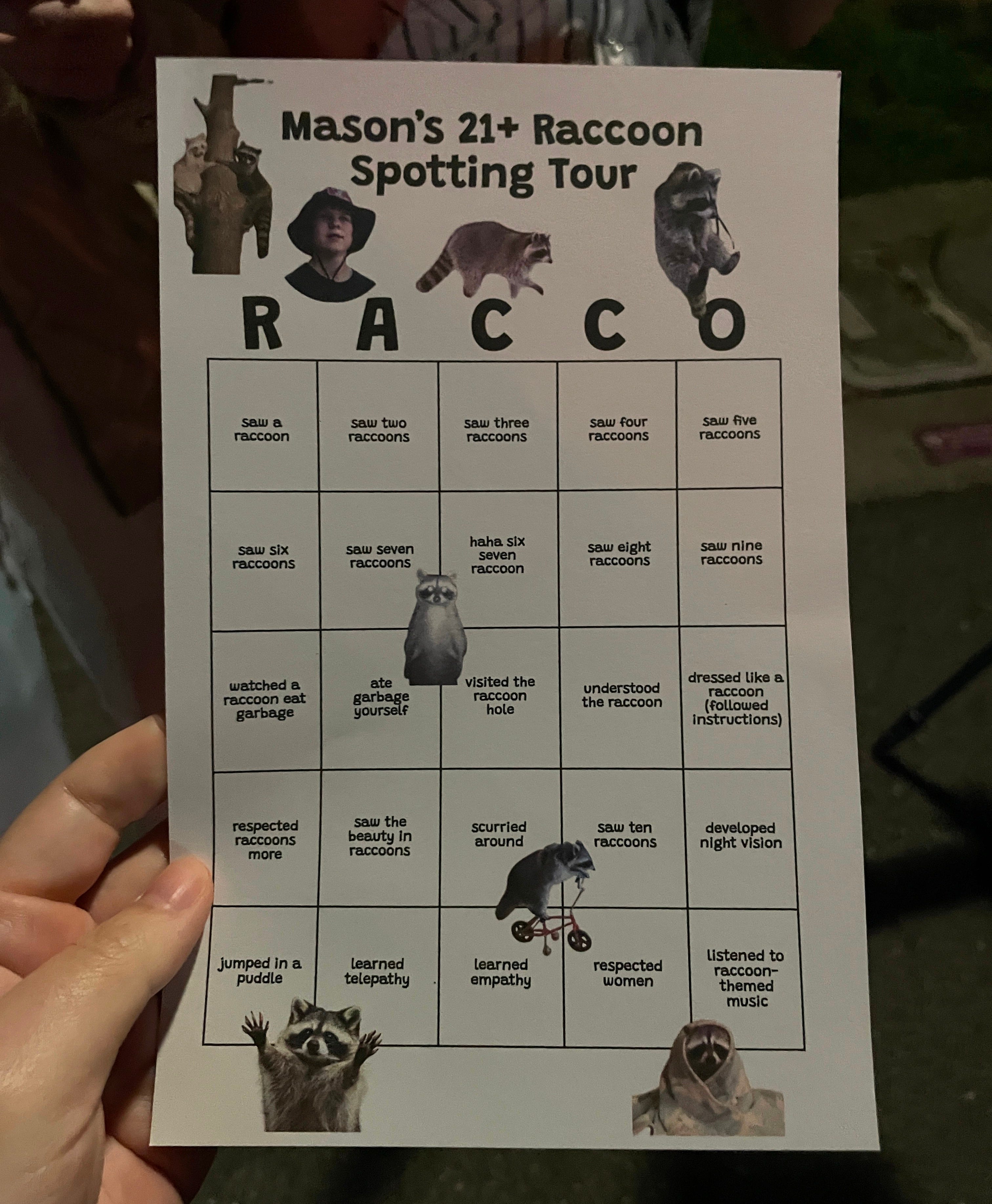
Then I distributed RACCO (raccoon-themed BINGO) as an exercise for the evening.

RACCO card. feel free to copy if you would like to go on your own raccoon spotting tour.

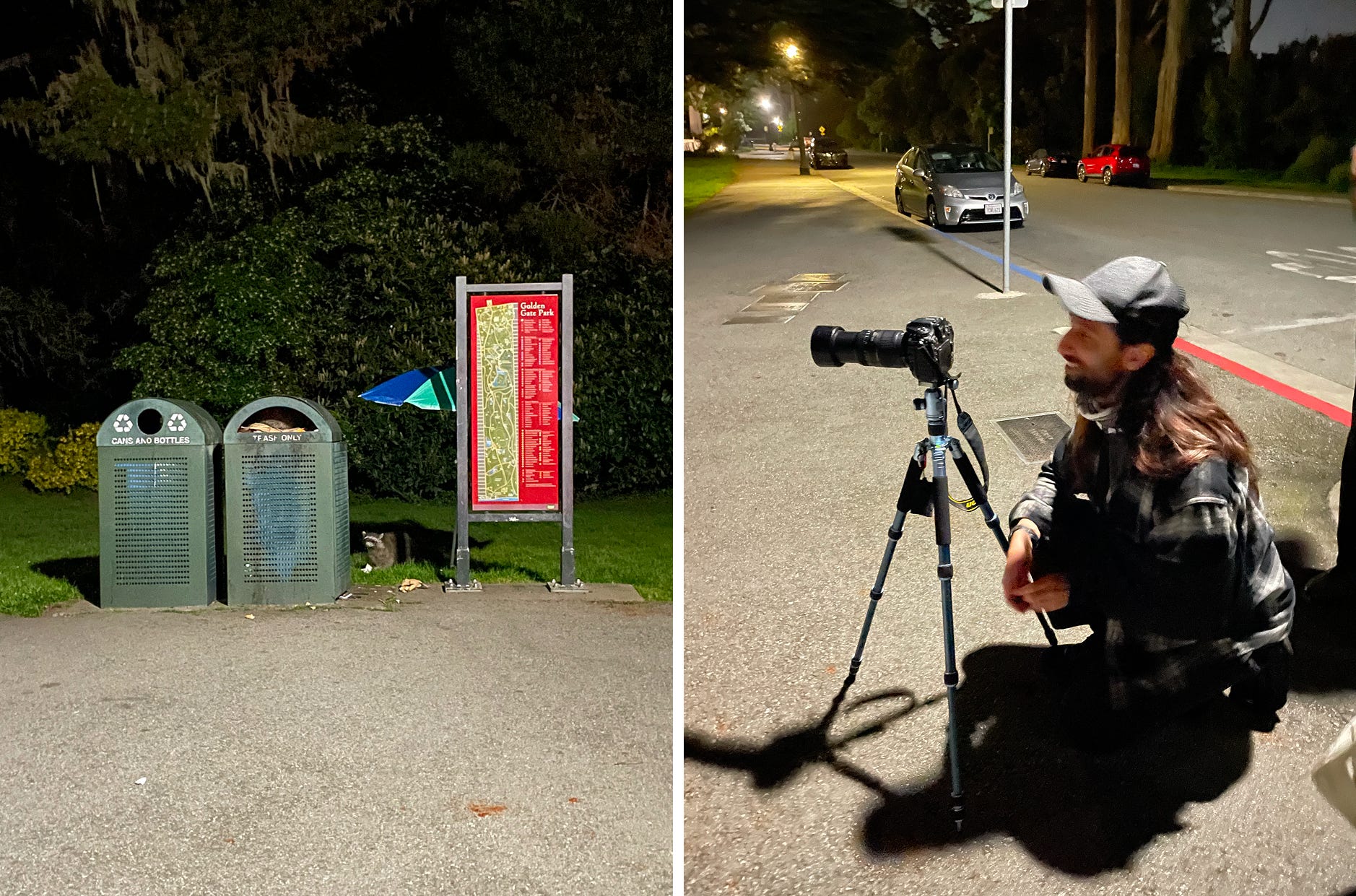
The night started off strong: we spotted a raccoon shortly after we began. We oohed and ahhed, took some action shots at a respectful distance, marked “saw a raccoon” off RACCO, and continued onward.

raccoon spotted and raccoon camera in action. why is the raccoon under a little beach umbrella? perhaps it’s on vacation.

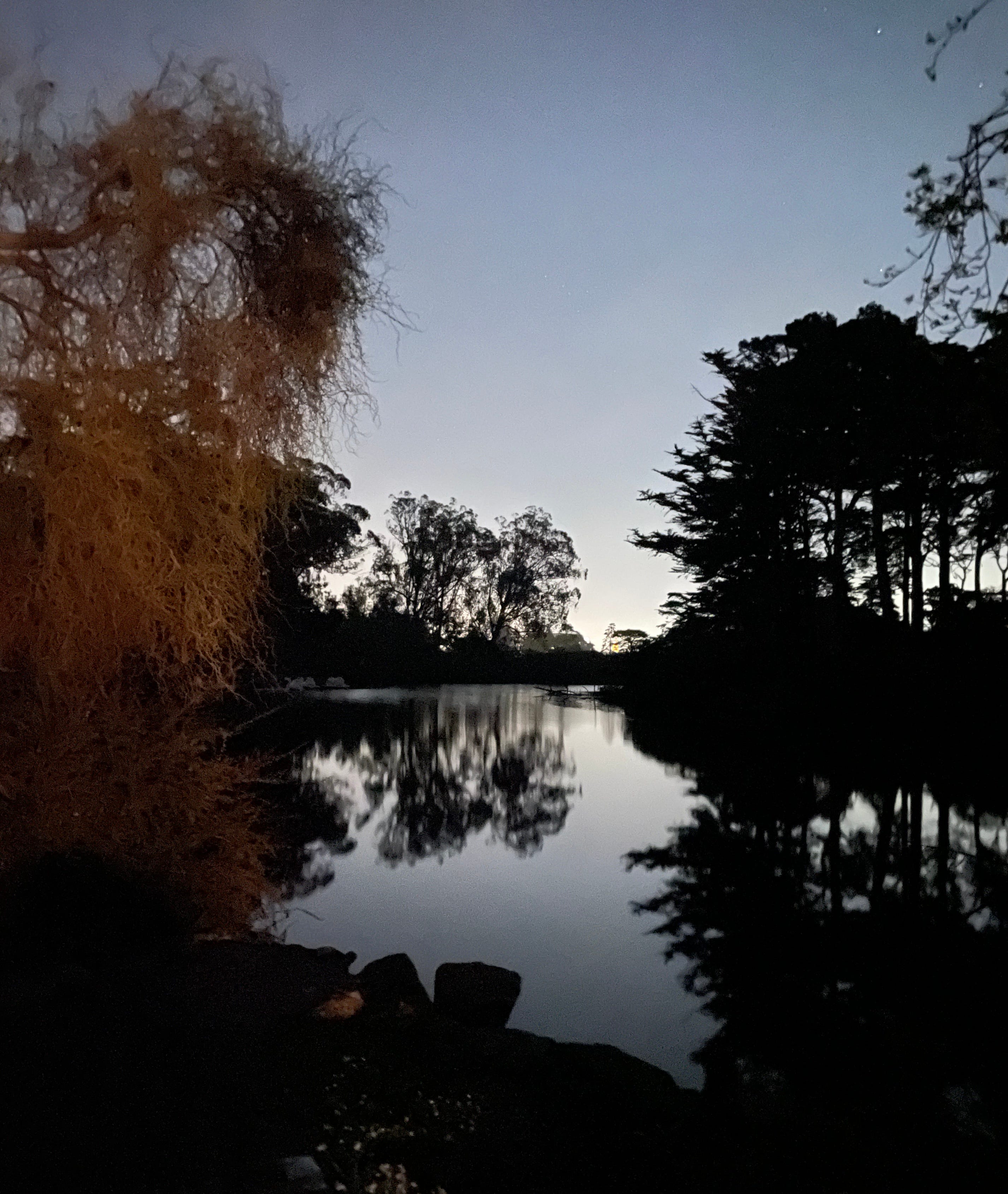
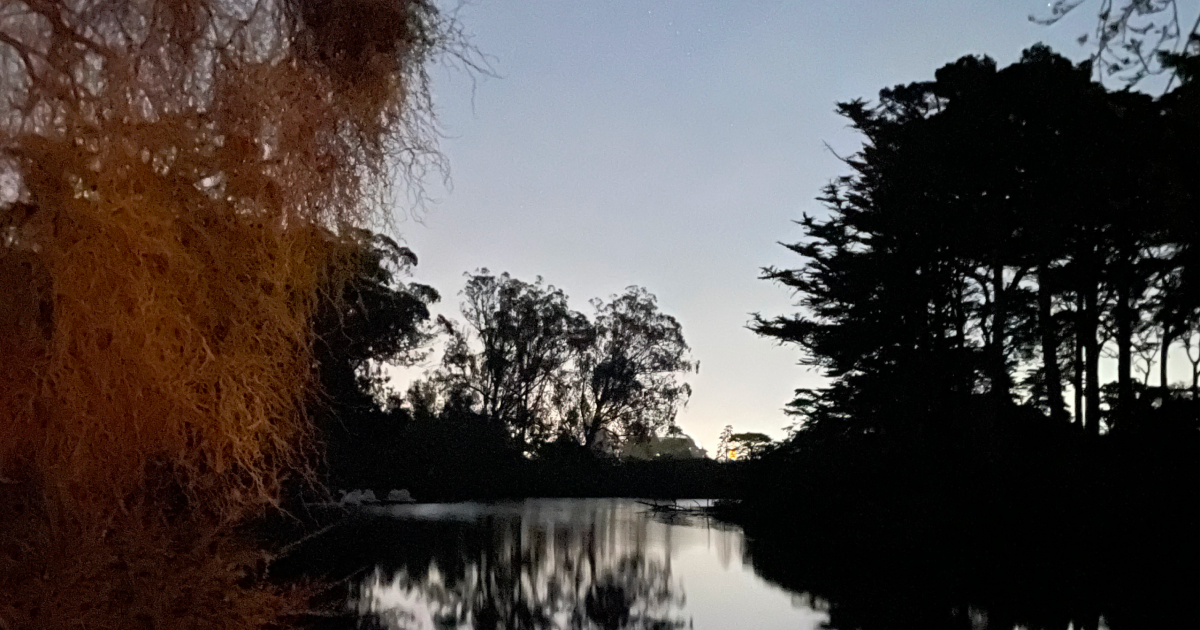
Traversing the park at night was beautiful, serene. Lit only by the moonlight, we had to trust our feet would know the path without sight.

We encountered some large dumpsters, and also Nick, who arrived late. The dumpsters appeared unoccupied by our feral targets, so we milled about, to see if the guests of honor would arrive. Mason grabbed a half-eaten hotdog from the trash and placed it on top of the bin, as bait. We retreated to a safe distance, played raccoon mating calls, but alas, no raccoons emerged. We continued onward.

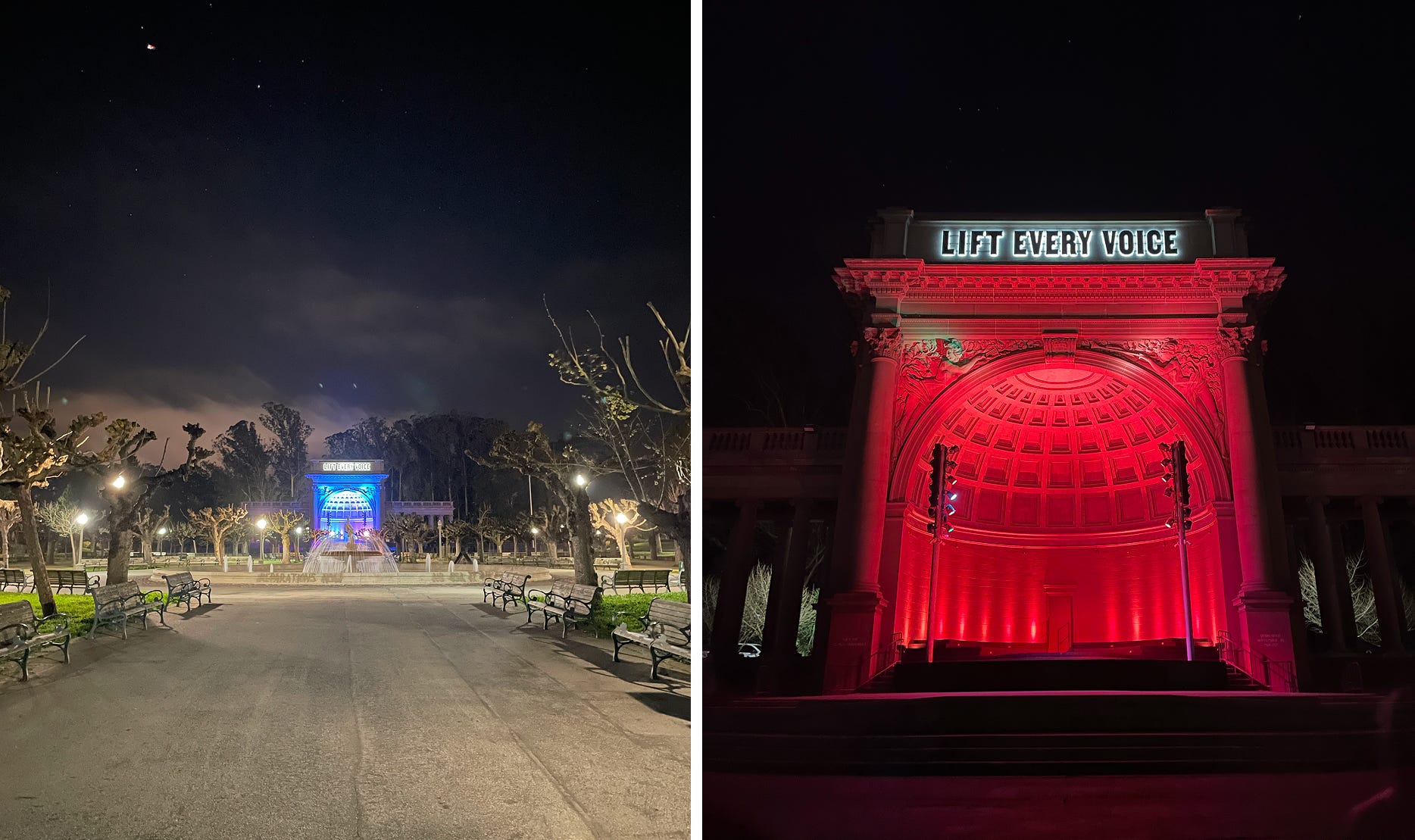
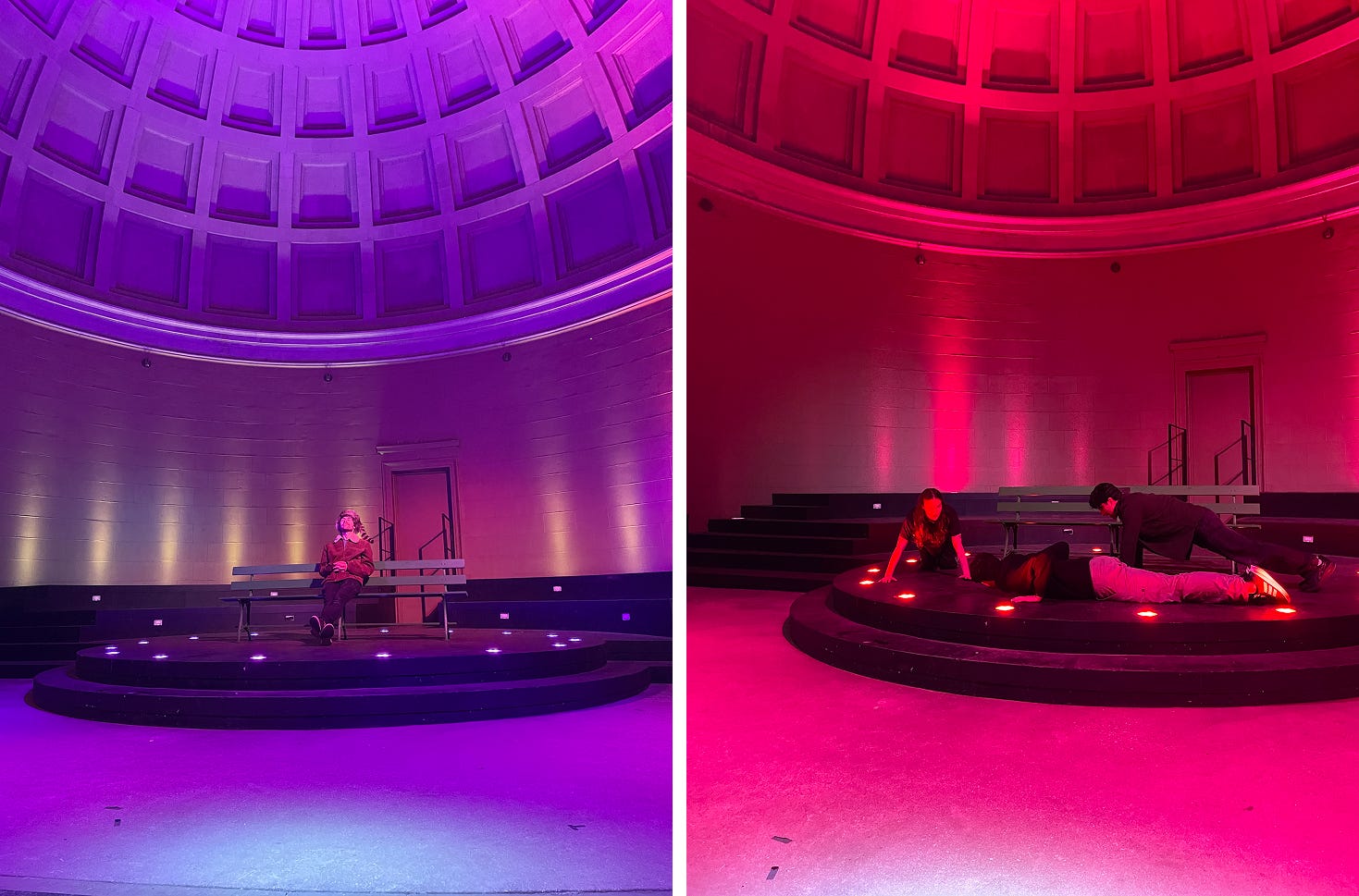
As our pilgrimage brought us by the De Young / Academy of Sciences, we were dazzled by the stage, left unattended with multi-colored lights pulsing. Obviously, this meant it was performance time.

We messed around on the stage, doing improv, testing the echo points, and learning how to do the worm and body rolls.

improv and worm lessons. it was quite the upgrade from the stage at Pier 39, where we usually f*ck around on, e.g. at Mackenzie’s commencement for graduating from the University of Michigan online course “Generative Leadership: Inspiring Capability in an AI World”

After an hour or so, we had to get back to business. So we continued onwards, peering in trash bins, playing raccoon mating calls off our phones and imitating them.

We ultimately concluded our journey at the site which we began.

Unfortunately, this meant our stroke of early luck was an anomaly - our first raccoon spotted was the only raccoon we saw. Most likely, our group was too large to covertly convene with the raccoons (despite being dressed like raccoons to blend in).

Although no one won RACCO, we spotted only one raccoon, and we could not find the sacred monument of The Raccoon Hole, there was nonetheless an abundance of raccoon spirit to go around. We will most likely spend our whole lives chasing raccoons. And they will always be there, digging through the dumpsters in Golden Gate Park.

There’s excitement in an unfinished tale, it’s a promise that more adventure is out there. There’s a whole big beautiful world full of raccoons just waiting to be spotted.

As the saying goes, perhaps the real raccoons were the friends we made along the way. And I unironically believe I have the most wonderful friends, that would be down to spend their Sunday night (on international women’s day no less) dressed as raccoons to chase the Raccoon Borealis. That would even contribute their own raccoon thematic bits! I am surely the luckiest person in Golden Gate Park, if not the world.

The same way a raccoon rummages around the dumpster and finds trash left by humans, I rummage around my heart and find joy left by my wonderful friends. And that is the real Raccoon Hole. The one filled with love.

subscribe and maybe one day you too can visit The Raccoon Hole

1

Mason is 17. I know what you’re thinking, “where the heck did you find a 17 year old?” At Fidget Camp, a “summer camp” for creative technologists, where he was the youngest by far. Mason is really cool but we can’t invite him to some things, and vice versa, because it would be weird. Because he is 17.

2

It’s just like a regular camera but for taking pictures of raccoons.


Read the whole story
mrmarchant
1 day ago
reply
Share this story
Delete

Quoting Jannis Leidel

1 Share

GitHub’s slopocalypse – the flood of AI-generated spam PRs and issues – has made Jazzband’s model of open membership and shared push access untenable.

Jazzband was designed for a world where the worst case was someone accidentally merging the wrong PR. In a world where only 1 in 10 AI-generated PRs meets project standards, where curl had to shut down its bug bounty because confirmation rates dropped below 5%, and where GitHub’s own response was a kill switch to disable pull requests entirely – an organization that gives push access to everyone who joins simply can’t operate safely anymore.

Jannis Leidel, Sunsetting Jazzband

Tags: ai-ethics, open-source, python, ai, github

Read the whole story
mrmarchant
2 days ago
reply
Share this story
Delete
Next Page of Stories