1593 stories
·
2 followers

Five Friends Make School Matter to Kids

1 Share

Lately, I’m working in two kinds of classrooms: ones where the teacher makes good use of digital devices and the other where the teacher makes good use of paper. I’m noticing the same challenge in both classrooms: students come to believe their effort doesn’t matter.

They know they can complete the next slide or not. They know they can answer the next workbook question or not. They know how to hide. Whether they’re working on screens or paper, they know how to look busy and when.

I’m watching the teacher circulate around the room. As she moves, every student inside a two-desk radius locks in on their page, brows furrowed, scribbling or typing, but when the teacher moves on they relax.
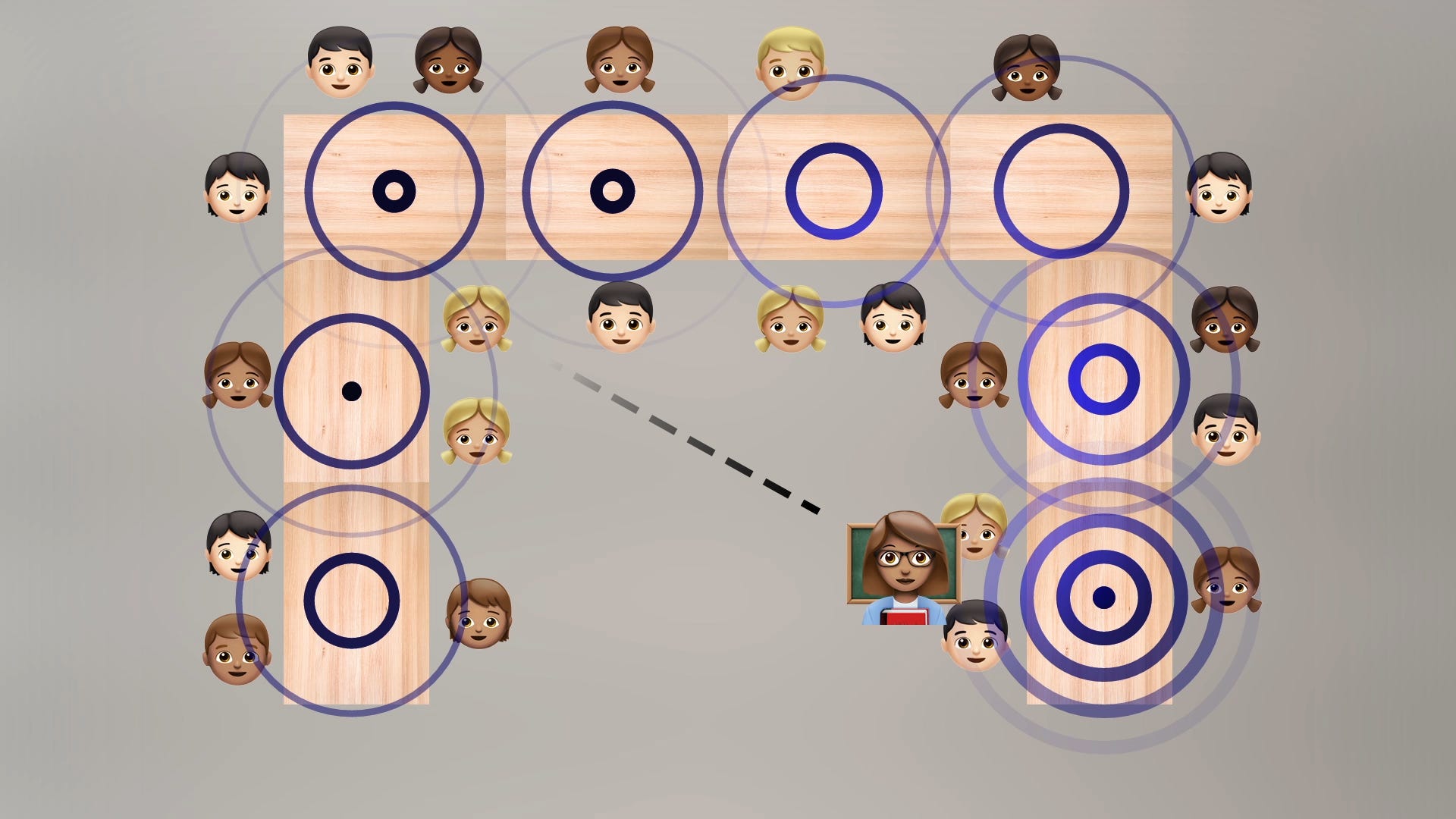
A teacher has walked away from a group of students who were working hard. Now they are not.
This is what it’s like.

This is the challenge—making difficult cognitive work matter to kids. Teachers have lots of responses to that challenge, but most of them scale the time cost linearly with the number of students. Checking in with students in class. Grading each warmup. Grading each student for participation. Calling home. Grading all the essays. Double the students and you double the time cost for each of those interventions. This is burnout. Teachers need non-linear responses here, responses where doubling the students costs something far less than double the time.
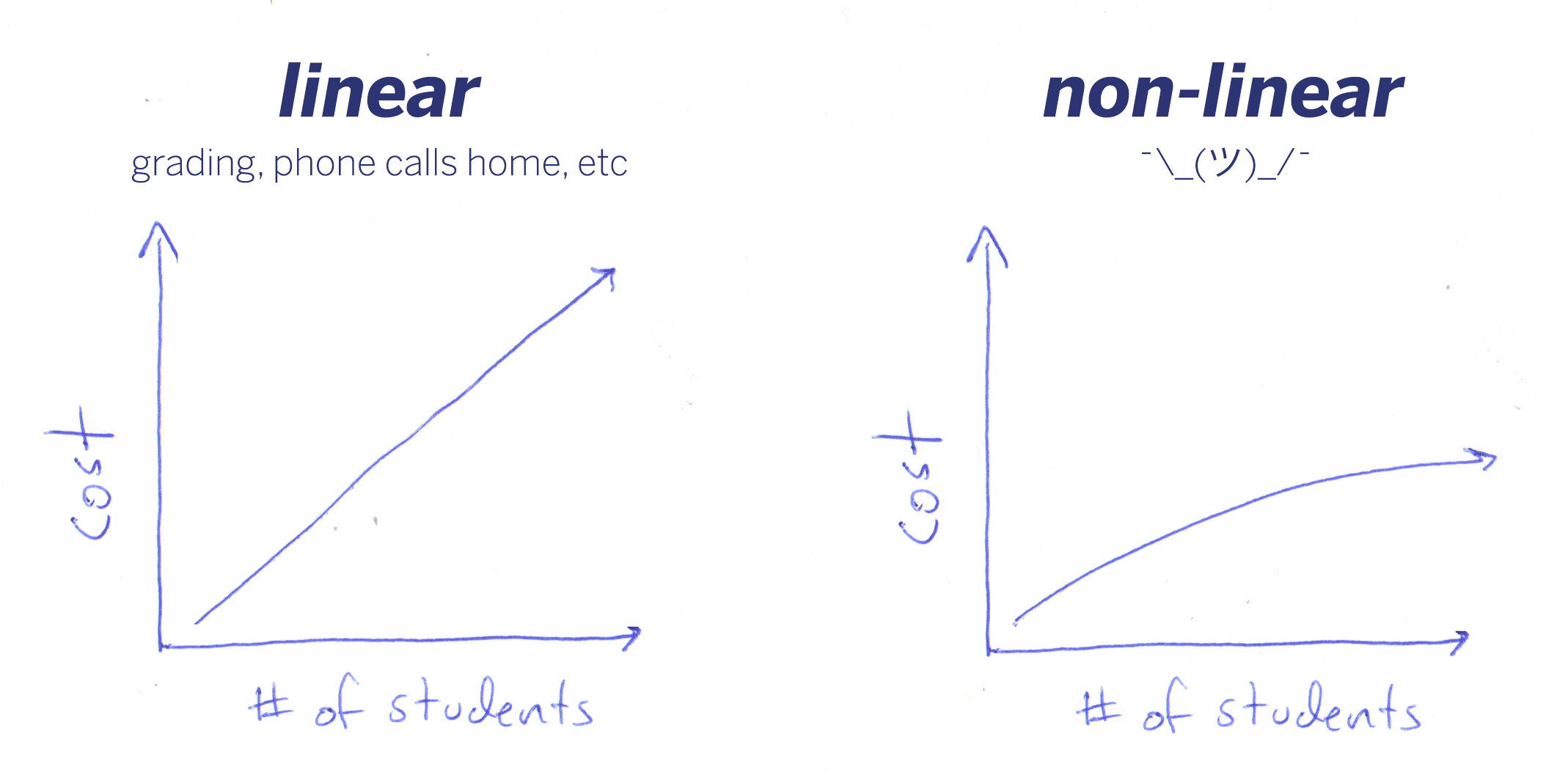
A graph that shows a linear and non-linear graph of the cost of an intervention and how it scales with the number of students.

“I have been struggling with this post-COVID,” veteran educator Nick Corley told me recently. “The number of students who only work when watched or for a grade has increased significantly. I’d love to hear what is working for others.”

Five Friends

Me too, Nick. So I pulled in five friends—veteran educators, coaches, total pros, and asked them:

What is a reliable way you can let a bunch of students—students who outnumber you 20 or 30 to 1—know that their effort, their work matters?

Zak Champagne taught elementary math for years and recently became Chief Content Officer at Flynn Education. He said the key to getting kids to sustain their effort with students was giving kids permission to stop sustaining their effort.

Now this might sound counterintuitive, right? Walking away from a math problem sounds like they don’t have to show effort. However, it was my experience that when the young people in my room knew they could walk away, they were less likely to do that. And they would spend more time working through the tough stuff. Sometimes just knowing you have the option to walk away from something is the very thing that keeps you going. And providing that option communicates to them that you trust them.

Katrine Bryan has been a secondary math teacher in San Luis Obispo County, CA, a math teacher coach, and I’ve showcased her teaching here before:

Moving away from a viewpoint focused on teacher knowledge to a stance that celebrates student voice and student actions will build the foundation, showcasing that what a student does matters: to the teacher, to their peers and ultimately, to themselves.

Pam Seda has held down jobs from classroom teacher to district math supervisor. She consults and recently co-authored the book Choosing to See: A Framework for Equity in the Math Classroom, which seemed relevant to my question.

Students learn that their work matters when the audience shifts from the teacher to their peers. When a classroom moves from a group of individuals to a community of learners — where anyone can be an expert and anyone can contribute to the group’s collective knowledge — the stakes become real.

One example: when students do group work, instead of asking each group to present their own process to the class, have the class speculate about how a group was thinking based solely on the work they see. No presentation, no narration — just the work, doing the talking. In this way, the phrase “make your thinking visible” becomes far more meaningful when students know their peers — not just their teacher — are the ones doing the reading.

Dylan Kane is one of the most thoughtful and discerning math educators around, one who teaches at a high level and still somehow has energy to share his thoughts at his newsletter:

I think really hard about the first things students do when we’re launching into a new activity to build momentum. I often start with a simple, straightforward question on relevant prior knowledge, and ask students to answer on mini whiteboards. Students are most likely to see their learning matters when I meet a few basic conditions: I build off of what they already know, I begin with something students can do successfully and that makes them feel smart, and I check to make sure students are learning and adjust when they are not. Mini whiteboards are the best tool I’ve found to help me meet students where they are, adjust on the fly, and build momentum at the start of class.

Tracy Zager is a former classroom teacher, current coach, author of Becoming the Math Teacher You Wish You’d Had, and perhaps most importantly, the editor of my book (still forthcoming):

I need to do the slow and careful and authentic work of creating a community where each student’s thinking and work really does matter–to the student, to their classmates, and to the learning of the class as a whole. My first thought is there are three big components:

  • I need to choose curriculum and tasks that are worthy of my students’ time and thinking.

  • I need to give a why behind everything we do–what is the purpose? If I don’t have a good purpose for a task, into the bin it goes.

  • And I need to teach students how to listen and learn together.

Three of my five friends name the same solution—community development—the slow, halting process of investing one student into the presence and ideas of another. This strikes me as one of those non-linear responses. As the class size grows larger, so too does the size of the community, the number of people who are, potentially, vested in your work. It’s also a solution that runs counter to the prevailing wisdom that what these kids all need is their own individual AI tutor.

I’m trying not to be a reactionary here, complaining about Kids These Days and yelling at clouds, but there does seem to be a dramatic vibe shift post-COVID that I am sure is multi-faceted and I’m grateful to these five friends (and anyone in the comments) each working to understand that shift and work to change it.

Thanks for reading Mathworlds! Put your email in the box to get a new post about teaching, technology, and math on special Wednesdays. <3 -DM

Odds & Ends

Tim Daly recently brought useful data to the question of what it takes to get kids to try hard.

What makes kids try harder? Teachers, mostly. Strong teachers motivate students to elevate their effort as the material gets more challenging. A positive school culture - the sum of many teachers and support staff aligned to the same standard - ensures consistency across classrooms and magnifies the effect.

EdSurge reports on a perspective towards AI among teachers that I also find quite common—not optimism, not pessimism, just indifference.

When teachers consider introducing AI tools to students during class time, the calculations they make change. The relevant question becomes: What student learning problem does this tool solve? Many educators are still trying to answer this question, even after several years of exposure to generative AI in some capacity.

Bill McCallum, a lead author of the Common Core State Standards and the Illustrative Mathematics curriculum, is publishing a newsletter. In a recent post, he re-opens a 20-year-old paper from Sweller, et al, celebrating direct instruction and criticizing discovery learning. McCallum checks the citations and finds something interesting in Sweller’s praise for worked examples:

Here is the irony. The strongest evidence-based use of worked examples—carefully designed, presented in contrasting pairs, with structured opportunities for analysis and discussion—looks a lot like the kind of instruction that Kirschner et al would dismiss as constructivist-based minimal guidance. It manages cognitive load, yes, but through thoughtful task design, not by eliminating the need for student reasoning. It is, in fact, a form of productive struggle.

¶ Just a bonkers survey out from RAND. Student use of AI for homework help is up 14%. The majority of those students use AI in spite of their belief that it’s hurting them:

As of December 2025, 67 percent of students endorsed the statement “The more students use AI for their schoolwork, the more it will harm their critical thinking skills” — up more than 10 percentage points from ten months earlier.

Peps Mccrea writes about the ways lesson plan design and user interface design inform one another.

The principles behind great UI are often relevant to the classroom. We could even think of teaching as Learner Interface Design. Here’s what that looks like:

Teachers have to think ten steps ahead of 30 other people, imagining dozens of possible futures, many of them quite bad. It’s fantastic preparation for the work of designing technology.

Read the whole story
mrmarchant
5 hours ago
reply
Share this story
Delete

Be Weird

1 Share

Teaching is weird. More specifically, humans are weird, and teachers spend their days trapped in a room with a bunch of little humans. Weird things happen.

Fierce Feats of Problem Solving

I shared a classroom with an English teacher over a decade ago who did something he called “Fierce Fridays.” I don’t remember the details, it was some type of close reading routine. And to get students excited, each Friday he would show a picture of something “fierce.”

Fast forward to today.

I adapted the idea into what I call “Fierce Feats of Problem Solving.” I wrote a few months ago about how I incorporate math puzzles, games, and problem solving activities into my classes. Before we do these, I frame the activities as “Fierce Feats of Problem Solving” and show students a picture of something fierce.

The first fierce picture of the year is always this one:

Environment.Exit – don't use it | Coding IT

I use all sorts of pictures. Humans, animals. Whatever. If it looks vaguely fierce, it’s in.

Over time, students started contributing. They send me pictures of their pets, or their younger siblings, or weird memes. I’ve accumulated a massive collection of fierce photos. Now I sometimes get stuff like this in my email inbox:

I think a student opened this weird double baby picture on their cracked Chromebook screen, then took a picture with their phone and sent it to me. I don’t know what it means. Probably my fault for showing a picture of a fierce baby.

If You’re Not Cracking...

Like many teachers, I love lame little catchphrases. Something I say sometimes is “Let’s get cracking,” as in “Let’s get started.” I think that’s a pretty normal phrase. Check me for a second here. Am I right? Does “get cracking” mean “get started” in this context?

My students this year told me that “cracking” actually means “to do crack.”

Now let’s be clear. My students are wrong. That is not what “cracking” means. I will not let a bunch of 12-year-olds change the meaning of a cherished phrase.

So I turned it into a little call-and-response. As class starts and students sit down to begin their Do Now, I say, “Let’s get cracking! If you’re not cracking...” and students (reluctantly) respond, “you’re lacking!”

Bootytickled

Ok this one is really weird. Brace yourself.

My students recently started saying “bootytickled.” Bootytickled seems to be a synonym for “bothered,” so “Bro why you so bootytickled” would mean something similar to,“Hello friend, why is this bothering you so much?”

Anyway, students started saying that word. I requested they not say it. Seems reasonable, right? This is math class. We should be talking about math, not booties.

A student wondered aloud why I was so bootytickled by the word bootytickled. I observed that it was, in fact, a bit ironic. Turns out many of my students don’t know what “ironic” means, so I taught a little impromptu lesson about irony. I thought I was being clever. Teachable moment, amirite?

This was a mistake. By engaging sincerely with the idea of being bootytickled, I gave the word legitimacy. Now I can’t eradicate it.

Like many teachers I get frustrated or annoyed on a pretty regular basis. Word has spread. When Mr. Kane gets annoyed, make a joke about him being bootytickled.

Happily, this faded after a few weeks and students went back to making 6-7 jokes. But for a while, any time I was visibly annoyed with something, a student would comment that I was bootytickled. For me, it became a kindof weird little reminder. I would get annoyed at someone flipping their water bottle. A student would say, “Mister why you so bootytickled?” And I would say to myself, “Hey, I’m not going to let this bother me.” I would take a little moment to find serenity, push down the annoyance, take the water bottle, and keep teaching.

Be Weird

I don’t recommend copying what I do. Every teacher is weird in their own way. Let your personality shine through in whatever way works for you.

I do think there’s a lesson here. Lean into weirdness. Be human.

One of my perpetually unpopular opinions is that school is good. Age-graded classrooms, one-size-fits-all curriculum, and factory-model schools are easy to hate. Hate them if you like! School is far from perfect, but it’s the best we have. It’s the worst way of educating ever invented…except for all the others.

I think one key reason is the weirdness. A bunch of kids are required to come to my class every day and I give them some math to do. For 50 minutes they’re stuck with me and I’m stuck with them. All the inside jokes and weird little moments are what change an obligation into a ritual. Am I a complete loser in my students’ minds? Absolutely. But I’m a complete loser who students are, more often than not, willing to work hard for. That sounds pretty cool to me.

Read the whole story
mrmarchant
11 hours ago
reply
Share this story
Delete

Quoting Soohoon Choi

1 Share

I want to argue that AI models will write good code because of economic incentives. Good code is cheaper to generate and maintain. Competition is high between the AI models right now, and the ones that win will help developers ship reliable features fastest, which requires simple, maintainable code. Good code will prevail, not only because we want it to (though we do!), but because economic forces demand it. Markets will not reward slop in coding, in the long-term.

Soohoon Choi, Slop Is Not Necessarily The Future

Tags: slop, ai-assisted-programming, generative-ai, agentic-engineering, ai, llms

Read the whole story
mrmarchant
13 hours ago
reply
Share this story
Delete

How Many Times Should a “Math-y Kid” See a Math Idea Before They Understand It?

1 Share

Idea

One of the most common worries I hear from parents and see on online forums is:

“My kid didn’t fully understand this concept. Should we slow down? Should I be worried?”

The truth:

  • Understanding in math almost never happens the first time or second time.

In fact, many mathematicians would say it takes three to five exposures to really understand something.

  • The first time: you get the shape of the idea

  • The second time: you notice what you missed

  • The third time: it starts to click

  • The fourth and fifth time: you can actually use it

So if your kid does not fully understand a concept the first time they see it, that’s not a problem.

It’s natural and expected.

Subscribe now

This is not a flaw in your child, nor is it a flaw in the material.

It’s just how learning math works.

Even if they are a “math-y” kid.


Story

There’s a wonderful (and very human) story about two famous mathematicians: Hermann Weyl and David Hilbert.

Hermann Weyl and David Hilbert are discussing this very topic.

For some context, a quick snapshot of their background.

Hermann Weyl was a German mathematician whose research was in theoretical physics and number theory, and he had been described as one of the “last great universal mathematicians of the nineteenth century.”

David Hilbert was a German mathematician described as “one of the most influential mathematicians of his time,” and in 1900 presented a collection of 23 problems known as “Hilbert’s problems” that have helped drive mathematical research ever since (note: many of them are still unsolved!).

Weyl asked Hilbert:

“How many times do you have to explain something to your students before they understand it?”

Hilbert replied:

“Five times, Hermann, five times. But for very talented students like you, three times is enough.”

Even among the greatest mathematicians, understanding wasn’t expected to happen instantly.

It took repetition.


Personal Example

A few months ago, one of my kids was learning a new concept in geometry.

They followed the lesson and could do some of the homework.

But there were some problems they couldn’t solve because they couldn’t quite grasp how the lesson topic related to the problem.

Instead of stopping everything, we kept going.

As a rule of thumb, if they’re getting about 60–80% of the material, we move forward, trusting we’ll see it again.

A week later, the same idea showed up again, only this time inside a new type of problem.

And suddenly:

“Ohhh… that’s why we did that.”

The problems that once felt impossible became solvable (and were!).

This has happened to us so many times that we now expect it to happen

Which is why we don’t aim for 100% mastery the first time.

Getting to 100% is nearly impossible the first (or even second) time, so we keep going, knowing eventually they’ll get it.

Each time they revisit the concept, their understanding deepens, not because they stayed longer, but because they saw it from a new angle.

What at first looked like confusion was actually the beginning of understanding.


Why it matters

If we expect children to “get it” the first time, two things happen:

  1. Kids feel like they’re failing when they’re not

  2. Parents feel like they need to intervene too early

Real understanding of math is layered and takes time.

This is why many math curricula (even traditional ones) are designed to spiral:

  • Concepts come back again and again

  • Each time with slightly more depth

  • Each time making more sense

  • With space in between, so the idea feels “new” again

There’s also another important piece:

Sometimes a child doesn’t understand something because they don’t yet see why they need it.

For example, many students struggle with high school algebra, not because algebra is too hard, but because they haven’t yet seen why it matters.

Then they encounter calculus or physics, and suddenly those same algebra rules become essential.

When I’ve spoken with (high school and college) calculus teachers, they often say:

It’s not the calculus that students struggle with; it’s the algebra.

In many cases, a student’s real understanding of algebra arrives during calculus.

There’s even a saying:

“You don’t understand a class until you’ve taken the class that depends on it.”

That is, understanding often arises when the context for why and how it’s used emerges.


Practical tip

Instead of asking:

“Do they fully understand this?”

Try asking:

“Have they seen this enough times to be familiar with it?”

And if they haven’t seen it enough times, you don’t need to:

  • re-teach everything

  • slow everything down

  • or find the “perfect” explanation

You can simply:

  • Keep moving forward

  • Mark the concept mentally (“we’ll see this again”)

  • Revisit it later from a different source

One of the advantages of learning today is that “another source” is easy to find:

  • a different book

  • a YouTube video

  • a new type of problem

  • or even explaining it to someone else

Different explanations unlock different insights.


Takeaway

Your child does not need to understand a concept the first time they see it.

They need to see it multiple times, in multiple ways, over time.

The key to getting good at math is to keep doing math.

So if frustration creeps in (for them or for you(!)), take a breath and keep going.

That’s how deep understanding is built.


How to practice

Try this small shift the next time your kid says:

“I don’t get this.”

Say:

“That’s okay. You might not have seen it enough times yet.”

Then:

  • Let them try a few problems

  • Move on if needed

  • Revisit the idea later in the week

You can even make it explicit:

“You’re going to have to see this idea a few more times before it clicks.”

Over time, your child will internalize the incredibly powerful lesson:

  • Understanding is a process that happens over time

Really, truly believing this lesson will help them not only in math, but in anything else they choose to learn.


That’s all for today :) For more Kids Who Love Math treats, check out our archives.

Stay Mathy!

Talk soon,
Sebastian


Kids Who Love Math is a reader-supported publication. To receive new posts and support my work, consider becoming a free or paid subscriber.

Read the whole story
mrmarchant
15 hours ago
reply
Share this story
Delete

The Students Who Believe Practice Makes Perfect Get Pretty Perfect Grades

1 Share

There’s a reason it’s a popular aphorism

The post The Students Who Believe Practice Makes Perfect Get Pretty Perfect Grades appeared first on Nautilus.


Read the whole story
mrmarchant
15 hours ago
reply
Share this story
Delete

The Entire Internet Is a UGC Reaction Video Now

1 Share
The Entire Internet Is a UGC Reaction Video Now

I keep a folder in Apple Notes called “cursed websites,” where I save various artefacts that make me feel like the social contract has dissolved. Call it an act of self-loathing. Call it collecting evidence of the fall. Dansugc.com went straight into the folder this morning.

It’s a site where marketers // entrepreneurs (and I find the line between those two groups has become blurred to the point of being illegible) can buy pre-recorded “Reaction” videos for $3 apiece. You browse a library of 2k clips, sorted by emotion (shocked! Happy! Crying! Excitement!), pick a face you find particularly appealing, download a 5-10 second clip of a stranger performing surprise // delight at nothing in particular, and splice it int your own content. The idea is to make it look like an actual someone had an actual emotional response to your app on TikTok. Custom orders run to $8 and let you specify outfits, emotional arcs etc.

The tagline reads: “100% Real Humans. Zero AI.”

And I think that tells you almost everything you need to know about where we are. And where we are is a place where “at least the fake fuckery was produced by a biological organism” counts as a premium feature. The pitch for selling manufactured authenticity at scale is that at leas the people in the factory are still real people. That’s the floor. That’s what passes for premium. We are drowning in content that is functionally the same as so many designer handbags stitched up alongside so many dupes.

The internet is the most powerful communication technology in human history, and we’re using it to sell each other $3 clips of faked surprise.

I don’t blame Dan, if that’s even his real name. He’s running a business filling a niche. He’s recognised that the entire internet advertising “ecosystem” now runs on simulated, casual, spontaneous “cool girl” energy. He’s simply the shovel-seller in an authenticity gold rush; except the gold is par asocial trust, and the shovels are clips of various women pretending to have their minds blown by your calorie-counting app.

100, ready to post UGC videos per month costs $800. A fully managed campaign for 500 videos goes for $10k. Dan claims over 5 billion total views generated, and I don’t doubt his numbers at all. But if this stuff doesn’t set off your alarms, even a little, you’ve probably been marinating in it so long you’ve lost the ability to smell it.

What Dan’s business lays bare - if you actually sit with it - is that the internet, as a social and cultural space is almost entirely performance. The whole apparatus has been hollowed into a content mill that grinds human attention into micro-conversions. I’m aware that I’m not the first person to make the complaint that the internet sucks - but every point of suck has now compounded into the final boss of shitty experiences. The algorithmic timelines, the social media homogeneity, the death of truth, the proliferation of monetisation strategies and side hustles etc have all contributed to this moment: a growth hacked, engagement optimised, brand-building logic that has destroyed our ability to distinguish between a person sharing something they give a shit about, and a person executing a “content” strategy.

Open TikTok right now and ~try to find a video that isn’t, at some level, trying to sell you something. A political identity, a digital product, a lifestyle, a personal brand. It's next to impossible. Every piece of content carries this faint whiff of ~strategy behind it. The girl doing a “Get Ready With Me” video has an affiliate link in her bio, and the asshole ranting about immigration has a Substack he can’t wait to funnel you to. The therapist explaining attachment styles is, naturally, building a course she’ll launch next month, and the couple doing a “day in our van-life” vlog is negotiating a brand deal in their DMs. There is always a funnel, always a CTA, and the output, no matter how “down to earth” it’s designed to feel, is always doubling as a mechanism to convert your attention into revenue.

Jean Baudrillard (read Simulacra and Simulation) identified how modern society replaces reality with the symbols and signs of reality. He mapped the process in four stages: first the image reflects reality, then it masks reality, then it masks the absence of reality, and finally it has no relation to reality whatsoever. A UGC reaction video purchased for $3 and spliced into a TikTok ad is operating at that fourth stage, because the reaction doesn't reference a real reaction, there was never a real reaction, and the whole thing is a sign pointing at nothing, wearing the costume of spontaneity.

You might say who cares, advertising has always been manipulative, and sure, that's true. When Grigory Potemkin allegedly erected fake village facades along the Dnieper River in 1787 to impress Empress Catherine II during her tour of Crimea, he was doing UGC marketing for the Russian Empire (the historical consensus is that the villages were probably real settlements that had been tidied up rather than total fabrications, but the legend stuck because the concept is so useful as shorthand). The instinct to manufacture the appearance of prosperity for the benefit of powerful onlookers is old as dirt. What's different now is the scale and the fact that regular people are doing it to each other all day long, voluntarily, for free or for pennies.

There's a phrase you hear in marketing: "everyone is a creator now." It sounds democratizing, hopeful even, like the whole internet has become a Renaissance workshop where artisans and thinkers reach audiences directly. In practice, everyone is a marketer now. The "creator economy" turned out to be an economy where the thing being created, more and more, is demand for more of yourself. Your aesthetic, your opinions, your morning routine, your trauma, your fitness journey, your face: all raw material for the content machine, all measured against growth metrics that would make a mid-career product manager feel right at home.

The result is an internet that feels, to use a technical term, like shit. Scroll any platform and you're wading through a river of optimized slop, and what makes it depressing is how same-y it all is despite the theoretically infinite diversity of human expression available online.

Political content looks like beauty content and beauty content looks like finance content and finance content looks like fitness content, because they’re all using the same hooks and they’re all built on the same emotional beats. The provocative claim in the first 2 seconds, the false tension, the extreme language, comment if you agree, like and subscribe and so on and on. Don’t forget to share this with someone who ~needs to hear this. Make sure you follow for part 2. The playbook is identical, whether someone’s raving about the best skin serum, or about their least favourite ethnic groups...

AI makes all of this both worse and darkly funny at the same time. AI slop and human slop have now converged to the point that Dan can credibly market “zero AI” as a premium feature, while his customers’ output offers no real elevation from the realm of deepfakes. And as much as Real Humans is a selling point for the internet today, the AI is getting better, too. It can produce damn-near the same hooks, the same engagement-bait captains, the same dead-eyed reaction that a human can churn out today. AI content creators aren’t even poisoning the well; not really. They’re simply drawing from a well we already puked in years ago.

AI slop is human slop with the labor costs removed, and that's why nobody can tell the difference, and that's why Dan has to specify that his product is made by real humans, like a carton of eggs stamped "cage-free."

There's a moment in Don DeLillo's White Noise where a character visits "The Most Photographed Barn in America" and realizes that nobody can actually see the barn anymore because the barn has been completely replaced by the aura of the photographs of the barn. Once you've seen the signs about the barn, he says, it becomes impossible to see the barn. The internet has done this to basically everything. You scroll past enough UGC reaction videos and you can't encounter a real reaction without wondering if it's bought, you read enough performative vulnerability posts and you can't encounter real vulnerability without suspecting it's a hook. The constant presence of the fake thing corrodes your ability to trust the real thing, and the really vicious part is that a lot of the "real things" were fake too, which means the thing you're mourning the loss of may never have existed in the form you remember it.

This is, I suspect, why nostalgia for "the old internet" has become its own genre of content (which is, of course, itself being optimized for engagement, because there's no exit door). People remember a time when someone's blog was their blog and nothing more, when a forum post was written because a person had a thing to say and they said it and moved on. Whether that era was actually as good as we remember is debatable, and I think there's a strong case that we're romanticizing it. Sturgeon's Law applied then too: 90% of everything was crap. But the crap was sincere crap. The crap was some guy with a Blogspot writing 3,000 words about his favorite Star Trek episodes because he liked Star Trek and had opinions about the Borg, with zero intention of building an audience or selling a course called "How I Built a 6-Figure Blog About Star Trek."

Read the whole story
mrmarchant
18 hours ago
reply
Share this story
Delete
Next Page of Stories