1999 stories
·
3 followers

How to Inoculate Yourself Against Edtech Psychosis

1 Share
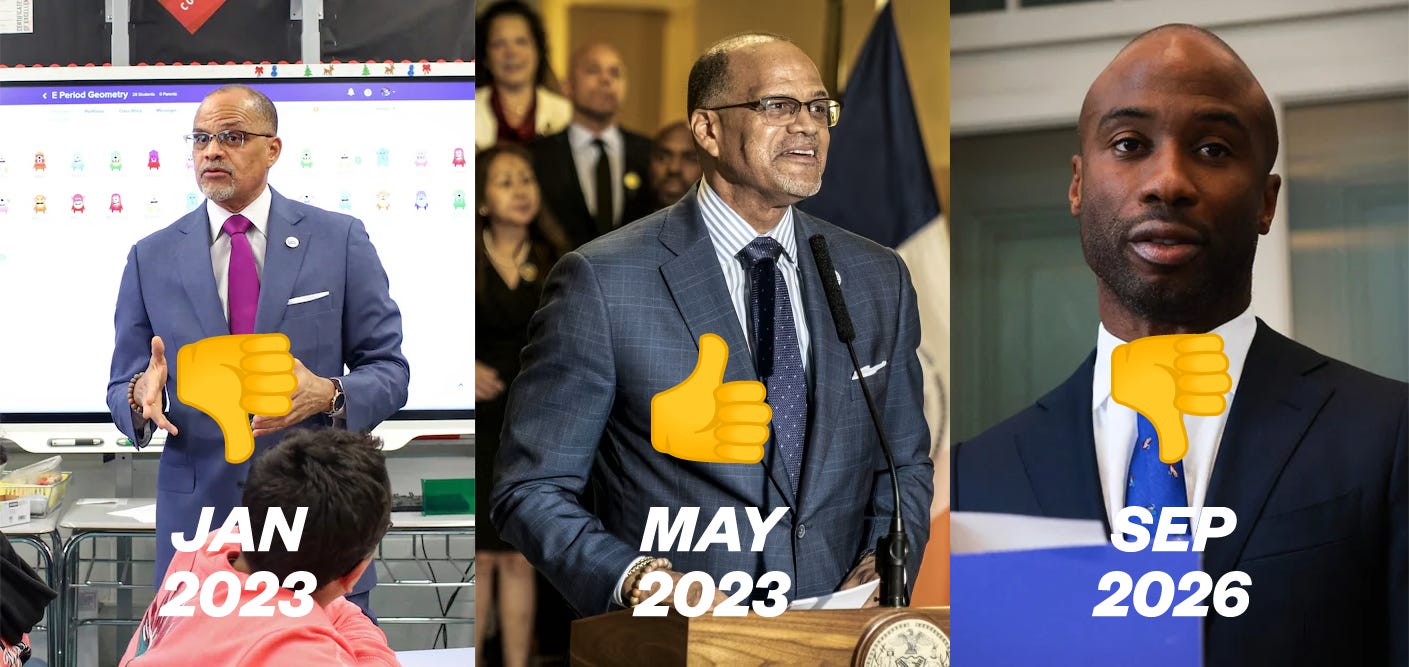
An image showing three moments where NYC school chancellors have banned, unbanned, and rebanned AI in schools.

Edtech psychosis is everywhere lately. You have Randi Weingarten, president of the American Federation of Teachers, partnering with AI companies one month and then denouncing AI a year later. You have New York City Public Schools banning then unbanning and rebanning AI in their schools over a span of three years. You have the Los Angeles Unified School District promoting their custom AI chatbot one year and then banning AI two years later. You have edtech insiders all over LinkedIn excited about technologies way out of proportion to any evidence that they support student learning.

Edtech psychosis flourishes wherever a giant tech company’s free cash flow meets education’s threadbare operating budgets. Edtech psychosis flourishes in people who are more impressed by a novel business model or a speculative technology than by good teaching or a well-designed curriculum. Edtech psychosis flourishes in people whose pedagogical convictions are too weak to withstand a wink from whatever new technology walks by.

If your job is to support students, teachers, or schools, then edtech psychosis is fatal for your project and you should hope for an inoculation. Edtech psychosis will stunt your understanding of the reality of schooling. You’ll imagine students as little empty hard drives or young disobedient employees. You’ll imagine teachers as frantic CPUs, desperately trying to write different bits of information onto every student. You’ll imagine most kids learn as you did—well-supported and self-motivated. You’ll imagine all kids are as eager as you are to work and learn by themselves on a laptop, as eager as you are to learn what a large language model might say next.

How do you inoculate yourself against edtech psychosis?

There are people who succumb to edtech psychosis and people who seem immune to its debilitating power. Immunocompetent people understand the “grammar of schooling”—the goals, constraints, routines, and aspirations that power the people who work in schools. The immunocompetent are teaching classes, observing classes, watching videos of classes, or, at minimum, reading testimonials from teachers all as often as they can. The immunocompromised do none of those things. Instead, they congregate on LinkedIn like kids at a chickenpox party, each one wondering in their own perplexed way why people aren’t as impressed by artificial intelligence as they are.

How I’m inoculating myself against edtech psychosis this year.

As of last week, I have successfully begged my way into a fifth grade public school classroom here in Oakland, CA, where I’ll work weekly this school year. I was trained as a high school math teacher and have since taught middle school but, until now, I have only experienced elementary school as a parent. This will be an adventure. Next week I’ll share some early observations.

What is your inoculation plan?

Time in classrooms keeps my imagination pointed at the actual rather than imagined problems of kids and teachers. It keeps me inoculated against edtech psychosis. Let me know your own inoculation plan in the comments or by direct message. Email a local school. Meet a teacher at a weekend farmer’s market. Ask if you can help. Get yourself fingerprinted. Get yourself a name badge. Become a substitute teacher and get paid to get inoculated. One hour per week will completely change your outlook. Let me know after you have received your inoculation, please, so I can stop worrying about you.

👋 Toss your email in the box to get a new post about teaching, technology, and math on special Wednesdays.

Upcoming Presentations

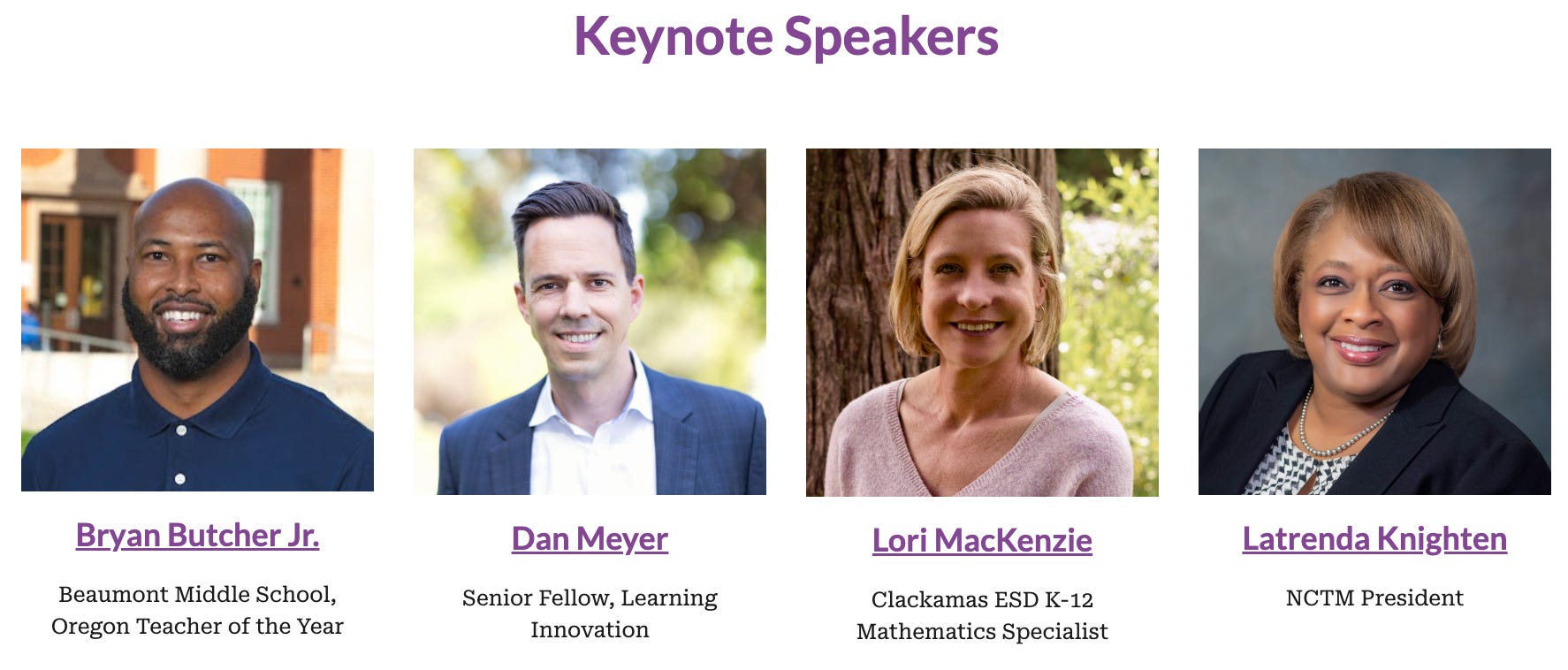
An image showing a set of keynote speakers, one of which is me.

I am keeping busy this fall and hope to see you at any of these conferences.

Odds & Ends

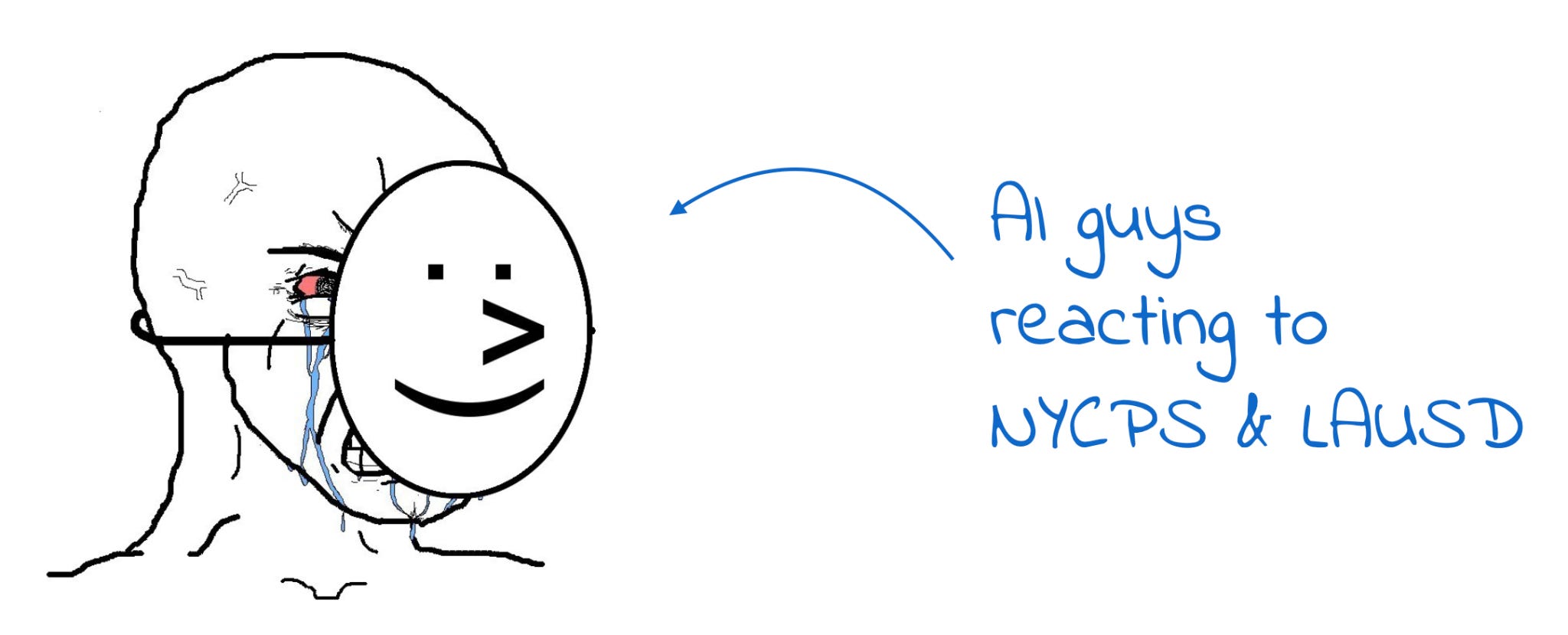
A meme with a sobbing face wearing a happy face and an arrow saying "AI guys reacting to NYC & LAUSD"

Los Angeles USD and New York City PS both enacted sweeping bans on artificial intelligence in the last couple of weeks. Over on LinkedIn, edtech operators are either trying to put on a brave face or they are fully rending their garments. My commentary here is brief: with artificial intelligence, you spent four years promising baby while delivering bathwater and too many people noticed. Next time: consider underpromising, overdelivering, or both.

Linda Jacobson at The 74 describes the ways AI in education has underdelivered in her round-up of recent research. Wise words in the article from high school history teacher Wendy Graham: “Kids don’t do their best for robots; kids do their best for people.”

¶ I appreciated this Justin Reich column which notes that the absolute best case hypothetical educational website lives inside a browser which lives inside an operating system which lives inside a device. The best case hypothetical educational website controls none of those outer layers and each one of them has goals for users that often run counter to the goals of that absolute best case hypothetical educational website.

New York Times reporter Natasha Singer has a quote from Brad Smith, Microsoft’s president, that we should inspect closely.

Brad Smith, Microsoft’s vice chair and president, told me the dynamic began because public schools often seemed ill-equipped to teach crucial modern subjects and prepare students for the ever-evolving demands of the job market. He also suggested I consider where schools might be without support from corporations like Microsoft.

“Philanthropy in the private sector is doing this work because the public sector has failed to do what it’s supposed to do,” Mr. Smith said. He allowed that the situation wasn’t ideal. “It’s filled the gap out of necessity,” he said. “It’s not the way we should want public education to work.”

Of course public education doesn’t operate the way you want it to, Brad. Private industry has always wanted the public to subsidize its employee development costs. The public simply doesn’t share either your opinion about the point of school or your fiduciary duty to Microsoft shareholders.

¶ My local district here in Oakland, CA, is contemplating screen time restrictions. School board member Rachel Latta came on board when she walked into a classroom and noticed the effect of technology on the class.

[Latta] said she has sometimes visited schools and seen entire classes of students not speaking to each other, but working independently on laptops with headphones on, which struck her as odd.

Yes, it’s odd! It’s very odd. We build and operate these expensive buildings called “schools.” We fill them with caring adults and we beg kids to come and then when kids arrive we say, “Whoa whoa whoa, let’s not have too much together time now! Here are your laptops and headphones.” People seem to have substantially less patience nowadays for technology that tears down rather than builds up a community.

Read the whole story
mrmarchant
53 minutes ago
reply
Share this story
Delete

Students who don’t use AI are ahead on every measure

1 Share

Every year, the OECD surveys students around the world for the Programme for International Student Assessment. The 2025 results were just released today. [OECD; OECD, PDF]

Around the world, results have gone down over the past ten years. But PISA includes an AI measurement. How do students do when they use the chatbot in school?

It turns out that winners don’t do chatbots. The graphs show that students with little or no AI use trounce the students who do use the AI:

In these scenarios, students who do not use AI outperform those who do, on average, by around 20 points — equivalent to being around one year of schooling ahead of their peers.

The summary subheading claims “the relationship between AI use and student performance is complex”. What that means is the AI avoiders do much better.

The kids who do use AI do at best about the same. Some do slightly better — but also just happen to be richer.

The report’s intro notes the obvious:

In the same way that we do not become fit by watching sports but by doing sports, learning does not occur through the consumption of content, but as a productive cognitive struggle of the mind with new material.

Of course, the report then tries to both-sides:

If we get this right, AI becomes a scaffold, not a crutch. A tool for thinking, not a substitute for it.

But I suggest there’s one responsible approach to the homework machine in education: don’t. Winners stay left behind.

Read the whole story
mrmarchant
3 hours ago
reply
Share this story
Delete

Students who use AI generally score worse at school

2 Shares
Photo collage of a pixelated student at a desk.

Students who use AI to help them study tend to perform worse at school than those who don't, according to data from a global OECD educational report. The situation is more complex than it sounds though, with certain types of AI use giving learners a slight boost, especially among students taught to critically assess how well the AI tools perform.

The OECD's Programme for International Student Assessment (PISA) takes data from countries around the world every few years. This year's study, based on data collected in 2025, is the first to be carried out since AI use went truly mainstream. It tests 15-year-old students in science, math, and rea …

Read the full story at The Verge.

Read the whole story
mrmarchant
15 hours ago
reply
Share this story
Delete

What If Students Are Sick of AI Too?

1 Share
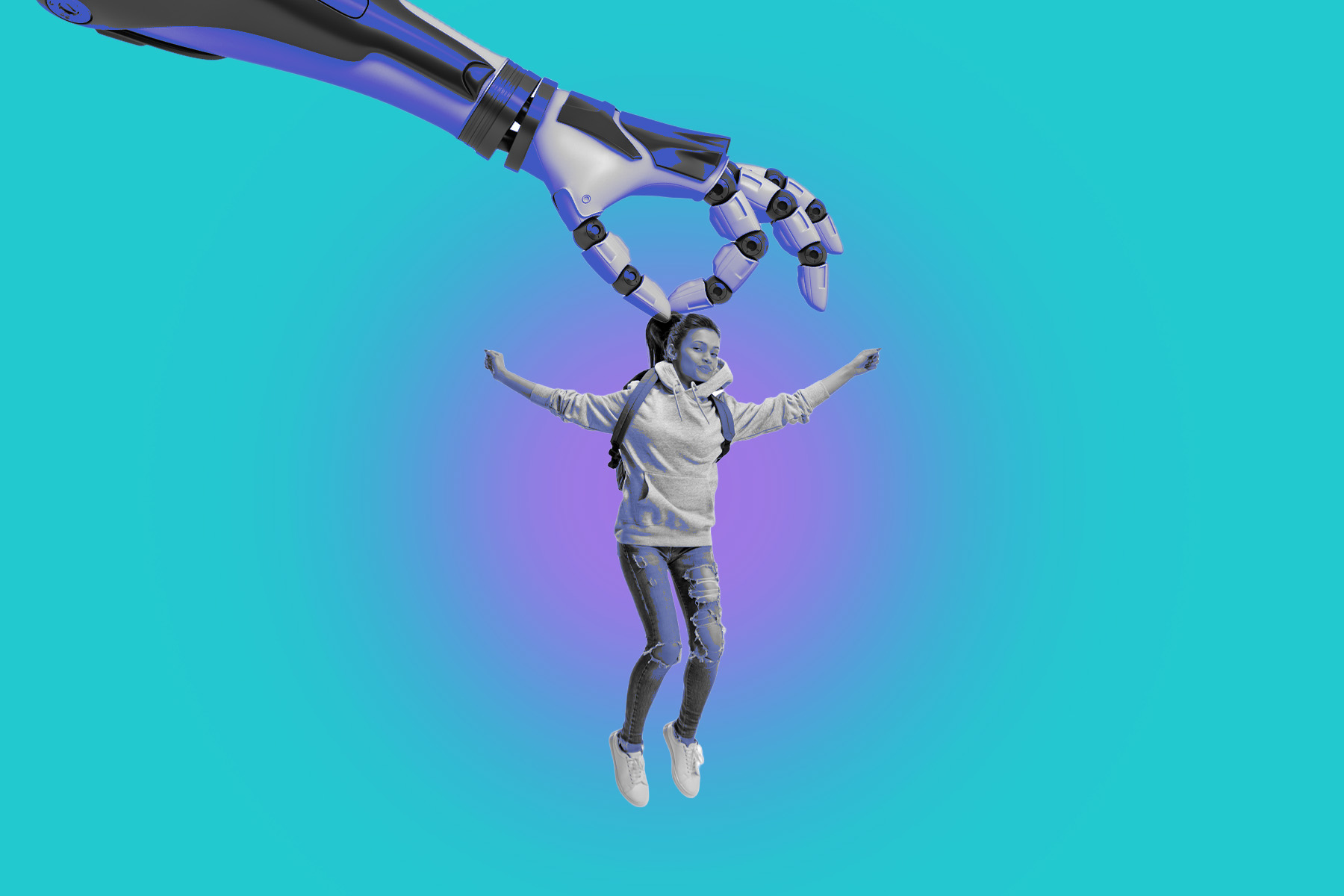
Image of a robotic arm holding a student who is wearing a backpack on a turquoise background

A generation raised on the technology is discovering there are shortcuts it doesn’t want to take

The post What If Students Are Sick of AI Too? first appeared on The Walrus.
Read the whole story
mrmarchant
1 day ago
reply
Share this story
Delete

Against Notes

1 Share

I’m not a fan of having students refer back to notes they have written. Wasn’t a fan when I taught high school, or when I taught middle school, or now in elementary.

First, I have a disclaimer. Writing things down is great for learning. Putting ideas into one’s own words, summarizing ideas, trying an example, putting pencil to paper. I am very much in favor of this! I have students keep a composition book on their desks. I often have students open it and do a bit of writing to summarize something I want them to learn. We do it in every subject. Writing is good.

50 Bulk Composition Book 100 Sheets Wide Ruled

What I don’t do is ask students to use that thing they have written down as a reference, as something they are expected to find and help them do things in the future.

If there is a resource I want students to have — a formula, a definition, a list of things to include in a paragraph, a map, a worked example, anything — I provide it to them when they need it.

The Pitfalls

Here is a list of things that happen when teachers ask students to take and refer back to notes which render those notes less useful:

  • A student takes notes incorrectly.

  • A student takes notes illegibly.

  • A student takes notes but takes so long that they miss critical instructions for what is happening next.

  • A student takes notes by copying from the board without thinking about what they are writing.

  • A student is absent and does not have the notes.

  • A student is present but chooses not to take notes.

  • A student is absent and gets the notes from some other means, but the teacher spends so much time making sure absent students have all the notes that they take away instructional time from other priorities.

  • A student takes notes successfully but cannot locate them when they are needed in the future.

  • A student takes notes successfully and locates the notes when they are needed, but they have spent so much time flipping around looking for what they need that they lose valuable learning time.

  • A student takes notes successfully but does not know which notes are relevant to a future task.

  • A student takes notes successfully, locates the correct note, but does not know how to apply that note to the task at hand.

It’s a minefield.

In my class we write things down all the time. Writing things down is good! Students should write things down. But I don’t stress about whether the things that are written down are useful for students to reference in the future. A lot of what I do might look like notetaking! Try this problem. Write a sentence with this sentence starter. Write down an example of a simile from the text. That’s good stuff. But what I don’t say is, “look back at your notes to help you figure out how to do this thing.”

Opportunity Cost

The argument I’m making here is fundamentally about opportunity cost. I’m not telling teachers that their notetaking routine is broken. It probably works for most students! I’m arguing that the time you put into a notetaking routine might be better spent on something else.

All of those concerns I listed above are possible to solve. Possible, but time-consuming. And time is precious. I could make sure every student has usable notes for every task we do. I could ensure that my future tasks are perfectly aligned so their notes are always useful. We could organize notes. I could have students practice looking back for different pieces of information.

But that is SO. MUCH. TIME. Time organizing notebooks, making sure every student has the notes, getting notes for absent students, flipping back through notes looking for a piece of information. Time that could be used for...well, anything. So many other things that help students learn. More practice, more feedback, more reading, more writing, more questions, more this, more that.

There are lots of pieces of information that could be useful to students in the future. Maybe it’s a formula for a math problem, or a structure for a piece of writing, or a definition, or a map, or an example of something for them to reference if they get stuck. I give students that information. The format varies: often it’s on the board, nice and big, easy to find. Or on an anchor chart that I can leave in the back of the room when we don’t need it, and bring to the front when we do. Or on a piece of paper I give to students. I make sure it’s clear, relevant, and helpful.

Some of you are saying, “but I found my notes so useful for blank and blank and blank.” Cool! I have students write down lots of stuff. They could choose to use those notes if they like. I don’t ban students from taking notes. It’s just not something I require.

Is Notetaking a Skill?

A classic result in cognitive science is that when students refer back to their notes, they overestimate how much they have learned. Looking back at notes is consistently inferior to other, more active ways of studying.

There’s an illusion of learning at play here. A student might look back for something, find it, and think that must mean they have learned it. It might look to a teacher watching students diligently take notes like those neat notes mean learning has taken place.

One risk with notes is that the goal of education becomes to have lots of well-organized notes and resources to reference. To me, the goal of education is for students to have lots of well-organized knowledge in long-term memory. That doesn’t mean references are useless, but it’s a different goal. My experience is that it’s much easier to move information into one’s notes than into one’s long-term memory, and it’s tempting to substitute one goal for the other.

Another common complaint here is that notetaking is a skill, and we should be teaching students to take good notes. I’m not convinced of that. I do want to teach students good study habits. I often tell students that in class we write about what we are learning so that learning is stronger. Putting ideas in your own words, or quizzing yourself, or trying another example on your own are great ways to learn. I’m not convinced that “take thorough notes and reference them in the future” is especially good learning advice.

I’m also just not convinced that notetaking is a generic, transferable skill that we can reliably teach students. I think many students will figure out notetaking skills on their own, whether they are taught or not. Many more won’t develop notetaking skills despite a lot of instruction. Plenty of students have a dozen different teachers who try to teach them how to take notes, and don’t actually ever develop that skill.

A common argument here is that in college, students will have to take notes and learn much more independently. To be blunt, most notetaking routines are about compliance. They’re about copying things down, then finding that thing you wrote down later to prove that you’re a diligent student. That’s not what college is like. Students who show up and try to write down everything the professor says aren’t going to learn much. A student who has practice summarizing ideas in their own words and being an active participant in their learning is going to learn a lot more, whether or not they ever refer back to their notes. Those are the habits I try to model for students.

Read the whole story
mrmarchant
1 day ago
reply
Share this story
Delete

This Bottle of Dijon Mustard from Costco is Crazy Hot. A Months-Long Investigation Revealed the Surprising Reason Why.

1 Share

Jake Edmiston, a business reporter for the Toronto Star, thinks highly of his mustard chicken recipe. So when one batch goes over like a lead balloon, he checks his namesake ingredients and finds that his usual glass pot of Maille Dijon Originale is extraordinarily spicy—a fact he confirms, good reporter that he is, by conducting a blind test with a professional taster. In no time, Edmiston is on the floor of one of Canada’s largest mustard mills, trying to stay dry and avoid mustard dust burns(!), and peppering Unilever, Maille’s owner, with questions. This isn’t exactly a case for Benoit Blanc, but Edmiston’s investigation takes a few surprising turns and drops some serious knowledge on glucosinolates on the way. Every ingredient is in harmony here.

“Do a little dollop,” she said, then turned her back so I could do my work in secret.

I spooned the mustard from my jar onto a plate, and some from another jar of Maille I found in the grocery store that morning. She tried the sample from my jar first and sputtered a little. 

“It’s quite spicy,” she said.

I asked her how much spicier it was than the control jar. 

“Like, 10 times,” she said.

Read the whole story
mrmarchant
1 day ago
reply
Share this story
Delete
Next Page of Stories