Log in




Many are asking my opinion on Emily Hanford’s new podcast series, Sold a Story 2, about the role of direct instruction in schools. Our conversations go like this:
Friend: Are you listening to it?
Me: No.
Friend, surprised: Wow, really? Why not?
Me: Just too busy!
Time for a confession. While I am indeed busy, the real reason I’m not listening to Hanford’s podcast is that I just don’t care.
Sorry not sorry.
I have not spent a single minute of my life lately wondering whether the proportion of direct instruction taking place in our nation’s classrooms is at the optimal balance. This does not make my top 10 list of concerns about US education in 2026, or even my top 100. America is presently the grips of a fascist government, one that — with the help of our techno-fascist Big Tech oligarchy — is explicitly working to systematically dismantle public education in this country. If they succeed, I promise you this will matter far more to our children’s future than the amount of Zig Englemann-approved teaching techniques they happen to receive (or not) during their schooling.1
But there’s another reason too, one that meets Emily Hanford and other direct-instruction enthusiasts on the common ground of what effective classroom instruction should entail. I’ll get to this reason momentarily, but first some context. I’ve spent the last 20 years of my professional life thinking about teaching, and as part of that, I’ve observed classrooms all over the US (and also New Zealand). I’ve also spent that same 20 years circling within education’s chattering class, by which I mean the nexus of philanthropic-policy-think tank-LinkedIn folks that ride herd on the education-conference circuit.
There’s a big gap between these two worlds. Very few of the edu-chatterers, myself included, have meaningful K-12 classroom teaching experience. As such, the chattering class tends to focus on systemic policy levers that can be pulled, or slightly more interestingly, debates about the ideology of education. To date, the latter question has been more true in England than the US, but Hanford seems determined to get this country in on the fun.2
And already I see conversations unfolding along lines of predictable ideological dispositions. There’s a small c-conservative strain of thought that finds direct instruction attractive, insofar as it posits that the adults should be in charge of the classroom and we should dispense with woke lefty progressive nonsense about agency and inquiry and discovery and the like. Just tell them, dammit. (Pick up Sir Nick Gibb’s book Reforming Lessons if you want a case study in capital-C Conservative fever dreams along these lines.)
This was me too…15 years ago. In the early days of the Science of Learning movement, I hewed close to the small-c conservative vision of the classroom that affirmed and amplified the authority of teachers. “Teachers should be guides on the side, not sages on the stage,” boo hiss, these were fighting words. Sir Ken Robinson can fuck right off was the sentiment of the SoL tribe then and now, and at the start of my education career, I fostered it as much as anyone.
But a funny thing happens when you actually start to visit classrooms with regularity, rather than talk at conferences about education, or (ahem) listen to podcasts about education. Ideological dispositions start to give way to complexities, ones that surface again and again and again. At least, this is what happened to me. Which is another way of saying — I became educated about education.
And the amount of direct instruction just isn’t that important, or even all that relevant, to meaningful student learning.
To illustrate this, I’m sharing three videos of teaching that reflect the reality I’ve observed in schools, and the complexity of classrooms and teacher decisions. They are all videos I use in my workshops — last year, I collaborated with my friend Dylan Kane to deliver one to teacher-educators on the cognitive principle of attention to meaning.3 The goal was to help them understand how they could support novice teachers in getting their students to pay attention to what’s meaningful within a lesson or task.
That same task I now put to you — what do you find meaningful in these teaching videos? What do you notice, what do you wonder? Let’s start here, with apologies that you’ll have to go to the Bad Place to watch it:
Is this direct instruction? Yes, no doubt. When I asked workshop attendees what they noticed in this video, the first four or five mentioned the strong classroom management, the use of call and response, the rapid turn-and-talk and quick return to whole-class lecture — they noticed the pedagogical moves, in other words. And there was palpable enthusiasm in the room for this pedagogy, they were digging it. But then one workshop attendee said something that shifted the conversation:
“Are the students learning what bonding in compounds really means?”
Bingo. That’s the key question, alright. What’s more, and this is crucial if challenging to understand, there’s no right or wrong answer. In this two-minute snippet of direct instruction, we have no idea whether these students actually understood what bonding entails, or whether they just learned how to properly pronounce “covalent,” or if they learned anything at all. Nonetheless, many will watch this video and think Yes, More of This Please — and not entirely without reason. But many others will watch and think, No Thank You, This Looks Robotic — and this too is understandable. We interpret pedagogy through our existing values, and in a pluralistic country, our values are diverse. I suspect wherever you fall on the good-versus-bad continuum with Mr. Raichura’s methods will go a long way toward explaining your receptivity to Hanford’s new podcast.
Here’s another teaching example, it’s long but you only need watch a few minutes to sense the vibe:
Is this direct instruction? Well, the teacher certainly is talking aloud and telling the kids to do things. But it’s obviously not going well, she’s struggling with an unruly classroom (one that’s well aware of the cameras in the room), and the students are being led through tasks that do not appear meaningful. Direct instruction doesn’t solve for that problem, but that is the problem that matters. The instructional mode of delivery is often just a surface feature of teaching. A compelling lecture might get students to pay attention to meaning, but a boring one will not. Likewise, a well-designed inquiry task might get students to pay attention to meaning, but a boring one will not. And in my view, partially born of doing a ‘lil teaching myself during my workshops, it’s varying between the two, interleaving we might say, that will almost surely be better for maintaining attention versus slavish devotion to one approach or another.
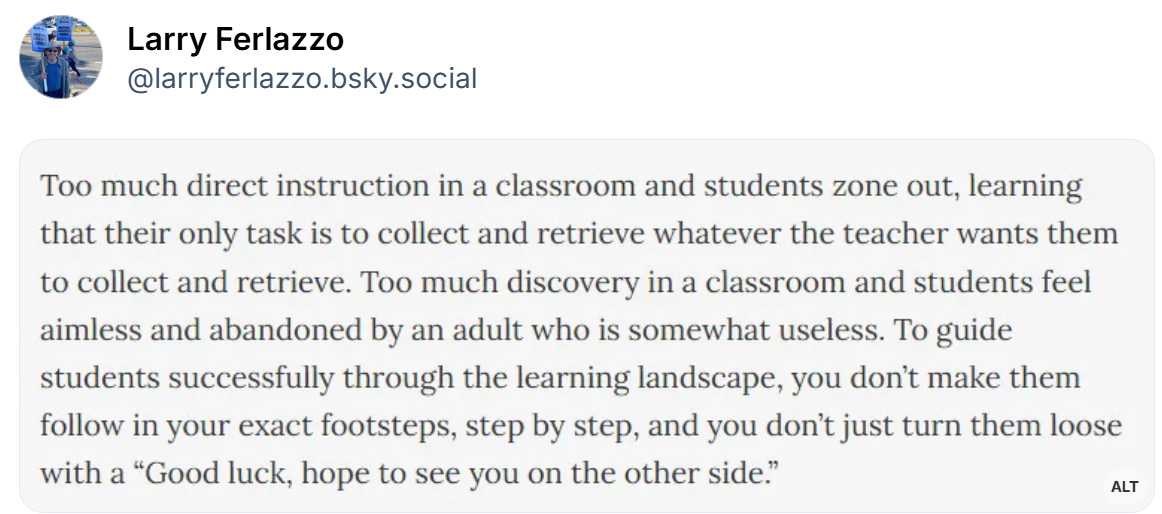
Veteran teachers know this — here’s Larry Ferlazzo’s take after his 40 years in the classroom:
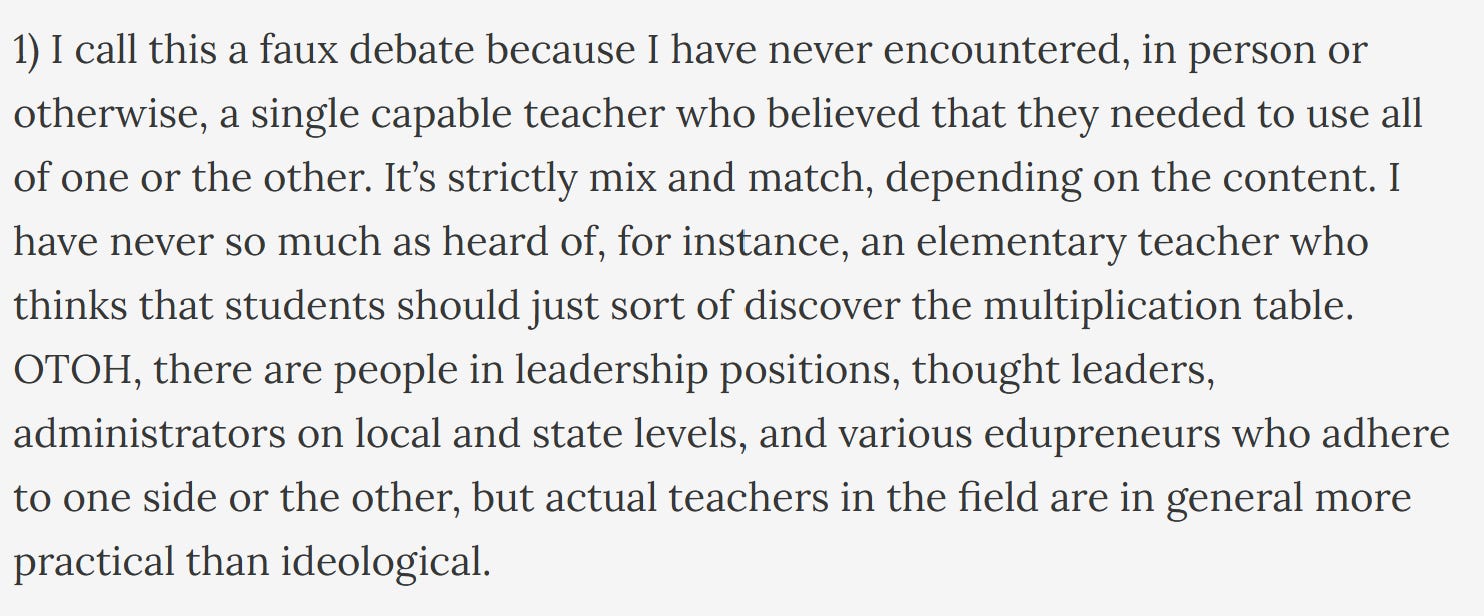
And here’s Peter Greene, another grizzled veteran with more than 30 years of teaching experience:
This brings us to our last teaching video, one I’ve shared with you before that comes courtesy of Dan Meyer:
Is this direct instruction? I don’t know and I don’t care. Can you see how irrelevant this question is as a starting point for having a meaningful conversation about this absorbing classroom moment?
Ms. Bryant has a student named Sam who is checked out, head down on desk, he’s disengaged entirely. She could let him stay checked out — all too often, teachers have to do that, if they want the rest of the class to learn something. But Ms. Bryant does not let Sam stay checked out, she wants to check him back in. So she affirms him, she validates his knowledge and his place in the world (“you even have a wallet”), she knows he can do the math task (because they have a human relationship), and therefore she decides to apply steady but loving pressure to coax Sam into thinking. And she succeeds.
When my friend and collaborator Alicia Stoller writes about reclaiming a vision for humane schooling, I know without even asking her that it’s fostering moments such as this one that she has in mind. Me too. That’s what we want, or should want, for our own children, and for everyone’s children. We want teaching as loving grace.
Instead, we get sold a story that’s lost the plot. If we want more teachers to practice the radical empathy on display in Ms. Bryant’s interaction with Sam, and we should very much want that, direct instruction is not going to bring us one inch closer to that goal. It’s a complete sideshow, but then, the chattering class often prefers listening to a well-crafted story than listening to what teachers actually want and need.
Last thing I’ll say about the podcast I don’t plan to listen to — I find the timing odd. At a moment when parents are rising up to resist continued technological intrusion into schools, and advocating for more meaningful human connections in the classroom, one wonders how receptive they’ll be to a vision of teaching that, when done poorly, is quite mechanistic, even when delivered by human teachers. I’m sure Hanford’s anticipated this objection, she does do her homework, and she’ll no doubt make sure to explain how we might prevent this pedagogy from turning teachers into robots.4
But y’all will just have to let me know how that goes, because I plan to maintain my focus on fighting American fascism, and its direct threat to the core principles underlying public education and democracy. If Hanford does a podcast about that radical danger to schools, and how it’s eroding our shared humanity — well, consider me sold.
Marcus Luther is listening to Sold a Story 2, and it’s making him shudder and revisit his Steinbeck. I highly recommend his erudite take among the many takes floating around out there right now.
And Peter Greene also recommends Tevor Aleo’s and Nick Covington’s “useful and illuminating conversation about the first few episodes of Emily Hanford’s newest foray into the world of educational haranguing” — find it here.

Fun historical fact: The Pet Goat, the book President George W. Bush was reading to a classroom of elementary school kids on 9/11 when he learned about the Twin Towers being hit, was authored by Siegfried “Zig” Engelmann, godfather of Direct Instruction. There’s some nuanced differences between the proprietary form of Direct Instruction he developed and direct instruction generally (sometimes called explicit instruction), but I’m not going to get into that here. See footnote three if you’re curious.
One flaw in this approach, as Michael Pershan aptly observes in relation to Hanford’s first Sold a Story series, is that “teachers are ideologically incoherent.”
Dylan has looked into Direct Instruction of the Engelmann sort, and he employs aspects of it in his own teaching, while finding it wanting in other respects. As to Hanford’s podcast, he presciently warns us to not fall for a simple story.
An astute observation from Annie Abrams (and she has many): “Mandates and scripts can be called direct instruction, they can be called project-based learning, they can be called whole books. If it takes conscious decision making out of the equation, watch out.” Exactly right.