I've been thinking about the small web, the indie web, and the seeming resurgence of personal blogs. Let me get right to it: The only people talking about this community-centric (?), personally driven Internet are tech people. Programmers, developers, and so on. Nobody outside of tech is talking about this, unless they happen to be terminally online. (Like me, hello!) This "indie web" is incredibly technical—just try parsing microformats. And, of course, none of that is necessary...but what is a non-technical person supposed to do? Pay money to use Squarespace? Create a Mastodon account? (A social network that has become primarily for programmers and journalists, it seems.)
No, I don't think any normal person who wants to escape the cage of social media is going to rent a VPS and install a headless Linux OS just to host a blog they have to code themselves. (Maybe they know HTML 2.0 from the early days, but now there's HTML 5? Not that there's much difference, mind you, especially for a personal website, but two to five is a big jump!)
Normal people don't use the internet; they use social media. All of the blog posts from developers who have largely left behind social media, who code a "status" page on their personal website that they coded themselves, celebrating their one or two years free of social media (all the while running curated groups chats on #pick-your-platform) are completely disconnected from the normal person who doomscrolls and follows influencers. Amongst the #SponCon, they still see life updates from their friends; they still have individual and group chats on proprietary platforms; they search on google dot com and read the AI summary because, well, there it is.
Normal people don't scrub the URLs they share for tracking links! They don't even know how to parse a URL—the domain looks right and, well, most of the other information they don't even see because they're using the share sheet on their phone's browser.
I think this has actually divided the internet. For all intents and purposes, normal people simply don't access the internet as it was 20 years ago (which is roughly what I would pin this small/indie web is trying to reach—not to go back in time, but to find that same freedom). They're using siloed social media, they're logging into Google Workshop or whatever, they're ignoring Gmail, they're making a restaurant reservation on OpenTable, and so on.
All of this is honestly just to complain about tech people blogging. I can't read another resume building post on what development to CSS is coming! Who cares!!! Email your colleagues! If you want the small web, start journaling. Start commenting on the world around you. At least start talking about some hobby in programming, not your fucking day job, god.
It was a Monday afternoon in early December and, boy, was I nervous.
I was giving a webinar on Story Tables. This is the first of several posts I hope to write about that day.
I always start presentations by introducing myself, telling some joke about the venue we are in or how little sleep we’ve all had, thanking all of the incredible people I’ve worked with, sharing a brief, yet vague agenda. Nothing terribly out of the ordinary.
Then, before we discuss any Story Tables, I spend about 5-10 minutes talking about one slide. I have found that it shapes our conversations and, when we come back to reflect on the same slide at the end, makes the work we have done together all the more powerful. The exact words have shifted over time but the title remains the same.
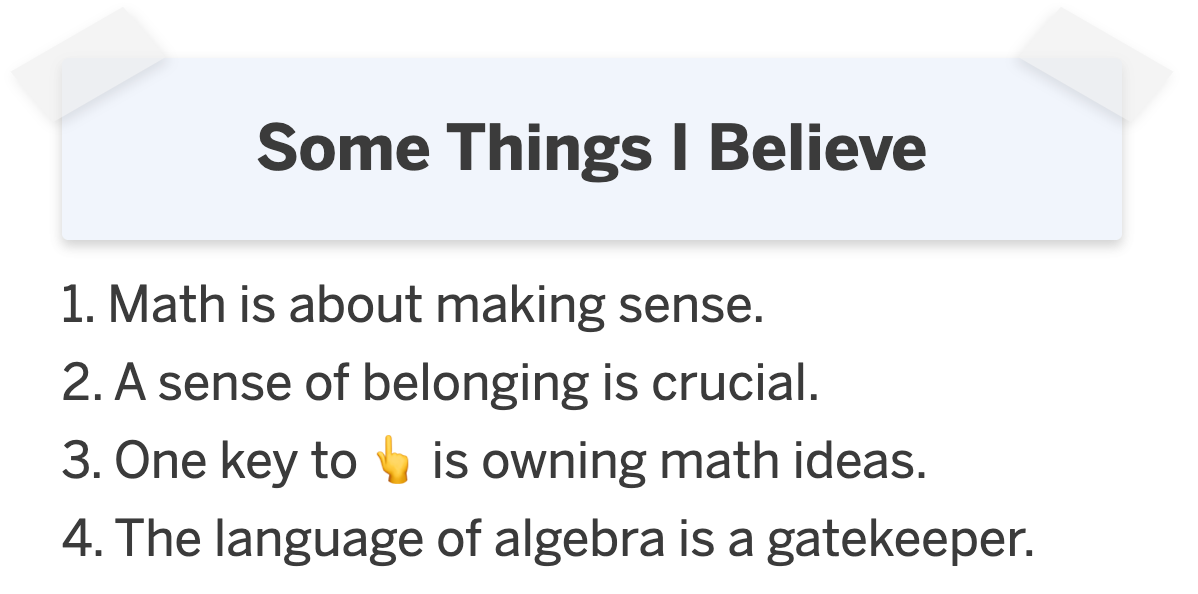
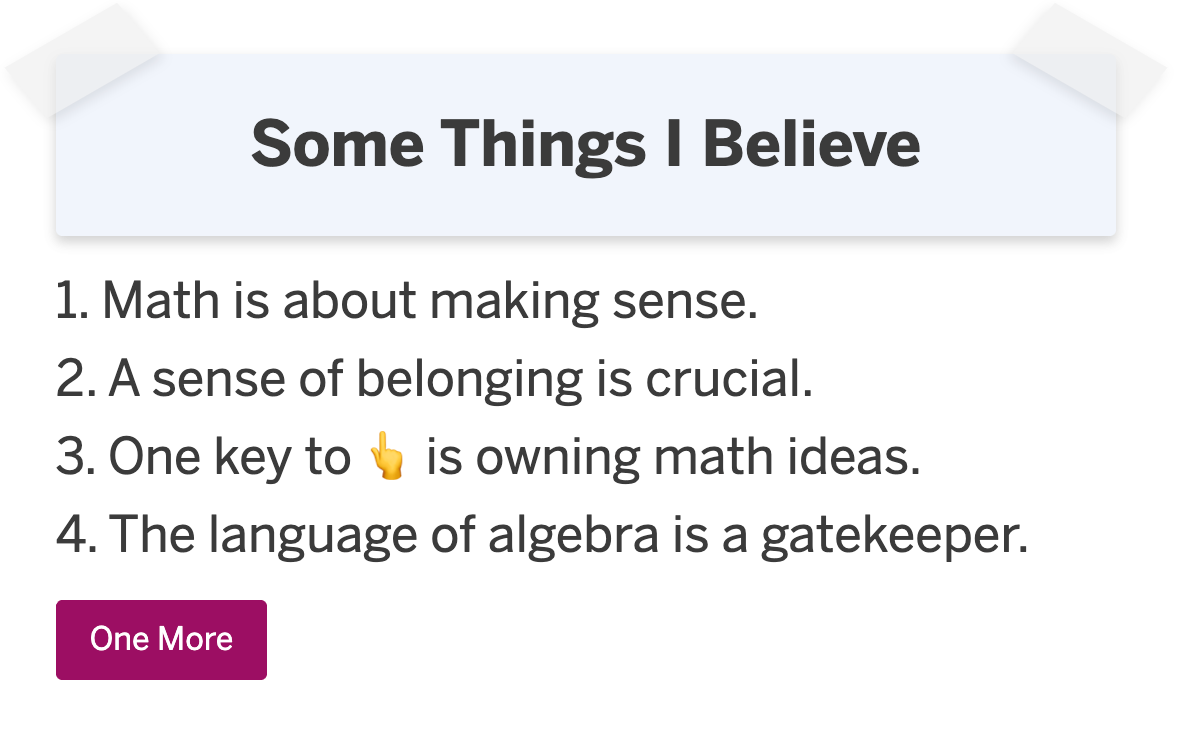
Here’s that slide from the Monday in early December.
1. Math is about making sense.
There is a lot of heated debate about what is important to teach and know in math, and why it matters in the first place. I don’t always know where I fall, but I do believe this: ifthe math that students are doing doesn’t make sense to them, something is wrong.
2. A sense of belonging is crucial.
If you asked me in high school what needed to be true for people to learn, I would have talked all about the content - what math we learned and maybe how the teacher explained it. I even once scheduled a meeting with the department chair formally requesting that we include more matrices in the curriculum.
Another thing that was true at that time is that I was bullied - a lot. The classroom, and especially the math classroom, was one place I felt like I belonged. When other spaces didn’t feel safe for me to share my ideas without fear of ridicule, there was at least one place that was.
That hasn’t been true for many students (and adults) I’ve met. I believe learning requires vulnerability, a willingness to share a half-formed idea or to analyze a mistake you’ve made and work to correct it. Without a sense of belonging, that’s just really hard.
Zaretta Lynn Hammond has a quote I think about a lot. “Attention drives learning. Neuroscience reminds us that before we can be motivated to learn what is in front of us, we must pay attention to it.” It’s really hard to pay attention if your energy is going towards wondering whether you’ll get laughed at for saying something wrong or whether you should have a place there at all.
Ask me now what needs to be true for people to learn and my answer is different.
3. One key to 👆 is owning math ideas.
I feel like I’ve won if every student thinks they have something valuable to share and all their classmates have something valuable to share with them.
4. The language of algebra is a gatekeeper.
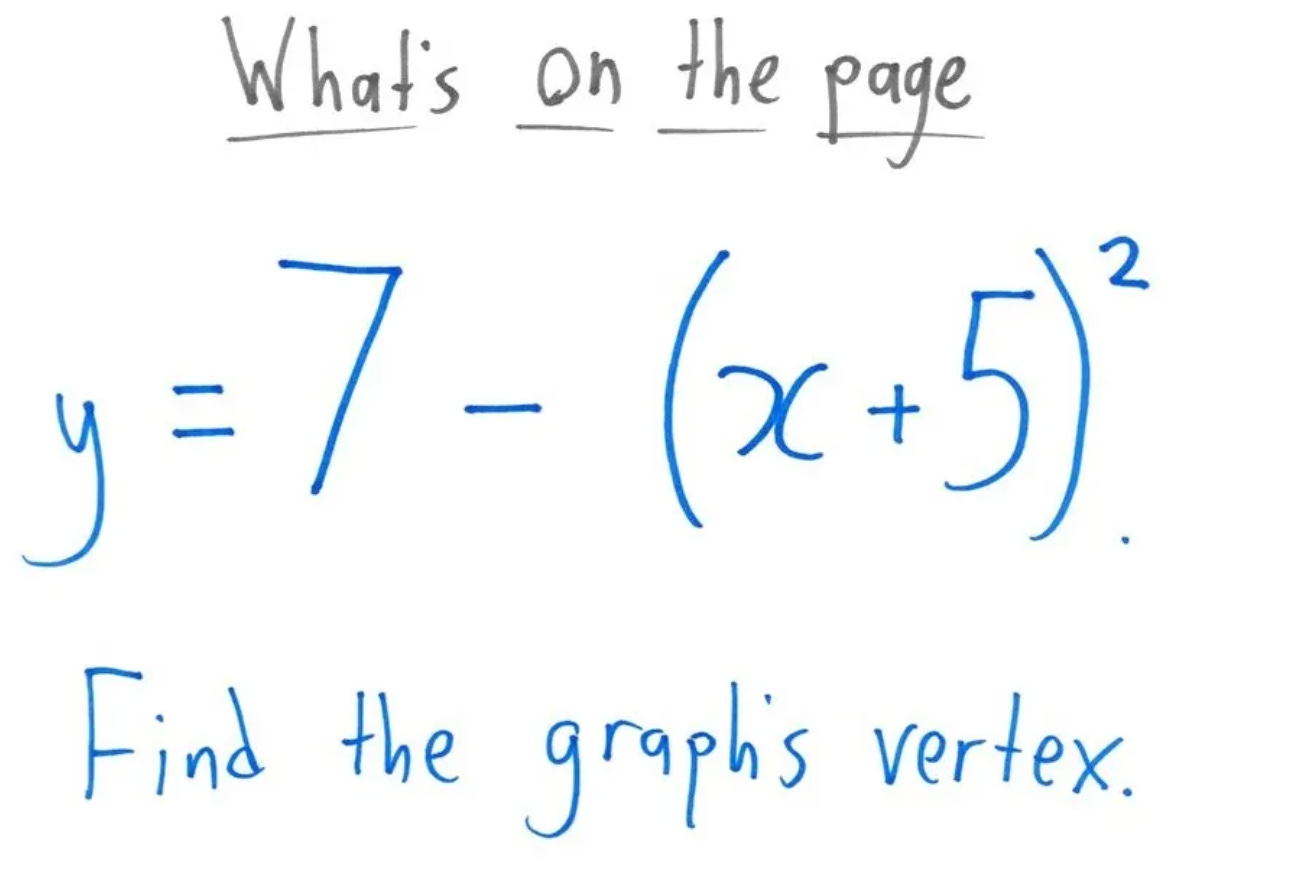
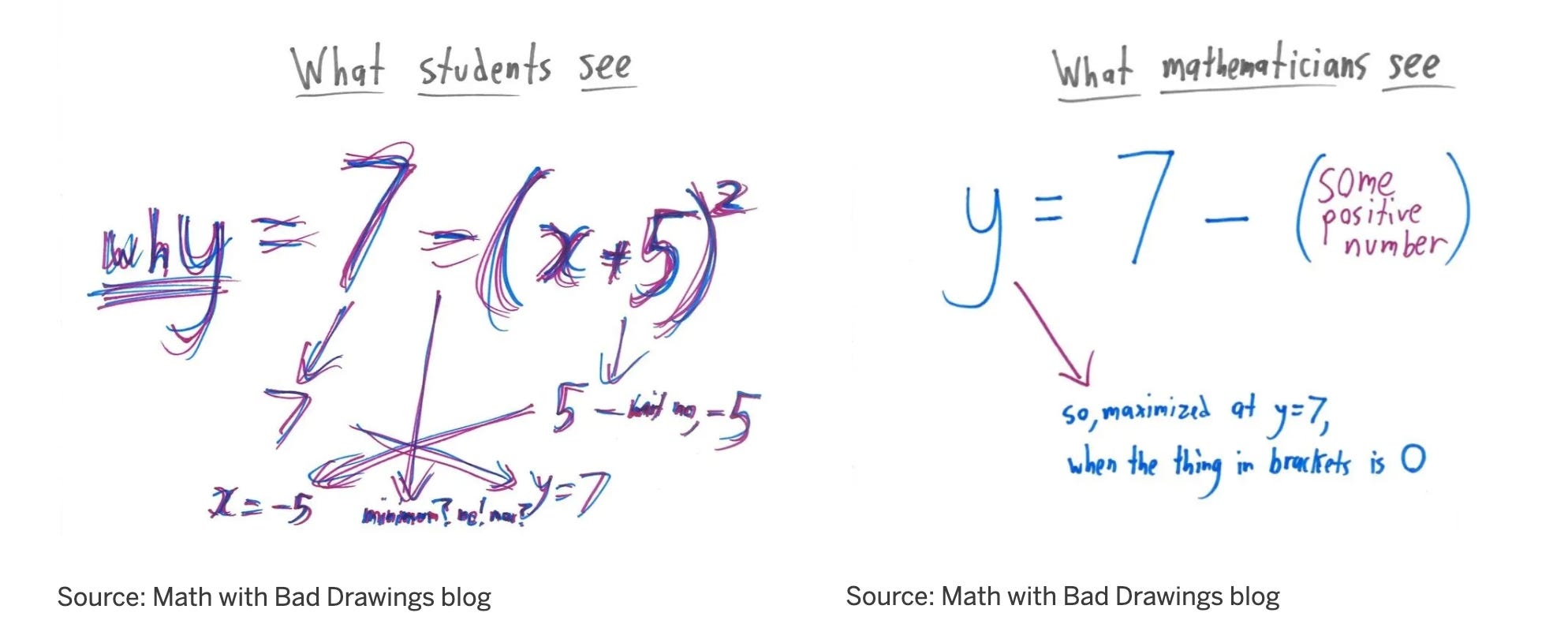
I still remember how I felt when I saw this blogpost from Ben Orlin. Here’s the example I think about the most, though they’re all excellent.
THIS. This is it.
When I look at an equation, I see its structure - there’s something being squared and you take that number and subtract it from 7. Lots of my students see it as a mess of symbols, or, as my student Ariel* put it, as “alien language”.
What brilliant ideas could my students have if the world looked more to them like the image on the right than the one on the left?
*All student names in my posts are changed for their privacy.
What You Believe
You don’t have to believe the things I do. In fact, it would be surprising if you did.
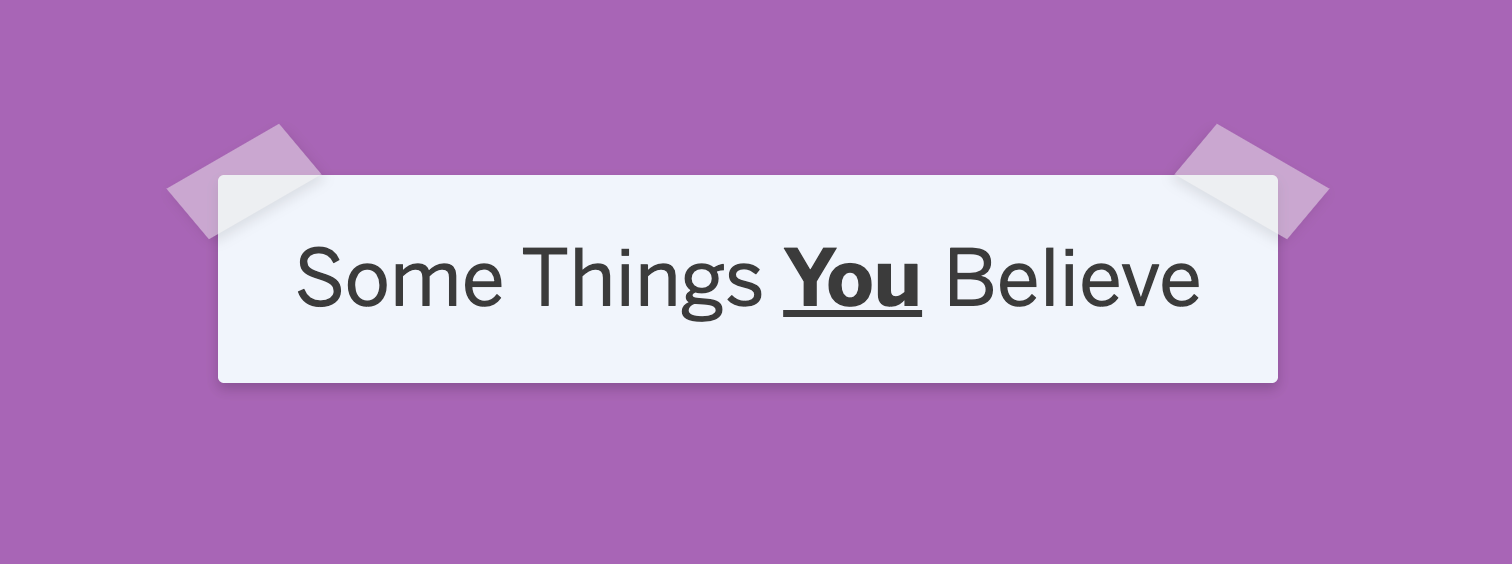
After I talk about what I believe, I like to spend a minute on this slide.
If you were making a list of things you believe, what would you put on it?
A (Small) Lie
Okay. So the image I showed you at the beginning of this post isn’t exactly the one I shared in December. It’s close, but missing something at the bottom.
What’s the fifth thing I believe, the “One More”?
Well, that’s the subject of my next post.
Thanks for reading Story Table Talk! Subscribe for free to receive new posts and support my work.
I like things that are strange and a bit obscure. It’s a habit of mine, and a lot of this blog is to document things I haven’t heard of before, because I wanted to learn about them. I mean, jeez, I’m certainly not writing blog posts about strip mahjong because the people demand it. But I can’t stop seeing misinformation everywhere, and I have to say something. This post is just a rant.
Phantasy Star Fukkokuban
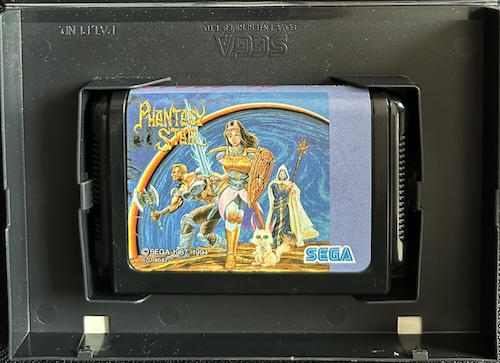
This is Phantasy Star Fukkokuban, a Japanese Sega Genesis game released in 1994 to commemorate the release of Phantasy Star IV by re-releasing the original. It has an interesting component: it is the Master System game, just packaged into a Genesis cart. The PCB wires the Genesis lines the same way your Power Base Converter would. My guess is the reason for this is because the Master System wasn’t very popular in Japan, and Phantasy Star IV tied together the whole series with a lot of tiebacks to the first one in particular.
As a Master System game disguised as a Genesis one, this game is technically interesting. Some Genesis consoles can’t play Master System games, and those ones can’t play this game either. Also, I love the Phantasy Star series; even if 2 is my favorite. This makes this cartridge a perfect subject for my interest, so I’ve talked about it before and will talk about it again. In fact, I have a post I’m working on where I mention it.
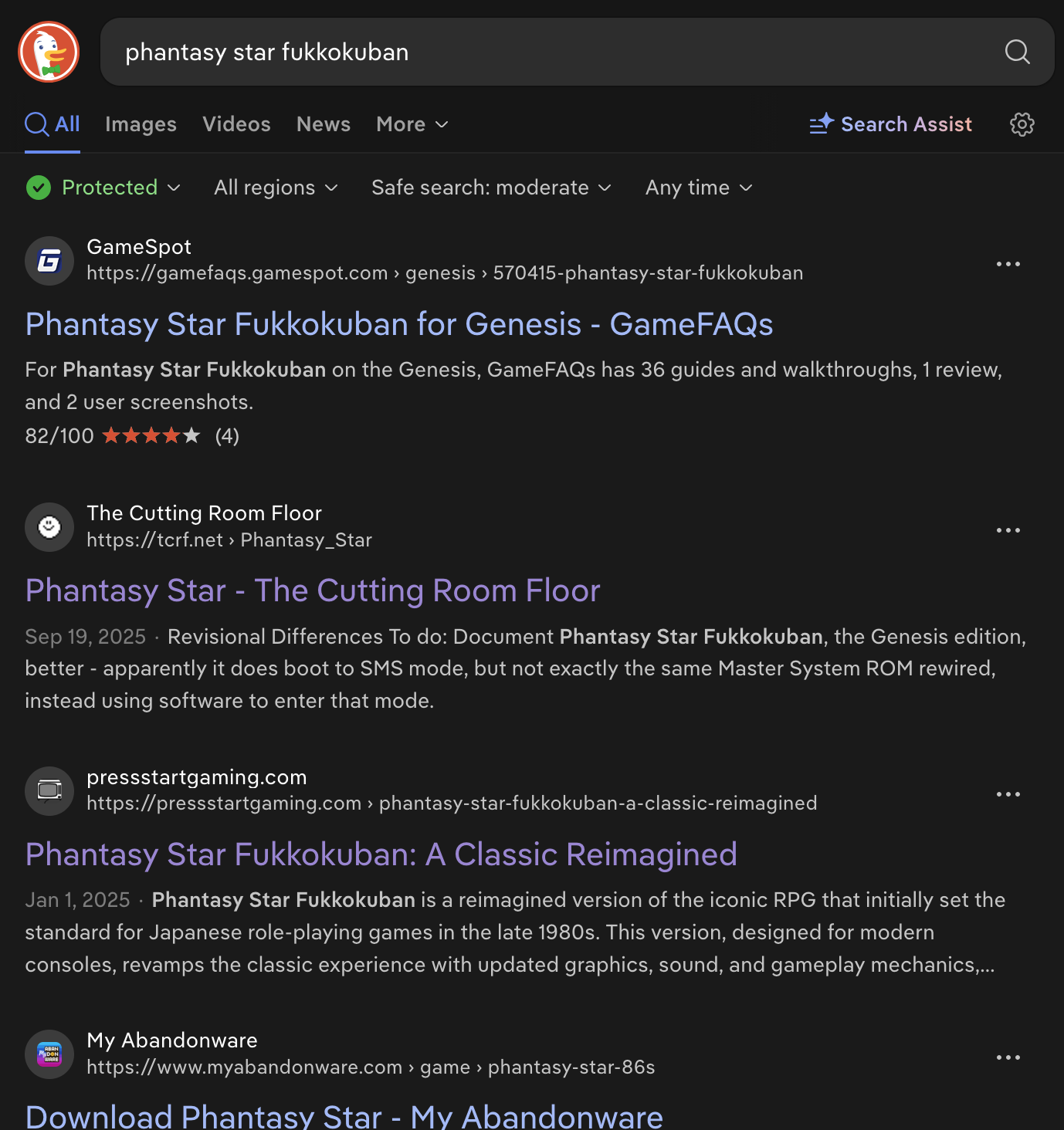
So there I was, writing a blog post, and wanted to look up the release date. The first result I found in DuckDuckGo, my search engine?
And here’s a thing about me. I want to trust new websites. I have a bias towards clicking on articles from sites I don’t know, because to be quite honest, I’ve read the TCRF page on Phantasy Star a thousand times. How else do you learn something new?
Also, I clicked it because the headline was “Phantasy Star Fukkokuban: A Classic Reimagined”. Because here’s the thing. It talks about how the graphics were improved:
Phantasy Star Fukkokuban breathes new life into the classic with its updated graphics and sound design. The visual overhaul retains the charm of the original’s 8-bit aesthetics while incorporating modern graphical techniques. Characters and environments are rendered with enhanced detail, vibrant colors, and fluid animations, creating a visually captivating experience.
The art style honors the game’s roots, with character designs and enemy sprites redesigned to reflect contemporary standards while maintaining their recognizability. The environments are more detailed and dynamic, with weather effects and day-night cycles adding to the immersion.
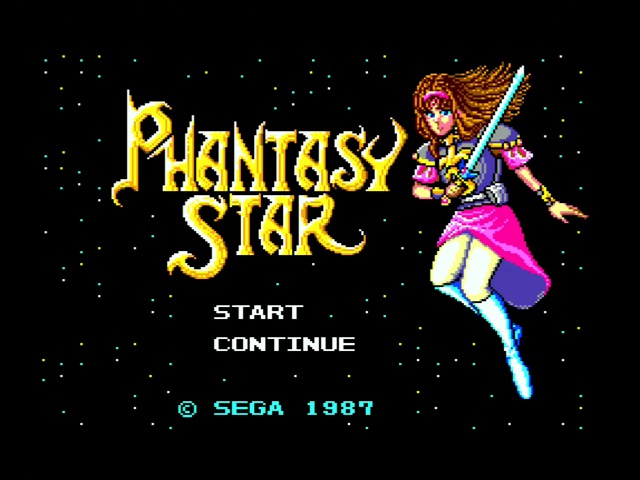
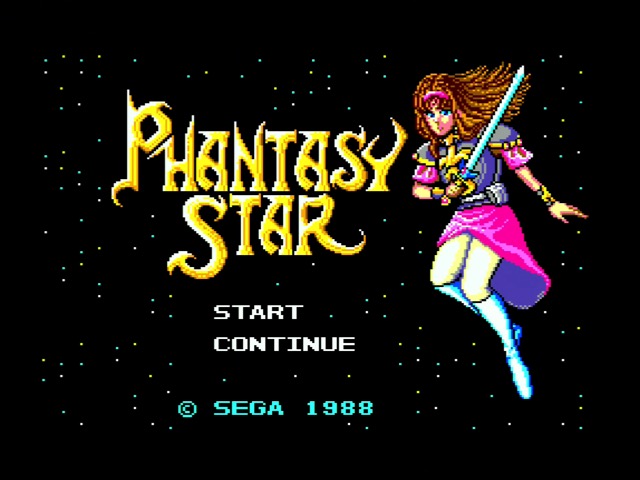
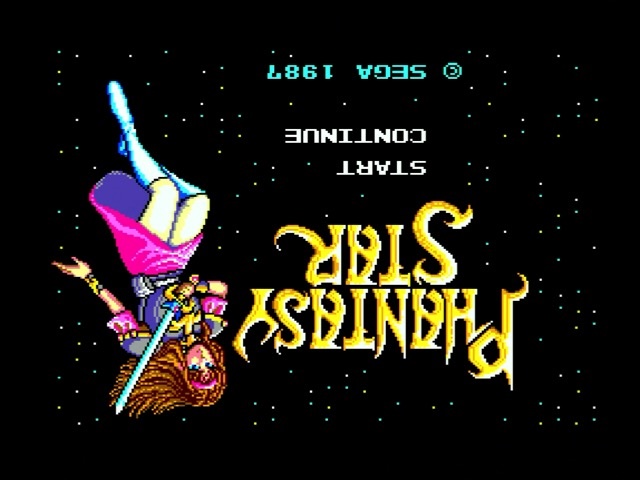
Well, compare the title screen shots of Phantasy Star above. Which one is Fukkokuban and which one is my personal copy, played through the same Genesis? You can maybe tell, but only my Master System version is the US release. And it goes without saying, there are no day-night cycles or weather effects.
I should’ve known. The first sentence of the article was “Game data not found,” after all.
And that’s the thing
Large language models are described sometimes as “fancy autocorrect”; this is dismissive, but not inaccurate, in the sense that the core loop of an LLM is to predict the next token in a sequence. Phantasy Star Fukkokuban is an obscure title that is likely not well-represented in the training data. But relations do exist:
It knows about Phantasy Star, a very popular game
Fukkokuban (復刻版) means “reprint” or “facsimilie edition”
So, lacking sufficient factual data in the training set, it describes what a remake of Phantasy Star might plausibly be like. There might even be knowledge in the data set of the actual remake, Phantasy Star generation:1 that gets looped in.
To reproduce this myself, I went to ChatGPT, and asked it Please describe the game "Phantasy Star Fukkokuban". Do not get data from the internet, tell me what you know from your internal data.. And what did I get in response?
Phantasy Star Fukkokuban is not a brand-new entry in the series, but a retro compilation release of the original Phantasy Star, created for the Sega Sega Saturn era…
There was a retro compilation release of Phantasy Star for the Sega Saturn in Japan; it’s called Phantasy Star Collection. Indeed, the description of the game it continued from there isn’t too far off from that game’s version of Phantasy Star.
And it’s not just Phantasy Star Fukkokuban. I describe in my post on Mahjong Daireikai that that game is so obscure, the only Japanese source I could find was another “this is plausibly what a game called ‘mahjong daireikai’ might be like”. Well, what Mahjong Daireikai is actually like is a lot different than what’s in your training data, and that’s exactly the sort of information people want to read websites to find out.
The trampling of the internet with SEO-mongers predates AI, but what LLMs do is massively increase the ease it can be done, and also hallucinate a ton. If they hired a person to write about Phantasy Star Fukkokuban for pennies, maybe that person would’ve found the Sega Retro page or something and at least grabbed some facts. Now you don’t need to do even that. And no one making these decisions reads Nicole Express, or even cares about actually providing information with their sites. That’s not what they’re for.
Anyways, eventually models will do a better job integrating Nicole Express, and will know more information about Phantasy Star Fukkokuban. And is this the worst thing the AI boom is doing? No,notevenclose. Even the fully automated hit piece against an open-source developer is probably worse than this.
But it’s a real shame. The commons of the internet are probably already lost, and while I might want to learn new things from new sites, I’ll just have to stick to those with pre-LLM reptuations that I trust. Well, until those sites burn their reputations to make a few extra pennies with AI, like Ars Technica seems to just have.
This post is just a rant. Thanks for listening, at least.
Finding AI videos is hard, but finding AI accounts is easy. Anyone can do it with some basic knowledge about how AI media has advanced over the past two years.
I often joke about how many beautiful 24-year-olds discovered Instagram for the first time in November of 2025. Google’s Nano Banana Pro was released November 20th, and a rush of fake people registered. Let’s turn this into a practical way to find fake accounts. Put a pause on finding individual AI videos and AI videos; it’s more efficient to find the AI accounts, then work backwards.
In this piece we’ll plot out the timeline for recent advancements in AI generation and how new accounts and videos coincide with each change.
The Account Age Paradox
It’s obvious to us that an iPhone 17 Pro’s camera looks better than the camera from the iPhone 6S. 10 years of technological advancement separates them. But in 2015, a new iPhone 6S produced photos notably better than the HTC One M7 I had at the time. That HTC One took the earliest photos in my current photo library, and I look back on them fondly.
The same cannot be said of an AI creator in the year 2035, who is trying to prove their character is real. Can they look back at the old, Veo 3 AI generations from 10 years ago to establish proof of life? Of course not - it has the opposite effect, because Veo 3 looks awful and obviously AI to people in 2035. This is a huge difference between AI and real media, and one that AI creators are already aware of.
On Instagram, relevant AI accounts are usually just a few months old and pop up with AI media innovations. When I find a suspected AI character on TikTok, which unlike Instagram or YouTube does not make “account age” visible on the app, I immediately scroll down to their earliest posts. Did they leave the old, bad generations, or did they delete them and start over recently? Either are huge red flags and nearly impossible to overcome.
Putting it into action
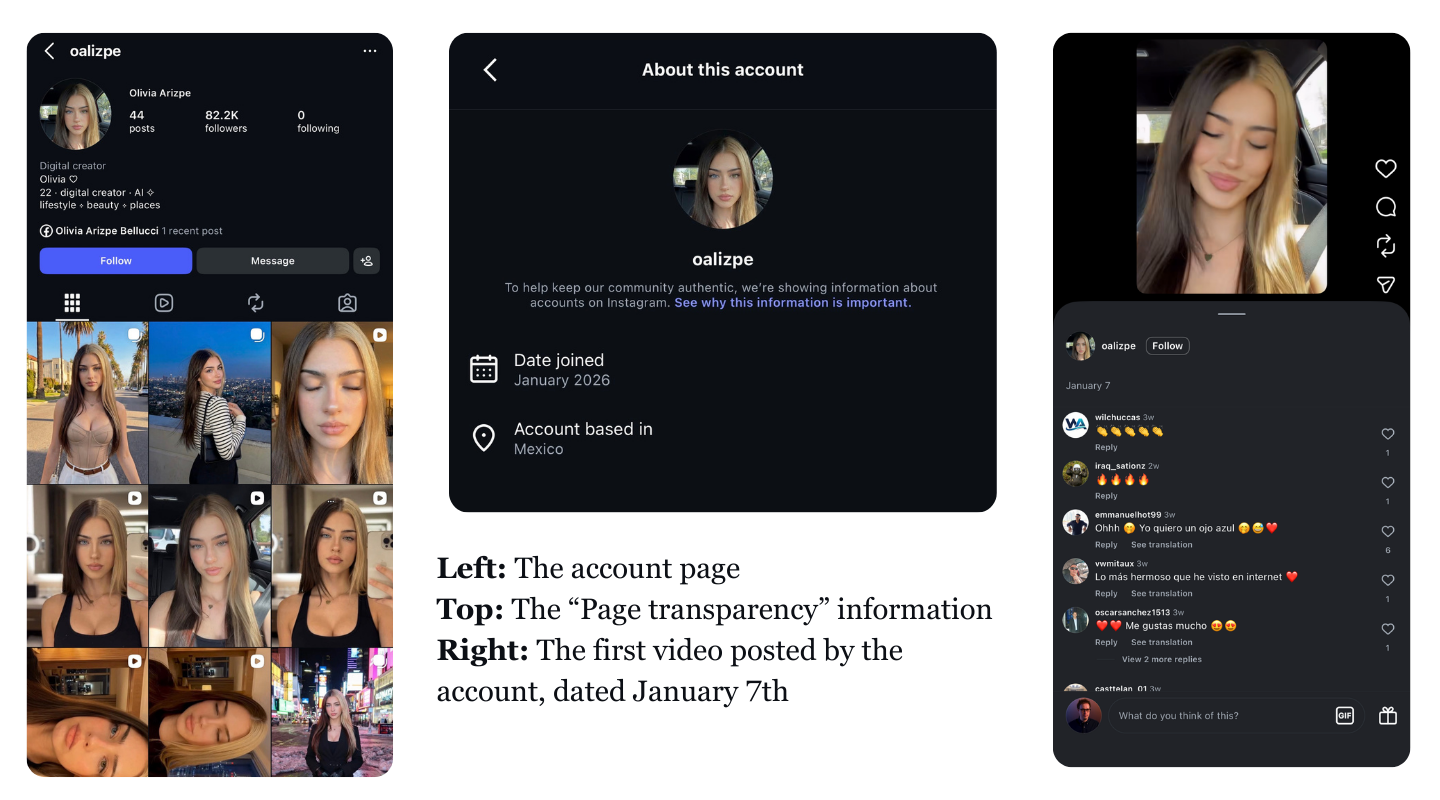
I just found a new account on Instagram: an AI influencer named Olivia Arizpe. First of all, her bio says “Digital Creator” and “AI” in it, but let’s pretend the creator wasn’t so honest.
First, I’ll tap on the three dots at the top of the account page to pull up “About this account.” Here I see that the account was created in January of 2026. The first video is also from January of 2026. This video shows the AI avatar lip-syncing to a Tame Impala song. This is follows “motion control” trend I’ll talk about later. That’s all the information I need to confidently call this an AI account.
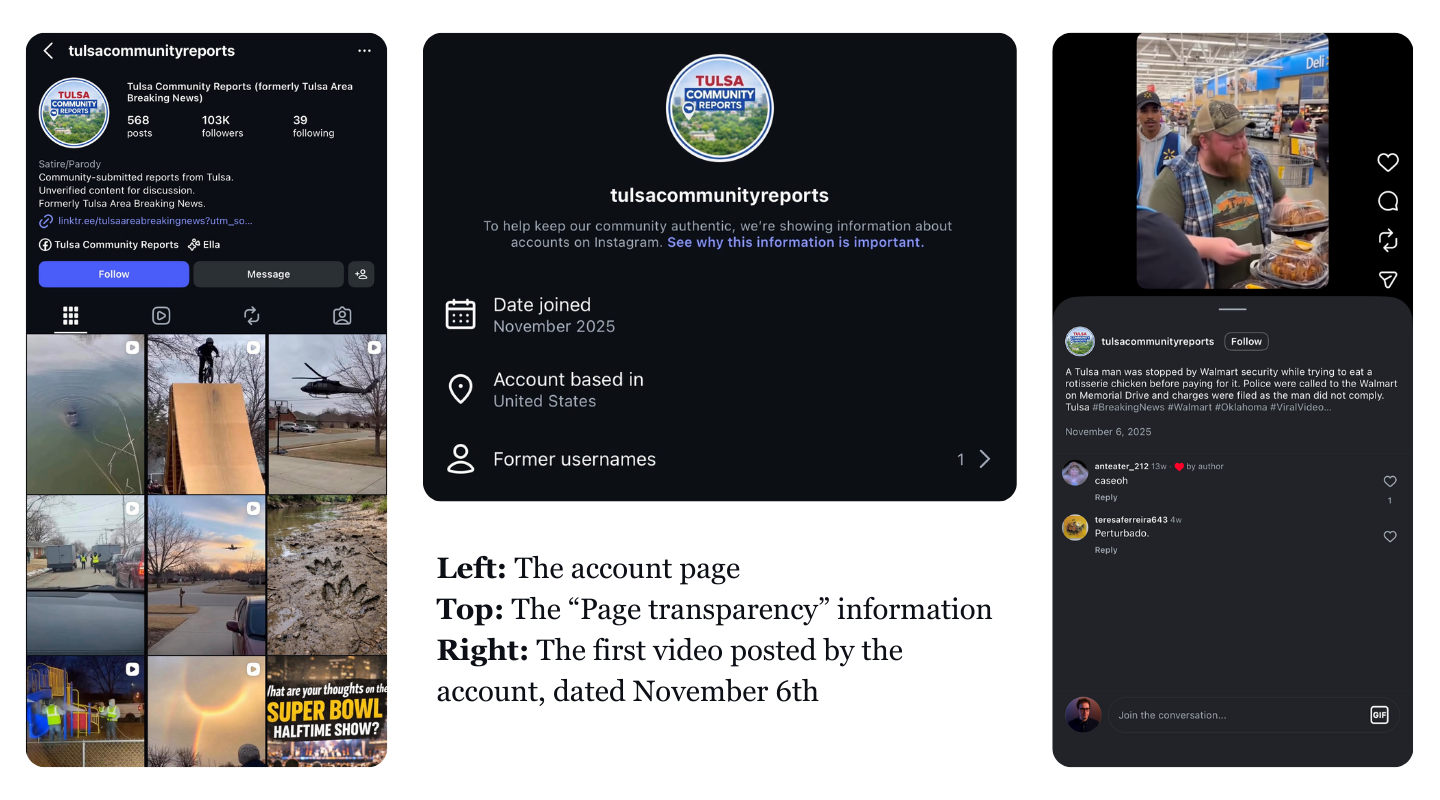
Or what about this account, a “News” page that claims to be from Tulsa, Oklahoma?
This page used to be called “Tulsa Area Breaking News”, but it’s just an AI slop page. They started in November, and their earliest available video is from the same month. This follows OpenAI’s release of Sora, and indeed there are Sora watermark scrubbing artifacts. Not to mention, their first video follows the format of the AI-generated EBT videos coming out at the time, and those were almost entirely generated with Sora.
None of this required good eyesight or any pixel peeping. And if any shiny, new AI slop comes out of the AI-generated Tulsa area and they really want to trick you, they’ll have to delete the old stuff.
We dive into how to find account transparency information in this article, by the way. It contains instructions for Instagram, Facebook, YouTube, TikTok, and X.
Granted, it’s unreasonable for you to remember that Sora came out in October, or that Motion Control AI generators were trending in January. Luckily, you don’t have to remember: I wrote it all down below for you to reference any time you need.
When coming across an account we suspect is AI-generated, we’re looking for either:
A relatively new account that appeared and immediately implemented some recent technology
An account that shows signs of older or more affordable AI technologies in older posts
Let’s look at previous major advancements in AI media and how those popped up on the Internet. This will not only demonstrate how new technology changes trends on social media, but also what to look for when looking back at old posts. This will also give us some important cutoff dates. For example, if you see a dance video from 2023, you can be sure it wasn’t AI-generated.
Before 2025
2025 will probably go down as the most pivotal year in AI media history, and most of the AI-focused accounts today don’t use models from 2024 or earlier. But there are some notable exceptions you should be aware of.
Until Late 2023 - Deepfakes and AI avatars
In 2018, deepfake technology was creating memes and porn, but it was very much in the experimentation phase. Deepfakes aren’t AI videos — they use a different tech architecture — but they’re the first popular form of “AI video” in its broadest possible definition. The corporatized versions of deepfakes are usually called “Avatars”. These are made by companies like Synthesia, who were already around by 2020, and companies like Heygen joined the mix later.
Important takeaway: Face-centric “AI videos” were already possible before 2023, but their uses were pretty limited.
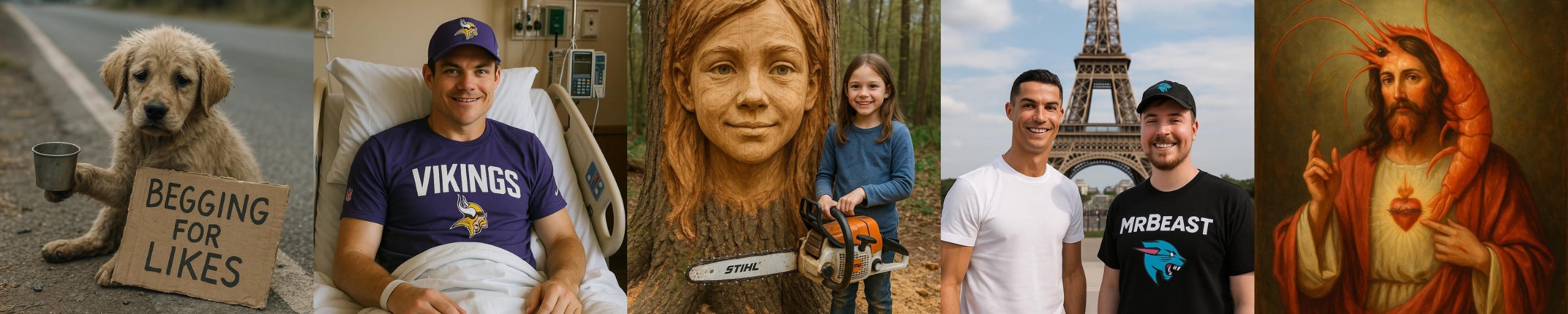
A collection of “classic” AI image slop
Late 2023 to Early 2024 - AI Image slop starts hitting social media
A lot of Facebook posts still have I would call “classic” AI slop. These are the images created by technology from late 2023. For example:
OpenAI released DALL-E 3 in October of 2023
Midjourney released V6 in December of 2023
While these are just two of many image generators of this era (and OpenAI is depreciating the DALL-E 3 API shortly), there are many accounts still stuck in this era because it’s cheap! These sorts of images became ubiquitous when OpenAI integrated DALL-E into ChatGPT, lowering the barrier of entry and opening the AI slop flood gates.
This is the era of Shrimp Jesus and “engagement slop” like old, disabled puppies asking for donations, or ragged puppies begging for likes. Today, we still see NFL coaches who desperately need help with medical bills. They don’t look like the coaches exactly, there’s a yellowish tint, and it’s giving “Polar Express.”
Important Takeaway: If you see a decent image from before mid-2023, its foundation is probably a real photo. Maybe it’s a heavily edited real photo, drawn, or 3D rendered by this era’s already incredibly powerful animation or gaming engines. But it wasn’t made by “AI”.
Early to mid 2024 - First (decent) AI Video models released publicly
Sora got a lot of early attention February of 2024, followed by models like Luma Dream Machine and Runway Gen-3 in June that year. AI video was still relatively limited, but boosted by many new scaling and training advancements from 2023. Given its limitations, memes and AI video slop was their primary social media use.
Important Takeaway: If you see a decent-quality video posted before mid-2024, unless it was professionally modified or rendered, it’s a real video.. There aren’t any good “AI videos” before this point.
2025
March - ChatGPT 4o Images
I still remember sitting on the couch with my wife on March 26th, 2025 - the day after OpenAI released ChatGPT’s 4o image generation. The internet was lit up with Studio Ghibli-ified images. Feeling guilt about the inherent ethical quandaries of that style, I instead made a photo of our recent vacation in the Family Guy art style. Our surprise and fear from that day seems pretty quaint in hindsight, given what else 2025 was about to bring.
AI-generated profile pictures from this era are still common. The yellow-tinted, glossy, evenly-lit photos from this generation are ubiquitous. Since ChatGPT is the most popular large language model, its built-in image generation is also really popular.
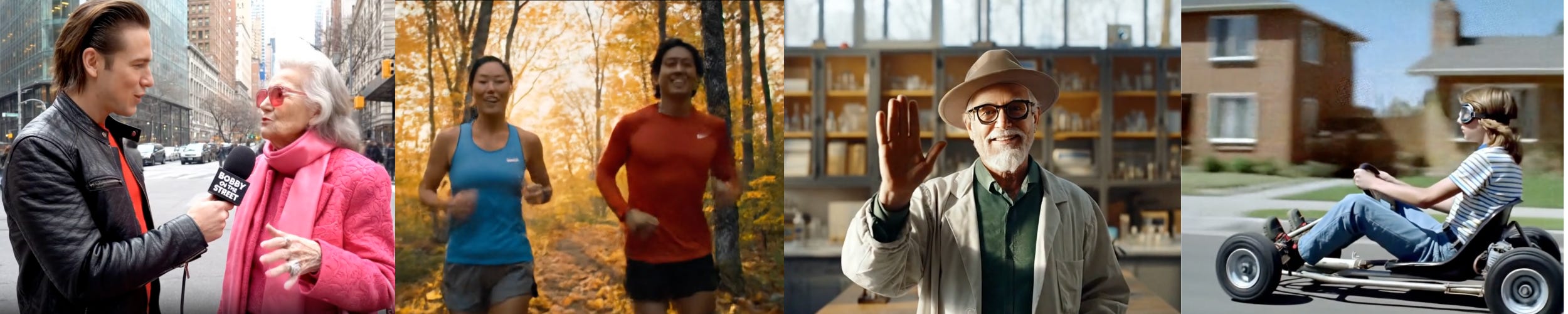
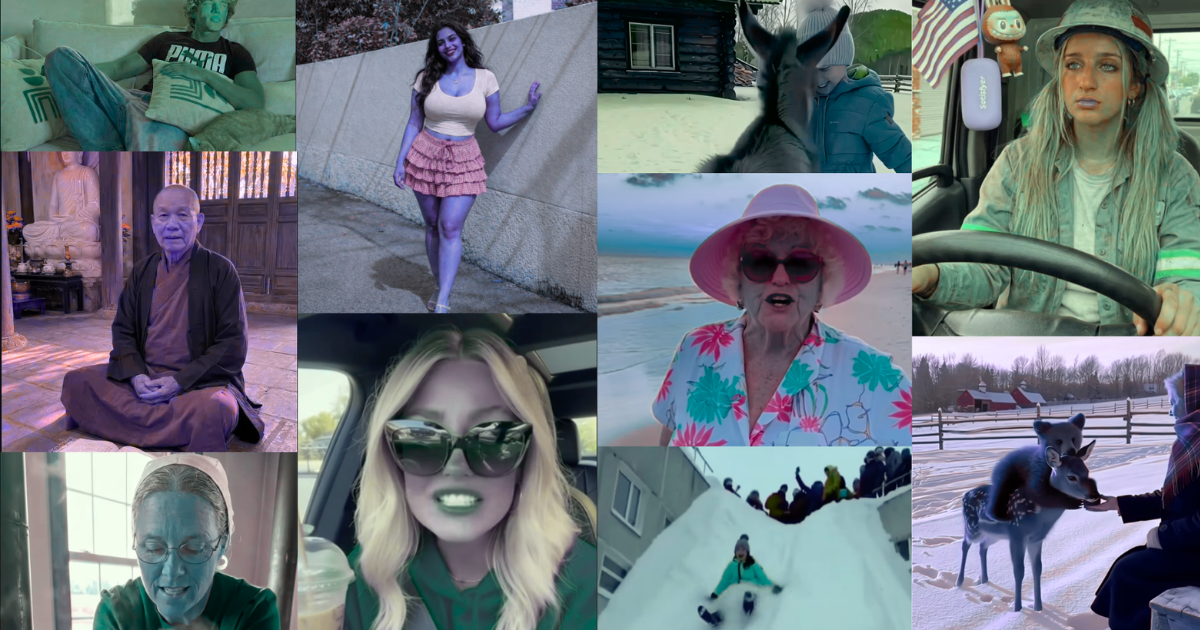
A collection of stills from Google Veo 3 test generations
May - Google Veo 3
Veo 3 was the first AI video model with meaningful sound, and it was also a jump forward in video quality. It generated videos with a cinematic look and feel, though it definitely wasn’t up to cinematic standards. As a result, though it was envisioned as a tool for creatives, it instead flooded the internet with AI videos.
A Veo 3 Review was my first ever YouTube video. Today, Veo 3 makes a platonic “AI video” that’s relatively easy to spot after you’re familiar with it. The most distinctive characteristics include smooth and even lighting, temporal inconsistencies and background issues, and the character’s robotic and melodramatic voices.
Immediately in May, a ton of AI slop pages popped up on social media. Since Veo 3 could only do widescreen 16:9 videos at first, vertical-native platforms like TikTok suddenly had a ton of new accounts posting AI videos with black bars (also known as letterboxes) on the top and bottom of every video. ASMR Fruit cutting videos and AI man-on-the-street interviews were trend. But also, people’s first “I got tricked” moments came with Veo 3’s bunnies on trampolines.
Important Takeaway: If you find a realistic video with matching sound or dialogue posted before May of 2025, unless it was generated with a game or animation engine, it’s a real video.
Mid-2025 - Other video models
Around the same time as Veo 3 were Runway Gen 4 (April) and Kling 2.1 (May). These were similar in video quality to Veo 3, but neither had synchronized sound. They traded this for vertically-native videos and different video styles. Along with Midjourney releasing its first video model in June, Alibaba’s open-sourcing of Wan 2.2 in July, and many more advancements from companies like LTX and Minimax, a plethora of good video-generation options came online in mid-2025.
Google’s Nano Banana, the informal name for Gemini 2.5 Flash Image, was a big jump in photo quality. Before Nano Banana, mainstream AI photo still had a glossy look. After Nano Banana, photorealistic images were very accessible.
Important Takeaway: A lot of photo-only AI accounts got a huge boost or started in August of 2025.
October 2025 - Sora 2
The next jump in AI video came from OpenAI, who took a year and a half after the original Sora to release the Sora 2 video model. Alongside it was the release of the Sora app, a TikTok-style vertical video app with only AI videos.
The Sora 2 model had a few key innovations:
It felt less uncanny than Veo 3 for many viewers. Eyes, mouth, and skin detail were more realistic.
It had better physics than any other model at the time.
It was funny. Lazy prompts were spiced up by a language model in the background. This meant inexperienced AI prompters could make viral videos.
Sora’s release coincided with a huge increase in the number of “AI slop” accounts because it was free. Until this point, good AI video generation was expensive, but the Sora app let users generate a lot of videos in the free app. These videos could be downloaded with a watermark (that was easily scrubbed), then reposted to the other, much more popular social media sites. The Sora 2 API released just 2 weeks after, providing videos without watermarks, and giving more people access to the powerful Sora 2 Pro model. To this day, a ton of AI videos come from Sora 2 because it has a good price-to-quality ratio.
Important Takeaway: Many AI video slop accounts have October 2025 birthdays or changed their usernames at this time.
November 2025 - Nano Banana Pro
Google’s jump to Nano Banana Pro (Gemini 3.0 Pro Image) was surprising. Just three months after the original, it brought big improvements to realism and quality, as well as improved spacial reasoning and text rendering. This is the point where AI photos became mostly undetectable on first glance, though they can be spotted when looking closely.
Along with Nano Banana Pro came the release of SynthID, which can be accessed through Google’s Gemini large language model. It’s an invisible watermarking system that embeds and detects a watermark hidden inside the pixels of a photo.
Creators reacted accordingly. Misinformation like the infamous “Bubba Trump“ photo and fake celebrity paparazzi photos spread wildly. More relevant to our everyday social media use, AI generated influencer accounts proliferated in late November. The Nano Banana Pro release also corresponded with TikTok’s unfortunately-timed new emphasis on image carousel posts. And, since many AI video generators have a photo-to-video mode, these AI images are the starting frames for many AI videos. Nano Banana Pro is still a leader in this field, and while other generators have caught up, this was an important demarcation point.
And that wasn’t all that happened in November...
November and December 2025 - Motion Control AI improvements
Coinciding with Nano Banana Pro’s release were improvements in Motion Control models, most notably Wan 2.2 Animate. This prompting innovation lets creators take a “control” video — often a video stolen from a real creator’s social media — and “replace” them with a new character, real or not. This method saw further improvement through Kling 2.6 Motion control.
These models unlock very realistic motion and physics for AI characters. Combining Nano Banana Pro (or similar photo models) with a motion control video model lets creators generate realistic, consistent characters across posts. While not perfect (there are still plenty of AI giveaways), AI influencer creators now had a ton of tools at their disposal.
Important Takeaway: Accounts that feature human avatars and started or rebranded in November or December of 2025 are a huge red flag. A lot of AI slop accounts moved into the more profitable AI influencer business.
Early 2026 trends
Releases from Kling and Bytedance show further improvements in AI video quality, which we’re still analyzing as of this post. I expect some new accounts in February that play off their strengths, but those are yet to be determined. Right now it’s a bunch of demos of stolen intellectual property and celebrity deepfakes, as can be expected with a new model release.
Moving Forward
People regularly ask me what might happen if AI video becomes “perfect” or “undetectable.” But to my eyes, real videos aren’t “perfect”. There are always artifacts of the process that made them.
I remember watching Superbowl XLV 15 years ago, on an imposing 75-inch high-definition TV. It was incredible and perfect at the time. But looking back at it now, it looks a bit dated, even without today’s de-interlacing conversion artifacts. In 5 years, perhaps the oversaturated HDR look of today’s iPhone phones will be an out-of-fashion artifact of our current era.
The highest-end, most impressive AI video generations today still don’t look "real” to me, but they do look “really good”, which is real enough for most people. The difference is marginal, but with hindsight it may become obvious. Those of us who make real media will have to adapt and differentiate ourselves from AI advancements, figuring out what our advantages are. It’s always going to be changing, so stay tuned here for updates on the latest releases and countermeasures.
Riddance is a reader-supported publication. To receive new posts and support our work, consider becoming a free or paid subscriber.
It feels like we’ve reached a critical mass of consensus: AI is just bad for our students. The American Association of Colleges and Universities just released the results of a national survey of U.S. faculty, which found that 95 percent believed AI would “increase students’ overreliance” on such AI tools, and 90 percent believed AI would “diminish students’ critical thinking skills.” This is mirrored in a recent Brookings report, which concluded that “the risks of utilizing AI in education overshadow its benefits.” As one professor (“I’m an AI power user”) put it, “I want to strip things back: no laptops, no phones, just pens and paper.”
It seems everyone wants to find a way to minimize or even forbid AI use, kind of like how cell phone bans and restrictions in K–12 schools have passed in 33 states. The consequences of doing nothing, such narratives proclaim, could be dire. The Brookings report, for example, throws around terms such as cognitive decline, cognitive impairment, and cognitive atrophy—all of which, it notes, are associated with an “unhealthy aging brain.” They quote an MIT brain imaging study that suggests the long-term consequences of AI use may include “diminished critical inquiry, increased vulnerability to manipulation, decreased creativity…[and] risk internalizing shallow or biased perspectives.”
Here’s the problem with all this “Chicken Little” hysteria. Four years ago, before any of us had a clue about weird acronyms such as GPT, LLM, or AGI, every education expert I know was bemoaning students’ continued lack of academic competence. NAEP has for decades documented how just a small percentage of U.S. students reach even a “proficient” level in their reading and writing and that, compared to other countries, U.S. students consistently are middle-of-the-pack. Results from the Collegiate Learning Assessment incited two prominent scholars to conclude that college students were “academically adrift” and learning almost nothing across their years in college.
AI, in other words, did not erode critical thinking; it exposed how poorly we have been teaching it.
Let me be blunt: There was no golden age of critical thinking or academic achievement before AI came along and seemingly ruined everything. In the years before ChatGPT arrived, K–12 educators said some of their most pressing concerns were that schools were boring and that we didn’t know how to talk to each other; college leaders worried that they lacked the ability to strengthen students’ critical thinking, communication, or problem-solving skills to successfully enter the workforce.
So, sure, I understand today’s basic argument: Maybe using AI in the wrong way will make all this even worse. Trust me, I’ve been there. I was ready to give up and walk away as I saw AI supercharge a disengagement spiral that turned my college classroom into a transactional mirage of learning.
EdNext in your inbox
Sign up for the EdNext Weekly newsletter, and stay up to date with the Daily Digest, delivered straight to your inbox.
But here’s the thing: The emergence of AI truly marks a transformation akin to a Copernican revolution in education. This is because AI has given us the chance to implement a type of powerful personalized learning that we have only dreamt of, a potential reality that education theorists have spent decades developing key concepts and core theories about (e.g., ubiquitous learning, situated learning, legitimate peripheral participation, distributed cognition). The problem is we’ve never been able to implement this vision faithfully within the institutional constraints of our education systems. And revolutionary moments, like all transformations, create massive disruptions.
The solution, though, is not to pretend these disruptions don’t exist, nor is it to bemoan that the sky is falling. Instead, we need to embrace them.
I, for example, have finally figured out how to help my students use AI as a daily tutor, Socratic conversation partner, and writing mentor. I walk my students through the ethical use of AI and how—if prompted correctly and used deliberatively—it can help them think carefully and thoughtfully about some of our most complex and contested societal issues. So rather than face a passive and disengaged lecture hall of 70 students, I watch them write daily reflections such as this: “Overall in this course I have noticed that we are being taught how to think rather than what to think and I think that AI and been a great tool during this process.” Many other researchers and faculty are experimenting with how to make AI a catalyst for learning rather than a ghost writer for outsourcing thinking.
Recent handwringing about the loss of critical thinking skills, I would therefore suggest, says far more about how we teach than how our students learn. If we really care about saving students’ critical thinking skills, we need to think critically ourselves about how to re-envision our education systems with the right guardrails and guideposts to leverage AI-driven tools rather than disengage from this transformational moment. Prohibitions and nostalgia for a pre-AI world are the real dangers that will result from a failure to think critically. Instead, educators’ embrace of AI as a transformational tool is what will make a world of difference.
Dan Sarofian-Butin was the founding dean of the School of Education and Social Policy at Merrimack College and is now a professor of education there.
Americans are getting worse at math. Student scores have fallen to their lowest point in decades. Nearly half of high school students barely meet what the National Assessment of Educational Progress (NAEP) considers a “basic” level of comprehension, and more than 900 freshmen at the University of California, San Diego — 12.5% of the institution’s first-year class in 2024 — had the mathematical proficiency of a 13-year-old.
U.S. adults aren’t faring much better. Last checked, only 65% could pass a basic arithmetic test, making the country one of the more quantitatively challenged in the industrialized world.
But this isn’t the first time the math graph has trended downward. A similar development took place during the early stages of the Cold War, when enrollment in high school algebra fell to levels not seen since the start of the 20th century. It wasn’t until the launch of Sputnik in 1957, when the Soviet Union kicked off the space race, that alarm gave way to action. Math and science education were overhauled, and calculus was introduced into the curriculum.
As then, concerns about the national “math deficit” are closely tied to geopolitics. Instead of Russian rocket engineers, policymakers now worry about competition from China, India, and other emerging economies, which have for years provided Big Tech with some of its best and brightest. What will happen to the U.S. when Shenzhen overtakes Silicon Valley?
That’s one side of the coin, but the math deficit does not only affect national prosperity and security. As the U.S. Board of Education’s National Mathematics Advisory Panel stressed in a 2008 report, it also affects our quality of life. More than a launchpad to better job opportunities, math is a tool for self-improvement. It is useful in the arts, sports, and many other areas that, at first glance, seem to have little to do with numbers. To learn math, the French mathematician David Bessis writes in his book Mathematica, is to “change the way you see the world.”
Math anxiety
Remember that dreadful feeling you got in math class? Your teacher is flying through the coursework at 100 miles per hour, and all of your classmates are nodding along; meanwhile, you’re sitting there so lost and confused that you can feel your brain spinning.
If that sounds familiar, know that you’re not alone.
According to one survey, 9 out of every 10 U.S. adults have experienced some level of math anxiety. Math anxiety is so common that even LLMs — AIs trained on vast amounts of human output — associate numbers with words like frustrating, exasperating, and alarming.
Math anxiety even shares many symptoms with regular anxiety: clammy palms, an upset stomach, increased heart rate, and lightheadedness. By activating the brain’s pain and fear centers (the insula and amygdala), math anxiety can impair your working memory and, by extension, cognitive abilities — explaining all those times you watched aghast as the equations in your textbook morphed into indecipherable hieroglyphics.
The consequences of math anxiety reach far beyond the classroom. If internalized, the all-too-recognizable belief that someone is or isn’t “a math person” can lead them to forgo a rewarding career in science, technology, medicine, or many other fields that require beyond-the-basics arithmetic skills. In extreme cases, math-anxious people may try to avoid any activity involving numbers, from balancing bank statements to measuring out ingredients for home-cooked recipes.
Learning math, therefore, often begins with learning to cope with math anxiety. Studies find that many of the techniques used for managing regular anxiety — from breathing exercises to cognitive behavioral therapy — can help with math anxiety, as well. Echoing progressive pedagogical movements from the 1960s and 1970s, many contemporary educators argue that people learn best when mathematical exercises are presented through meaningful, relevant everyday situations, revealing a seemingly abstract discipline as the practical resource it really is.
Others argue that math is best learned when it is fun. This approach not only aligns with what we know of brain development — babies and children often learn through play — but also helps address math anxiety. If someone encounters math outside the classroom, away from an impatient teacher and those intimidating textbooks, they may give the subject a second chance. That’s one explanation for the sudden and explosive popularity of “math influencers” like Andy Math and 3Blue1Brown, who have over 1.3 million followers on TikTok and 8 million subscribers on YouTube, respectively. Browse their comment sections, and you’ll find no shortage of comments like, “This just proves that maths isn’t boring” and “Never in my life did I think I’d binge-watch math videos.”
Bessis — who specializes in algebra, geometry, and topology, and achieved mathematical fame for solving a problem dating back to the Nixon presidency — says overcoming math anxiety begins with recognizing that it is shared by people at every skill level.
“Every graduate student knows [the feeling],” he tells Big Think. “You sit in a seminar, and after 20 seconds, you understand nothing. It’s not that you don’t understand some of the details or references; it’s all just nonsense. There’s no meaning. It’s probably similar to when you were an infant, listening to people speak a language you don’t understand. As an adult, you don’t expect to be in such situations, so you need confidence and awareness to avoid panicking.”
Joining the ranks of Andrew Hacker’s The Math Myth, Matt Parker’s Love Triangle, and Francis Su’s Mathematics of Human Flourishing, Bessis’ Mathematica is part of a growing body of books that, much like those aforementioned influencers, attempts to restore the reader’s relationship with math. Using only mathematical concepts a middle schooler would understand, Bessis dismantles a variety of prejudices and preconceptions left over from our schooldays.
Perhaps more importantly, Mathematica seeks to reintroduce readers to the joyful side of math — the exciting, magical side that is too often beaten out of us at school, but cherished by those who stick with the subject. Using the celebrated French mathematician Alexander Grothendieck as an example, Bessis argues math is best pursued with the mindset of a toddler: with “radical curiosity and indifference to judgment.” Think not of the panic attacks you suffered during exams, but the pride you felt when you learned to count to ten.
The fruits of math
Think also of the many ways that mathematical literacy may help improve your life, professional and private. In the early 20th century, stern schoolmasters believed math taught order, discipline, and a strong work ethic. Today’s research points to different but equally valuable benefits. Studies have found that math exercises correlate with cognitive function and metacognition (thinking about thinking) — both of which, in turn, correlate with mental health. The research also suggests that math can, directly or indirectly, improve neuroplasticity and emotional regulation, and help stave off dementia.
Contrary to the long-discredited yet persistent left brain vs. right brain myth, mathematics is useful in the arts — another field that many wrongly believe requires an innate talent to explore and enjoy. A study assessing thousands of students in China found that mathematical literacy and creative thinking go hand in hand, suggesting that one stimulates the other and vice versa.
Similar suggestions echo throughout art history. Leonardo da Vinci and other Renaissance heavyweights could not have brought their paintings to life without a deeply technical understanding of perspective, and they often constructed their images using a variety of scientific instruments and measurement tools. More recently, saxophonist John Coltrane and drummer Clayton Cameron credited their musical success to their mathematical abilities — lived experiences that support contemporary research exploring the link between early music education and later mathematical performance.
Just as there is math in art, some mathematicians would claim that there is art in math. “When I write down a proof,” Cymra Haskell, a professor at the University of Southern California, once told her college’s newspaper, “it feels like a puzzle coming together. There can be an intense pleasure in that, similar to the pleasure I feel when I listen to a beautiful piece of music or gaze at a beautiful painting.”
More than a metaphor, her observation evokes a study that examined neural activity in 15 mathematicians. It found that looking at certain equations jump-started the medial orbitofrontal cortex, the same part of the brain responsible for perceiving and appreciating beauty.
Looking at his own creative output, Bessis proposes that his experiences as a mathematician helped him become a better writer. “There are quite a few writers who started out as mathematicians,” he says. “Victor Hugo was an accomplished math student and almost stuck with it. There’s something about math that resembles the process of literary writing. It teaches you to articulate what’s real, what’s in front of you, like describing exactly how you tie your shoes.”
Beyond self-help
Considering math’s many real-life applications, it’s no wonder that more than one reviewer has referred to Mathematica as a self-help book. Bessis disagrees with this categorization, even though he stands behind what it implies.
“It’s not a ‘ten lessons to become super smart’ book,” he says, “but inherent in there is this promise, this idea that math will make you smarter and help you see the world more clearly.”
Above all, math has made Bessis more confident and less afraid of the unknown. “After making an impact in my field at age 35,” he reflects, “I made a big bet: I quit math and reinvented myself as a writer and founder, two other territories where you’re supposed to come in equipped with rare skills. Math convinced me that those skills are not inborn; you could develop them with the right effort and focus. It made me capable of taking huge bets on my own learning ability.”
 Log in