
1597 stories
·
2 followers

Go Ahead and Use AI. It Will Only Help Me Dominate You.

2 Shares
By all means—continue. (Photo: Getty)

Recently there has been a lot of commentary of the following type:

BAD WRITER [touchily]: “Actually, I do use AI to help me write.”

Okay. That checks out. Carry on.

Want to use AI as a Valuable Part of Your Writing Process? Want to use it to “generate pushback on my column thesis” and be “more comprehensible” and “craft unique angles” and offer “positive and negative feedback” and “scale the quantity” of your “output?”

Knock yourself out.

You have my blessing.

Hey buddy— go for it!

Some in the “real writer” community find this sort of rampant outsourcing of the writing process to AI to be distressing. Not me. Would I do it myself? No. I have self-respect. But I want to tell you, my friends, that you have my full support for all of it. Want to throw your dashed-off notes into ChatGPT and have it spit a draft back at you and then edit that and call it your own? Want to toss a few hastily written headlines at Claude and have it generate the outline of your piece? Want to dump your entire career archives into a chatbot and then order it to replicate your own voice so you don’t have to?

Do you, a grown man, a successful professional writer who has received a book deal paying you real US currency, want to use AI for the purpose of “making sure the book matches [your own] writing style”[???]? Guess what, brother: I support you. I affirm you. I am right here offering you a classic thumbs-up gesture of affirmation.

“Whoa, a writer who I have never regarded as particularly inventive is using AI? I am surprised and disappointed.” There’s a sentence I would never utter. Instead, I would accept the news of your AI use with total equanimity, nodding almost imperceptibly to indicate that this is not something worth raising my eyebrows over.

No, I will not be joining in the chorus of condemnation. On the contrary. If you are a professional writer, I want you to use AI. Because this industry is competitive. I’ll take any advantage I can get. And if you want to make your writing suck, that’s all the better for me. One less person outshining me.

The tepid, conformist nature of your AI-assisted prose will only make my unexpected bons mots stand out more sharply. While you lean on a technological crutch of grammatical mediocrity to drag your essays over the finish line, I’ll be metaphorically zipping past you on my “magic carpet” of words emerging directly from my own declining and unpredictable brain. Over time, the intellectual box into which AI has seduced your creative process will suffocate you, leaving your bereft readers little choice but to drift into my subscription base.


Donate to our reporting fund


You’ll be all, “Politics in America is divided—but it doesn’t have to be. Let’s discuss how to bridge the partisan divide.” Your sense of joy at the possibilities of the English language will have been so eroded that you won’t even understand why that sucks shit. Meanwhile I’ll be dropping some wild similes you could never even imagine. “Politics is like a sea slug.” What?? How?? Readers will flock to me to find out. Too bad your AI editor struck that line from your piece as “indecipherable.”

You and your friend “Claude” wouldn’t last two seconds in my cipher.

Maybe you read the studies about how AI use causes “cognitive surrender” that slowly destroys your ability to think critically about the linguistic cud that the machine is serving you. Or about how it causes “cognitive foreclosure” that prevents you from ever developing the skills to critique AI output even if you wanted to. Maybe these studies give you pause, when you think about introducing these inscrutable tools of mental paralysis into your own creative process.

Don’t worry about it!

Life is hard enough already. You’re busy. You have lots of things to do—laundry, making lunch, and more. The last thing you need is a bunch of jealous (Brooklyn hipster) writers lecturing you about how this magical productivity booster is somehow “bad” for you. Those are probably the same haters who told you to stop doing so much crystal meth. Some people can’t stand to see you succeed!

I just checked a calendar—it’s 2026. AI is here to stay and you might as well beat the rush by using it more and more, right? Right. In the name of efficiency, it just makes sense for you to turn over ever greater portions of your thought process to this seductive helper, never stopping to ask yourself what it is costing you. You are a nice person and your job (writing) deserves to be easy. There, there. Allow yourself to sink into the warm opiate of cerebral ease. This is better. Yes. This is much better.

By all means—proceed.

And then, when you have settled into this comfortable pattern, sit back and watch me unsheath my massive, work-hardened intellect, built to staggering strength through a daily regimen of thinking about stuff. I think you’ll find that your panicked efforts to resist my onslaught will prove unsuccessful, hampered as you are by atrophied muscles of the mind. Ask your AI companion for some final words of comfort. The hour of your doom draws near.

I will crush you with ease.

Leave a comment


SUBSCRIBE TO HOW THINGS WORK

SUPPORT HUMAN WRITING

A DOLLAR A DAY KEEPS THE AI AWAY

Subscribe now

Read the whole story
mrmarchant
just a second ago
reply
Share this story
Delete

A Math Memorization Routine

1 Share

Hey, everyone! First up: I have a poem in Bruiser called “Trash Man.” It’s about a trashcan man. Also, I have a story in Does It Have Pockets? called “Tandem Jump.” It’s about a grumpy guy whose tandem skydiving instructor won’t stop talking during the jump. I like both of these things and I hope you can be tempted to read them!

Now, back to math.


Something you learn after a few years inside schools is a lot of educational “controversies” aren’t actually that controversial. The “math wars” or “reading wars” are real, but those battles are mostly waged in universities or online. Inside, even across schools, there’s not “war” as much as a mushy, often unsatisfying, consensus.

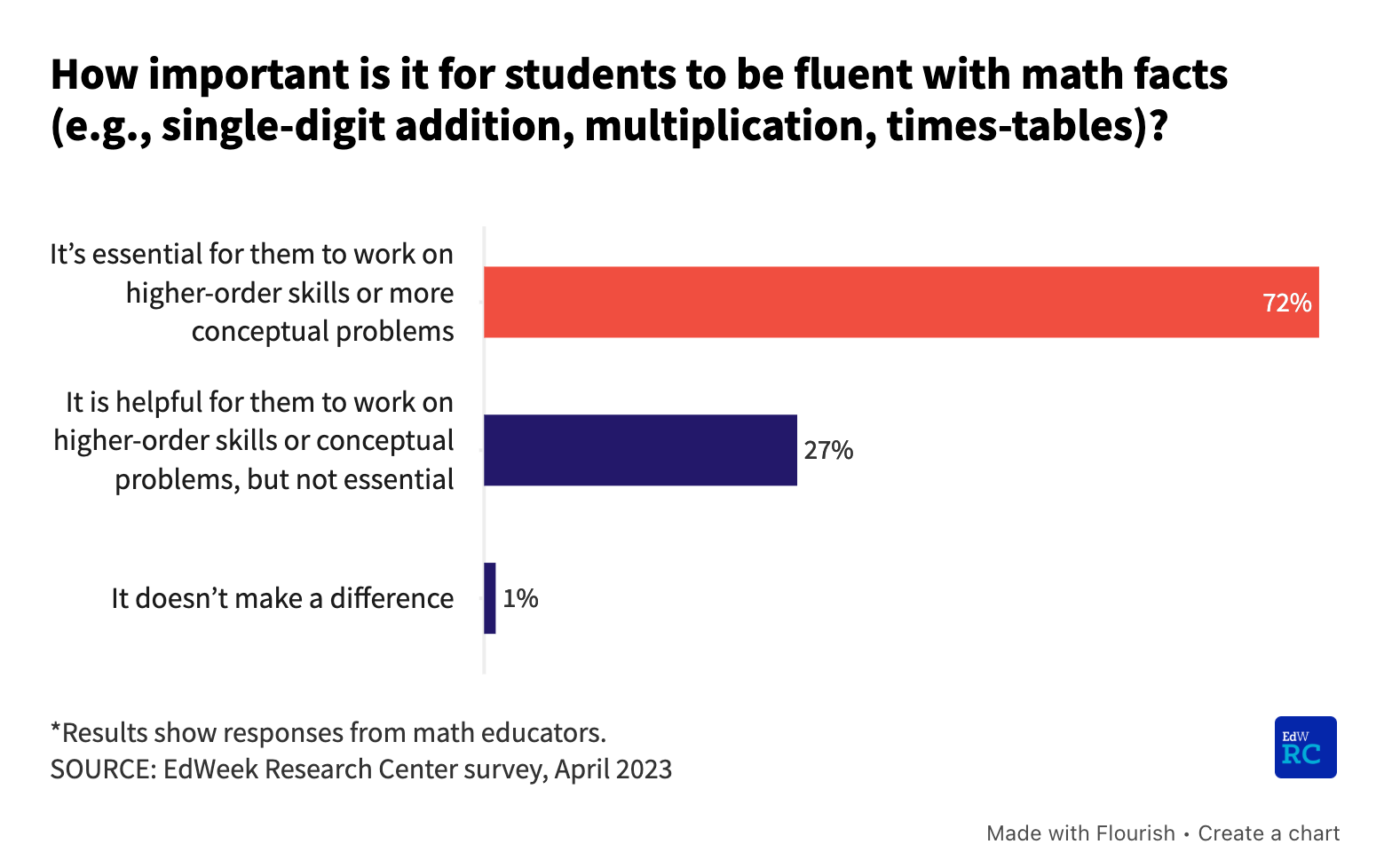
A good example of this is math fact memorization. There are endless articles explaining why math fact memorization is important. But when Education Week surveyed 300 teachers about math fact fluency, 72% said it was “essential” and 27% said it was “helpful” for future mathematical work—only 1% said it didn’t make a difference at all.

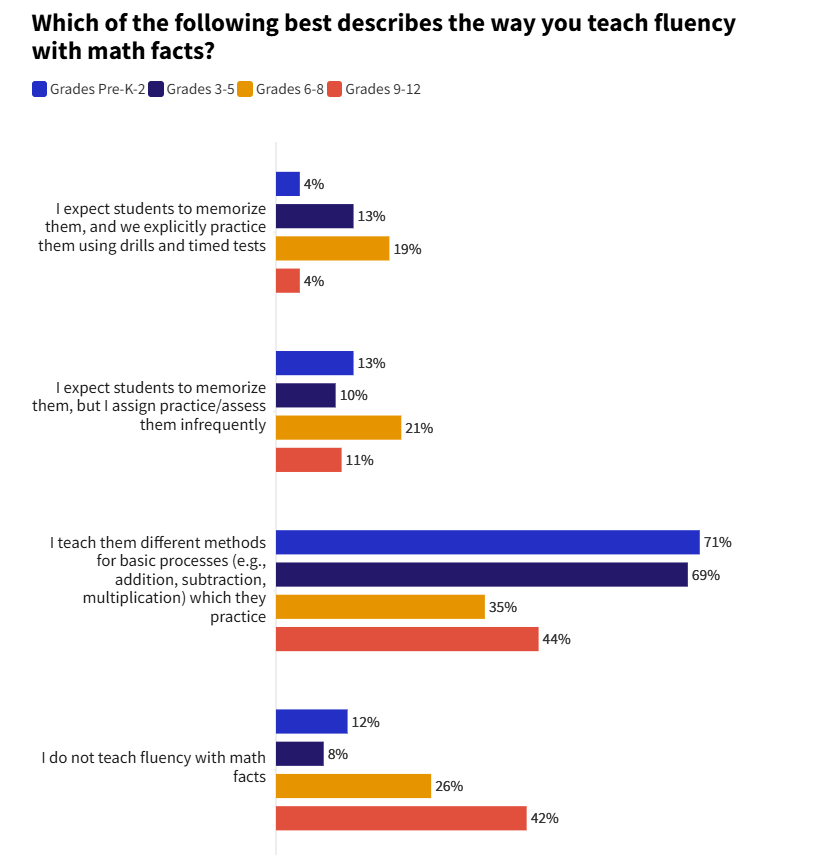
On that same survey though, EdWeek asked teachers how they taught math facts. The dominant response—just practicing the operations over and over again, hoping that they stick—matches my impression of what’s most common in classrooms. It’s unlikely to work for many kids.

Image

Back when I started teaching 3rd and 4th Graders, I had students practice things like 3 x 6 and 8 x 7 on paper a lot, over and over. The theory being, basically, how many times can you do the same thing without remembering it?

Heh. You know the answer, don’t you?

There are paths into New Jersey that I’ve driven a dozen times but could never in a million years recreate. There are two reasons for this. First, New Jersey is a highway hellscape and its exits were designed by psychos. Second, because I never truly rely on memory when we drive—I have Google Maps feeding me each step just in time.

In math also, kids likewise have alternatives to remembering. They can calculate. To learn facts by heart, we have to get students to rely more on their memory. (That’s why “practicing different methods of calculation” is unlikely to work.1) But how do you engineer a situation where students want to rely on memory, even though they’re (currently) bad at that?

“Oh, have you tried flashcards for this?” Yes, I have. I’ve spent a decade trying to make them work. But guess what—I’ve had it! Kids are constantly losing the decks or leaving them places. They also turn over the cards too quickly or (more often) too slowly. Plus, we need all these routines to handle situations where kids don’t immediately remember a fact: “Check the answer…say it aloud…place it next in your pile, then if you get that right…”

Thankfully, I finally have a sturdier routine, one that has uniform expectations that kids can more easily follow:

  • Study the Facts: If kids are going to practice retrieving a fact from memory, the facts need to be in their memory. That’s our first priority.

  • Whole-Group Practice: If we don’t practice remembering those facts right away, they’ll end up forgotten. Plus, I want to set the expectation that right now we should be answering these based on memory, rather than reasoning them out.

  • Individual Quizzing: Not a “quiz” quiz; just a low-stakes chance to practice remembering this stuff on your own.

Here’s what this could look like in detail.

Study the Facts

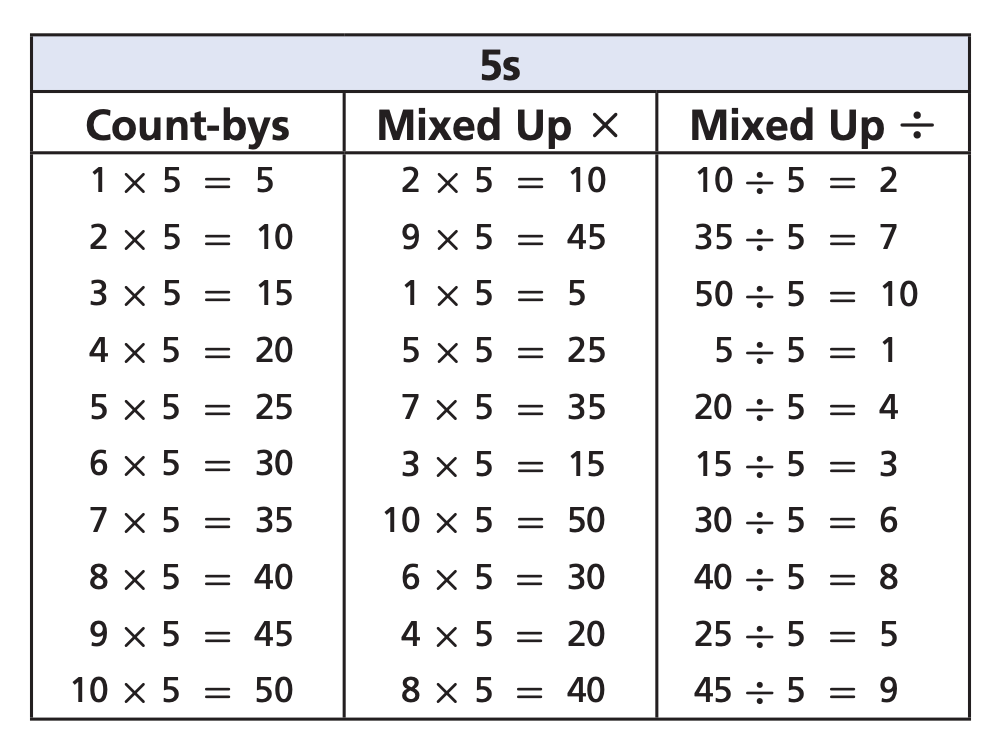
The curriculum Math Expressions makes these wonderful study sheets for math facts. They are intended for individual use. “To practice,” they write, “students can cover the products with a pencil or a strip of heavy paper. They will say the multiplications, sliding the pencil or paper down the column to see each product after saying it.”2

I tried to repurpose this for the whole group facing the board.

“I’ll say the multiplication, and you’ll say the product right back. One times five is…” We’ll go through that first column once. If you want a challenge, try not to look at the board.

Then sometimes I’ll launch a little discussion.

“What are some things you notice about the fives?” Students might mention regularities in the tens digits or that the ones digit toggles between 5 and 0. They might mention that half of 8 is 4, half of 6 is 3, and so on. There might be good math here, but I’m really just trying to keep attention on these facts a little bit longer.

There are other ways you might focus attention on these facts. You might have a more extensive choral shpiel. You might hand out this study sheet and ask students to do the Math Expressions thing — study each column, cover it with a finger or a pencil, then quiz themselves until it’s perfect.

My flashcard routines were missing this step, instead moving directly to quizzing without any studying first. That was definitely a mistake, but now I’ve fixed it.

Whole-Group Practice

If we don’t practice things right away, we often don’t remember them. One of my goals here is to give everyone a little quizzing before the memories fade. But it’s not just that—I’m also trying to set an expectation.

“We’re trying to know these by heart. I’ll show you waht I mean. Everyone, what’s 2 + 2?” Everyone shouts out 4, immediately. “OK, but what’s 14 + 9?” The response there is slower. We’re trying to learn single-digit multiplication by heart, the same way we know 2 + 2.

“Let’s see how much we remember,” moving the study sheet off the board. “Anybody willing to get put on the spot? Toby, thanks for being brave. Let’s see how much you remember.”

I ask for volunteers because I want to put on some time pressure, and they’re going to get some wrong. “Toby, what’s 5 times 5?” He answers, I give feedback. “25, good. Now, what’s 7 times 5? No, not 45. It’s 35.” I’ll loop back to questions, to show how learning and practice works. “That’s right, 2 x 5 is 10. Now let’s go back to this one. 7 x 5 is…?”

“Give yourself a pat on the back,” I’ll say to Toby. “Anyone else want to give this a shot?”

There are other ways you might do things at this stage. You might try whole-group, choral quizzing, where you basically do flashcard practice with everybody responding. You might cover up the products on that study sheet and call on students to complete them. I can imagine a lot of things working as long as there’s fast-moving practice involved.

Individual Quizzing

Everything up till now has been to make this individual practice useful. “Go to your seats and answer these questions. Let’s see how well you remember what we studied.”

But what if they don’t remember? Well, they still have the study sheets. “You can definitely check your study sheet if you can’t remember an answer. But try to check it as few times as possible, and keep it face down until you need it.” (Of course, I’m circulating the room, keeping an eye on everything.)

This whole thing takes 10-20 minutes.

**
Flashcards are a technology for individual practice. Their whole point is to be customizable and responsive to a single person’s needs.

Teaching a group is hard, so there’s a tendency to retreat to what works for individuals. Give everyone flashcards. Give everyone a computer. Every kid has a tutor. Every kid works on the app. This tendency is maybe especially strong in thinking about math facts, since they’re so heavily studied by special education and psychological researchers who tend to think in terms of individual support—the one-on-one intervention or study. The “Science of Learning” has a bias towards individual pedagogy.

This tendency should be resisted. Teaching a group is most viable when you’re able to teach them as a group. When you treat them as twenty single individuals, each on their own different path, the job also gets twenty times harder. Now, I’m not naive. I understand there are times when the different needs of students are too great for uniform expectations. But I think we’re often too eager to turn a class into a collection of individuals. Instead we can keep class vibrant, interactive, and engaging without asking everyone to retreat to their desks. The collective deserves more respect.

1

This became clear to me mostly through reading research about fact fluency routines. Shoutout to John Bransford and Ted Hasselbring, whose writing about early math apps in the 1980s I found clarifying.

2

This mode of practice closely resembles the cluster of fact fluency routines that are common in the world of math interventions. Brian Poncy’s website describes a few of these — Cover, Copy, & Compare, and Taped Problems. I think all these activities basically share the same logic as what I’m doing in this post.

Read the whole story
mrmarchant
1 minute ago
reply
Share this story
Delete

You Do, In Fact, Have To Hand It To The Ninja Creami

1 Share
You Do, In Fact, Have To Hand It To The Ninja Creami

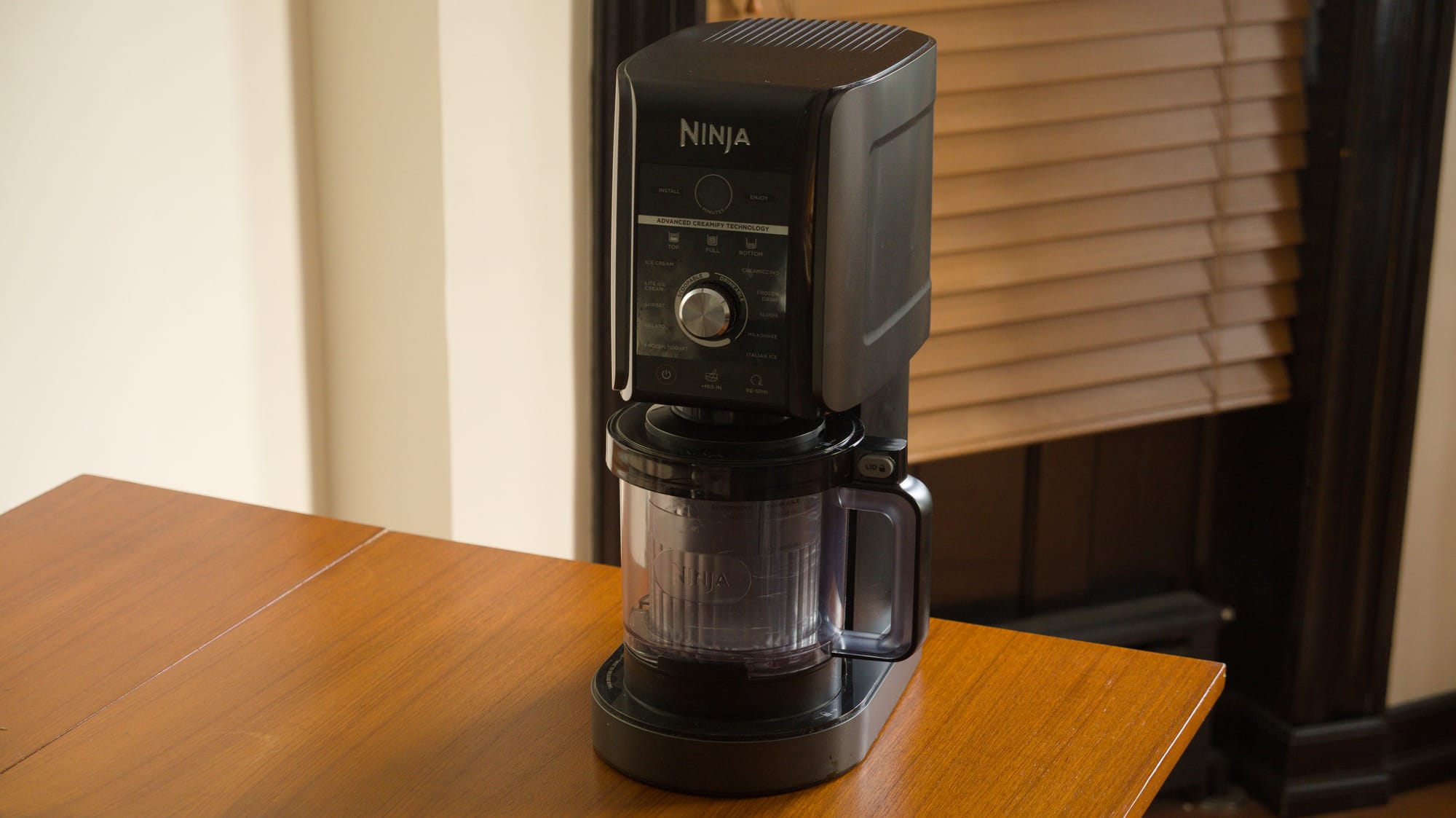
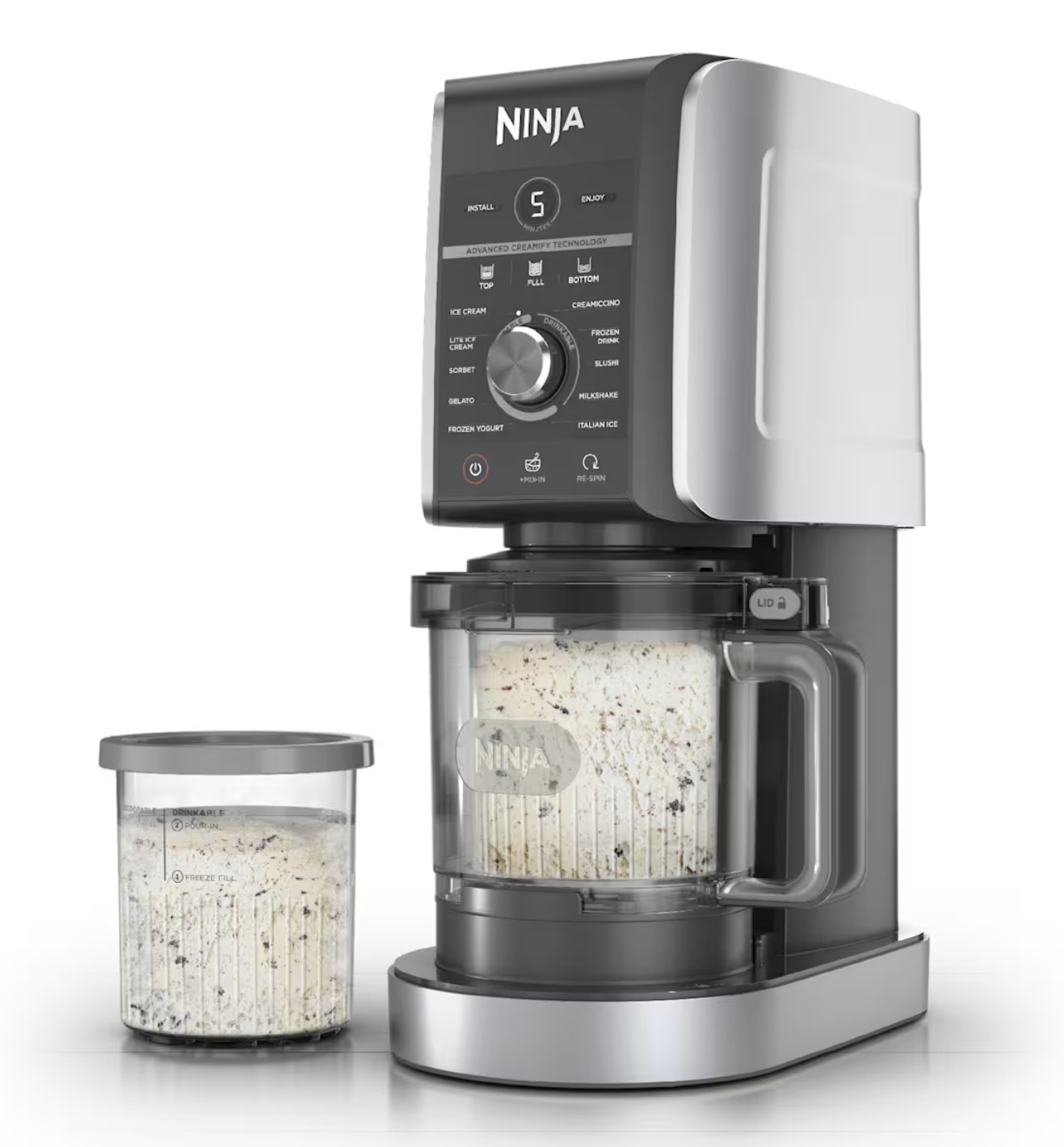
I do not want to give the Ninja Creami credit. It is not a handsome appliance; it’s built out of plastic, looks tacky and cheap, and generally feels like an unserious tool. However, it is also one of the most interesting pieces of consumer kitchen hardware to come along since the Instant Pot, a genuinely fascinating device that takes the mechanics of a high end $6000 machine and simplifies it to something that nobody can fuck up and basically anybody can buy. It is by far the most forgiving ice cream machine on the market, and is capable of creating frozen treats that should not exist. You do, in fact, have to hand it to the Ninja Creami.

Baby's First PacoJet

You Do, In Fact, Have To Hand It To The Ninja Creami
The Ninja CREAMi XL Deluxe makes more volume per pint than the base model. Costco has a special deal that makes it cost about 30 bucks less, and they have a generous return policy for things they sell.

To understand why the Creami is weird you must first understand how a normal ice cream machine works. A traditional ice cream machine works by chilling the sides of a chamber, often but not always with something akin to a small refrigerator. The sides of the machine are cooled and arms (called a dasher) rotate to churn the poured ice cream base. The ice cream base then freezes against the walls of the machine and is scraped off by the dasher. The repeated freezing and scraping forms tiny ice crystals that then form the structure of the ice cream. 

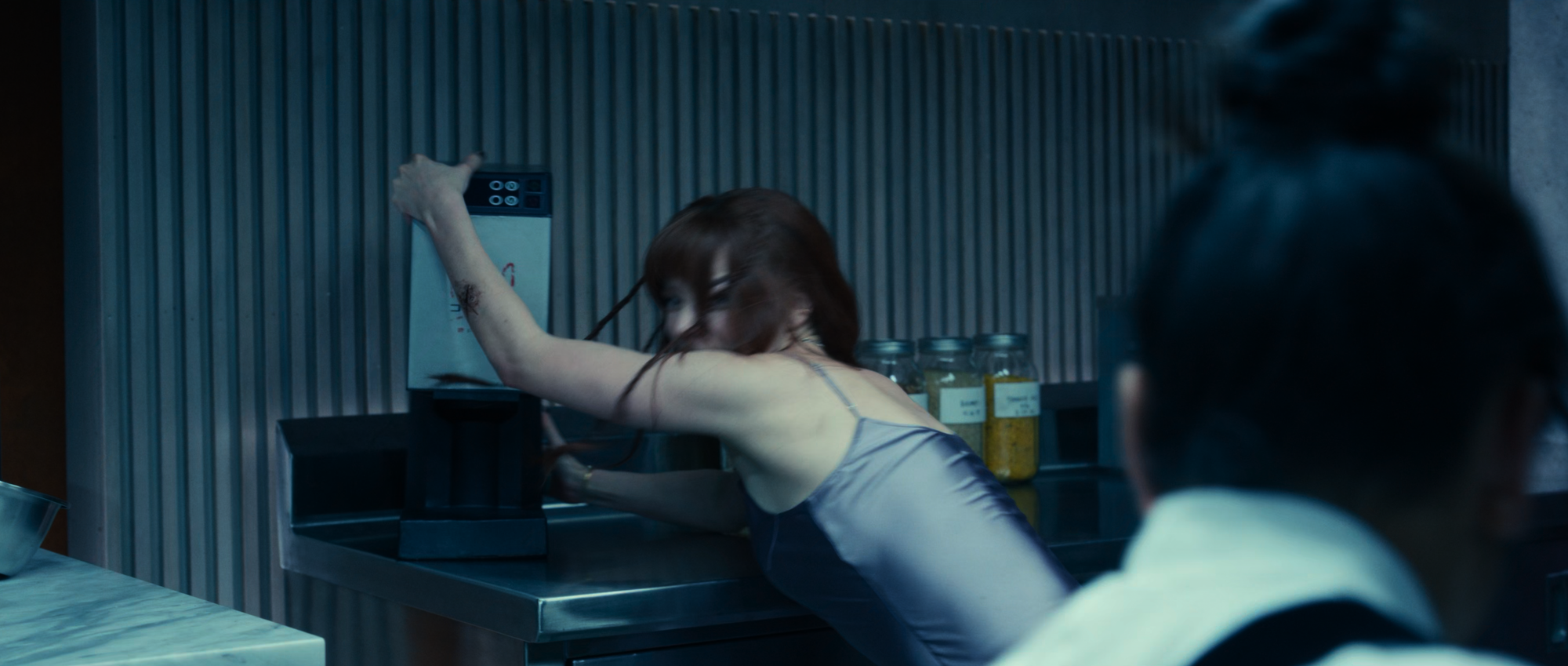
The Creami works in an entirely different and frankly bizarre way. It is a simplified version of a machine called a PacoJet, an commercial kitchen product whose patent lapsed in 2017. You may be familiar with The PacoJet if you have ever seen the 2022 dark comedy The Menu, as it is an obsession of the character Tyler (Nicholas Hoult), a high end restaurant groupie with too much time and money on his hands who does not actually know how to cook. A PacoJet is basically a big ass drill press that takes metal canisters full of ingredients and turns whatever is in them into a paste. It has many uses like making soup but is often used to make ice cream. You make a mixture, freeze it overnight, then put it in the PacoJet, and a spinning blade pulverizes the block of ice into ice cream. 

You Do, In Fact, Have To Hand It To The Ninja Creami
The Pacojet 2 Plus as it appears in the The Menu [2022], dir. Mark Mylod Credit: Searchlight Pictures

Ninja seized on the opportunity to knock it off when they legally could, simplifying the entire process and focusing exclusively on the ice cream part. Though not as powerful a machine, it costs less than $200 dollars instead of $6000. The resulting machine has many advantages over a traditional ice cream machine, the biggest one being sheer convenience. Because you are freezing the mixture in a refrigerator that you already own instead of buying a second tiny refrigerator (or in the case of the $60 Cuisinart Ice-21, freezing the bowl overnight), the footprint of the machine is far smaller. I have an immersion blender and so I’m able to bang out several batches at once in the pint containers themselves, freeze them, then toss them in the freezer for the next day. And because the mechanism by which the machine makes ice cream is inherently different, the ideal sweet spot for fat in mixtures is lower than in a traditional ice cream machine. It’s no wonder that diet freaks have come to love the Creami.

I buy my mysterious food science ingredients from these guys. They have a celiac-specific baking powder that rules if you need to bake something gluten free.

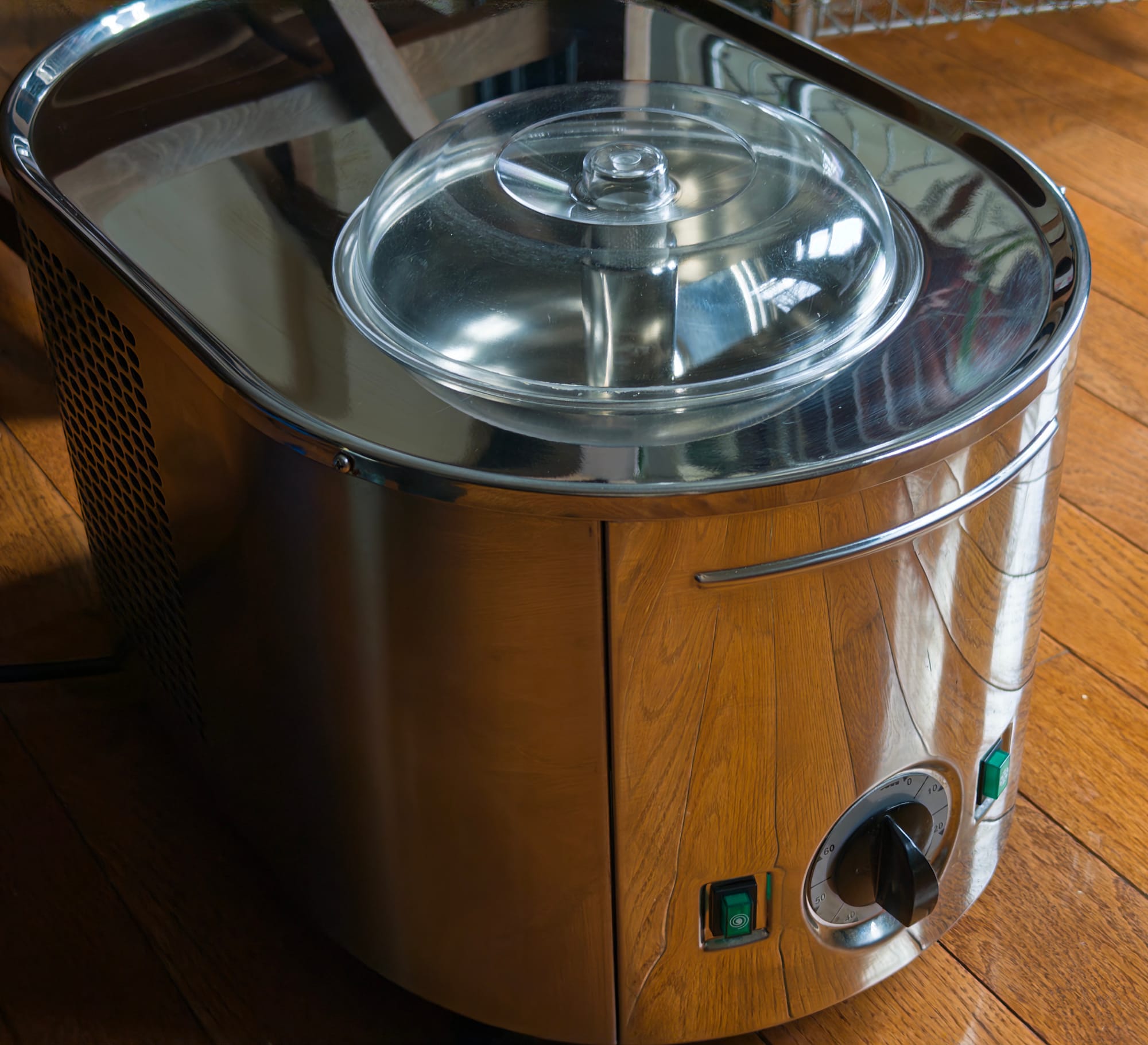
This is not to say that you can just throw whatever crap in a Creami pint and turn it into ice cream, though you’d be shocked at how well that produces something edible. A proper, well-crafted recipe will positively sing in that machine. In fact, learning how to properly make ice cream the traditional way will benefit you a lot in crafting your recipes, and it’s a fun skill to learn. Before I had the Creami I owned the Ferrari of consumer ice cream machines: the Lello 4080 Musso Lussino. I had gotten a deal on it second hand from a guy in midtown who had purchased it for his stalled protein ice cream startup. The Lello Musso is a beautiful machine: all steel, sleek Italian design, one of the most beautiful pieces of equipment I have ever owned. I loved learning to make ice cream on the Lello Musso because it taught me exactly how to make ice cream the right way.

You Do, In Fact, Have To Hand It To The Ninja Creami
Love you sweetie, I miss you.

Though it was a stunning machine, it was also huge, heavy, loud, and cumbersome, requiring a lot of prep work and time to churn. If you are making real ice cream to serve in a commercial setting, the Musso and its big brother are your first steps before you get into real kitchen equipment. But for the most part, it collected dust in my pantry because it’s a 38-pound mini fridge and was a huge pain in the ass to take out and put away. When my curiosity about the Creami got the better of me, my beautiful and correct girlfriend said, “if you get this thing you have to sell the other one,” and so with a heavy heart I sold my baby to a chef who lives down the street for exactly what I bought it for. I can see it behind the counter of his restaurant whenever I walk by.

The machine in action. If you own a small business and occasionally make ice cream, it's a great machine. It costs $799 retail and the next step up is its big brother.

I have been eyeing the Ninja Creami for several years now with morbid fascination, well before it blew up on everyone’s TikTok FYP. The thing that got me was that the close friend of mine who had taught me how to make ice cream years ago caved and got one. He was shocked at what he could get out of it for a fraction of the time investment. We both have a deep and unabiding love of weird food chemistry, trading notes on various weird gums and additives, and I think neither of us wanted to admit that something as corny, flimsy, and cheap as this could be everything it claimed to be.

Content warning: The following section discusses dieting culture. 

Food Chimeras

Over the years I have spent an inordinate amount of time fascinated with what I can only describe as “bodybuilder molecular gastronomy:” that weird kind of meal preparation that is more formulation than cooking and which creates something that can only charitably be described as food. It is a deeply American obsession to create a cruel mockery of a real dish using tricks, hacks, and cheats, trying to get as close to a real meal without including any of calorically dense or unhealthy elements that make it “taste good.” A similar impulse exists with vegans, although it reaches its apotheosis with lifting and gym culture specifically, the results of which you have probably seen on TikTok. If you ever want to see something unholy, look up the bodybuilding forum creation known as Protein Fluff, an ancient internet mixture of whey powder, diet soda and xanthan gum that looks like the imaginary meal the kids in the movie Hook ate that was just brightly-colored frosting.

There's like five million channels called like "the ripped kitchen" that make stuff like this. I have a weird nostalgia for this stuff because it's wrong, but it's also how you get MAHA shit.

Despite tasting objectively mediocre, I think the success of Halo Top really screwed a lot of people up. Ice cream is the holy grail for the food sensitive and fitness freaks because it tastes great but generally requires animal products, fat, and sugar to taste anywhere close to correct. Replacing those ingredients takes constant trial and error, precisely calculating and formulating based on tried and tested calculations. But the science has advanced light years in the last few decades, and vegan ice cream chemistry has gotten alarmingly good to the point of being on par if done well.

You Do, In Fact, Have To Hand It To The Ninja Creami
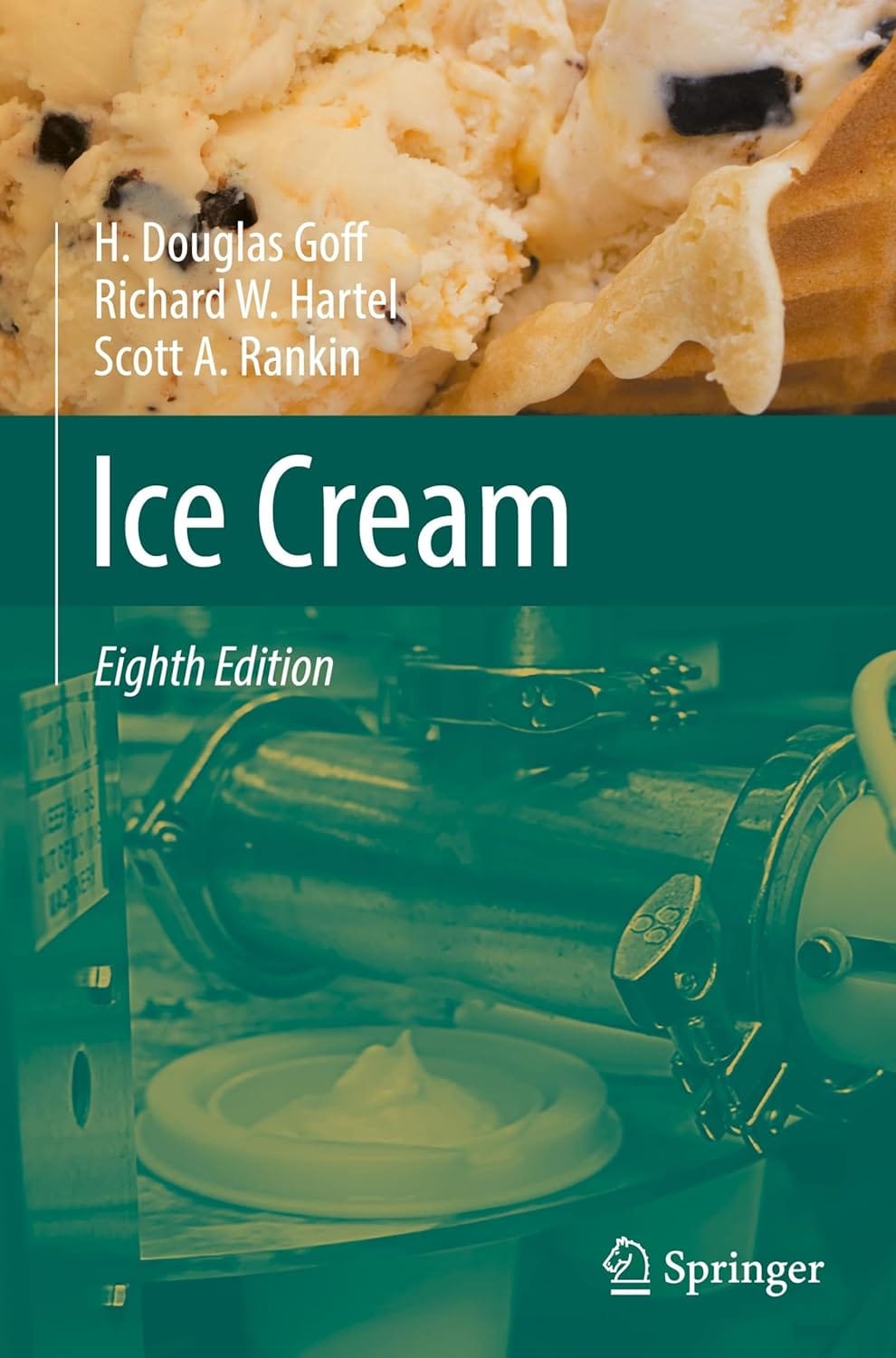
If you want the not screwing around academic textbook on the subject, the book "Ice Cream" is the one. I briefly emailed Richard Hartel while writing this piece and they've got a Creami they're playing with in the lab. Credit: Springer Nature

There are many recipes for the Ninja Creami that flat out suck. The ones in the included recipe book are less than great, and the formulations that are produced by an enthusiastic fitness guy telling you to dump a can of sliced pineapple in the pint canister are generally unserious. There are entire fields of food chemistry study devoted to this, and the most extensive book you can read on the topic is simply called Ice Cream, now in its eighth revision (two of the authors work at University of Wisconsin’s Food Science Department, known for its severely bangin’ ice cream shop). The Ice Cream Science blog from a while back has a good Tres Leches. Many of the recipes on the PacoJet website apply to the Creami, and they have many freakish molecular gastronomy recipes like Campari Sorbet, Mustard, Lassi (this one is VERY good), Porcini Mushroom, and Kale. Polar Ice Creamery has an entire playlist on YouTube I can recommend. There’s also a very dedicated and passionate subreddit around the machine. Jürgen Hermann, a prominent user on that subreddit, has attempted to organize a knowledge base around formulating recipes specific to the machine. It is worth noting this project makes extensive use of AI, both in its imagery and in how it uses a Google NotebookLM workspace to manage replacing ingredients. I personally prefer to craft my ice cream recipes through trial and error and assume that many other people feel similarly, but it’s still fascinating that something like that exists as a personal project around a weird ice cream machine you get at Costco. 

Polar Ice Creamery is just a very solid DIY channel and walks through his reasoning.

Over the years I have collected a ton of bizarre ingredients in my pantry in the pursuit of healthy treat science. Allulose is a big one, a rare form of sugar that doesn’t spike your blood sugar and is mostly undigested. It’s 70% as sweet as table sugar and if you eat too much of it you can get an upset tummy, but it works great in conjunction with other sweeteners. Because it’s sugar it forms ice crystals correctly, and it’s also a humectant, which is extremely useful in crafting ice cream. Tara gum is another big one, a thickening agent like guar and locust bean gum that imparts a creamy texture to whatever you put it in (although it needs to be heated to be properly activated). There’s also Quillaia extract and Yucca extract, which are both used in Sugar Free Slurpees and as foaming agents to give root beer that weirdly specific head it’s known for. I love nothing more than getting a package containing a baffling ingredient from Modernist Pantry that makes ice cream solidify at warm temperatures and melt when you cool it down.

After bringing the XL version of the Creami home from Costco, I banged out many different low sugar recipes, getting more daring and weird as I went on. The aforementioned Lassi was a delight. Cacio e pepe was alarming and tasty, a mild and sweet parmesan taste with an occasional peppery bite. White Monster Energy with fresh Strawberries (inspired by this post) was not bad. I had previously inherited a collection of food grade soda flavorings including Baja Blast from a friend after he had to stop vaping for health reasons. I keep them in two airtight containers in my pantry because opening it is like getting punched in the nose, but they proved extremely useful with the Creami. 

Strawberries and White Monster Energy sorbet is a confirmed banger and sugar free (not counting allulose).

Chris Person (@papapishu.bsky.social) 2026-01-20T22:57:12.917Z

White monster strawberry is honestly good as hell.

Once you get a base recipe down that you like, the sheer convenience of the device makes it easy to iterate, figure out where you fucked up and then modifying your recipe. The machine stores away far easier than my Lello Musso ever did, and in a few weeks I put more time into the Creami than I had with the Musso.

Seeing what sweet treats the Ninja Creami subreddit is cooking up.

Chris Person (@papapishu.bsky.social) 2026-01-13T22:37:05.775Z

OK this is bad but there is actually a recipe on the official Pacojet website for this. This supports my thesis that forum weirdos and high end chefs are functionally the same.

The Creami is not perfect. I miss the cold, mirrorlike steel of the Lello Musso, with its tactile analog timer that cranks exactly like an egg timer from the 1950s. I find the plastic design of the Creami tacky, a toylike design ethos that makes it feel like a disowned bastard of Dyson. I wish that the name of both the brand and the device, particularly when combined, did not make me shudder a little. I wish the Creami could handle what the PacoJet can handle. I wish the motor was just a bit more powerful, and that it had the indestructible heirloom feel of a Vitamix blender or a KitchenAid stand mixer. I wish it was easier to disassemble and deep clean, particularly around the piston. I would spend just a little more money for something a bit more serious, a little less embarrassing. But at its price, nothing is doing it like the Ninja Creami.

Since it became a viral hit, I have also seen several traditional outlets attempt to grapple with its popularity, and across the board all of the writing has the exact same begrudging and condescending tenor of a writer on assignment. They understand the machine’s relationship to the PacoJet and occasionally touch on the bizarre diet culture that surrounds it. They often follow the horrible recipes in the book, treat it identically to a normal ice cream machine, or downplay its cultural importance as a flash in the pan viral sensation. But while the relative virality of the device is what rocketed it to fame, much of the traditional media misunderstands the specific way in which the device is important. The Ninja Creami is not simply a weird ice cream machine, but rather the Costco-ificaiton of decades-old molecular gastronomy forum culture. It shares more in common with the Instant Pot or a sous vide culturally than older ice cream machines, allowing for specific styles of food preparation previously inaccessible to normal people. To misunderstand its purpose, its capabilities, or its fanbase is to fundamentally dismiss something actually noteworthy as simply some TikTok bullshit. Do not take the Ninja Creami lightly; it is not going away.

Read the whole story
mrmarchant
4 minutes ago
reply
Share this story
Delete

Who Goes AI?

1 Share

It is an interesting and somewhat macabre parlor game to play in the media business: to speculate who will go AI. By now, I no longer need to speculate. I have gone through the experience many times—with book reviewers, with tech reporters, with columnists. I have come to know the types: the born sloppers, the sloppers whom journalism itself has created, the soon-to-be-pilled. And I also know those who never, under any conceivable circumstances, would go AI. Let us look around the `net.

Take Ms. L, for instance. I don’t know that she’s ever publicly said so, but I will put my hand in the fire that nothing on earth could ever make her go AI. She’s written about the AI industry, and certainly sees clearly what’s wrong with it. But that isn’t the reason. Ms. L has been a correspondent in finance and technology for many years—she is as poached in these torrid waters as any journalist alive. It is not for ignorance that Ms. L will never go AI.

No, she will never go AI because the machine mind has nothing in it to approach what is already present in her own human mind. The machine pen has nothing to offer her life or her career. What use has she for a large language model’s mediocre ideas? She already labors beneath the weight of a stock of ideas far better than AI could produce, and larger than she could ever use. Even more, she has put in her time as an editor for other writers, and developed the skills and habits of mind to critique her own work. She does not require a mechanical red pen. And if a red pen is necessary she can always rely on her human colleagues for editing, such as Mr. P, who has already proven much superior to his own AI facsimile. No. Ms. L writes for the love of writing and publishes for the pleasure of sharing correct opinions and correcting erroneous ones. AI could only detract from that. Ms. L will never go AI.

You might think Mr. R not so different, superficially, from Ms. L. He’s also a long-tenured technology columnist at a respected mainstream publication. And yet he has eagerly, even gleefully, turned flack for the machines. He has delegated much of his professional life to them as well, and seems proud of it:

And why not? Mr. R is not known or valued for his elegance of expression. He has, at best, a “writing style,” and not one that can’t easily be duplicated by a large language model. Checking facts? Assessing his work’s strengths and weaknesses? More bathwater to be tossed out of this increasingly baby-less tub. So what explains Mr. R, who “expects AI models to get better than him at everything eventually?” Why does he go AI when Ms. L never would?

Mr. R’s secret is that his work is not primarily artistic or informative—it is functional. He serves a purpose for the industry he covers. Mr. R’s job is to absorb the tech industry’s self-mythologizing, and then believe in it even harder than the industry itself does. He serves as a kind of plausibility ratchet. His byline and employer legitimize a level of credulousness that would otherwise be laughable, and thereby allow tech PR to seem relatively restrained. Mr. R has no problem going AI because he himself has been a small cog in a big ugly machine for a long time.

Ms. R (no relation to Mr. R) brings us news of her former colleague Ms. M, who has casually admitted to going AI apparently against the policies of her employer, another national newspaper hemorrhaging both staff and readers. Ms. R writes that:

This is surely the first time Ms. M has been accused of “intellectual heavy-lifting.” Nevertheless Ms. R, who it goes without saying will never go AI, disapproves:

But after twenty-five years of dumb opinions clumsily expressed, is it any wonder that Ms. M is happy to turn over that labor to a device? AI couldn’t be worse at her job than she is, and anyway, being incompetent has never proven any hindrance in her grimly illustrious career filling the endowed Libertarian chair at a range of publications that wanted to help their other conservatives appear serious and thoughtful, if only by comparison.

Mr. N, on the other hand, will never go AI which we can admire about him. But he seems to have reached that correct conclusion via a chain of understandable but regrettably mistaken premises:

Ah, Mr. N! A good man. A hardscrabble labor reporter, a stalwart friend of the human worker. Nevertheless he doesn’t realize that despite its rarity, the supply of good writing always and everywhere far exceeds the demand for it. Mediocrity is no impediment to success—in fact it’s at least marginally preferred by what remains of the reading public. But whatever his romantic notions, Mr. N will never go AI and that’s what matters. Mr. N cares about his work.

II

Taking a rapid survey of the remainder: Ms. B will never go AI. She finds it “super embarrassing to me, and pitiful…”. Speaking of embarrassing, Mr. A.P. pays so little attention to his work that he didn’t even notice when AI cribbed from the Guardian for a book review it published under his name in The New York Times. “Can Art Compromise With Fascism?” asks the title of “his” review. Indeed. Mr. L onanistically confuses volume for value: “One Wednesday in February, he cranked out seven.” He could be replaced with a cron job hooked up to PR Newswire, if the traffic model of media funding were still viable enough to justify it. All the editors of website W decided together that they will not go AI, because otherwise what is even the point of website W. A different Ms. B denies going AI for her novel, but readers are unconvinced. Is it worse to get caught going AI, or to generate AI-quality prose with your own hands? Ironically Mr. M, who resentfully claims uncredited contributions to the reporting on this second Ms. B, has enthusiastically gone AI himself.

III

It’s fun—a macabre sort of fun—this parlor game of “Who Goes AI?” And it simplifies things—asking the question in regard to specific journalists.

Kind, good, happy, secure people never go AI. They may be the hard-working columnist, the former blogger, the independent media entrepreneur, or the virtuosic book critic—you’ll never make sloppers out of them. But the bored pseudo-intellectual, the rich and scared speculator, the fearful ink cannon, the fellow who has achieved success by smelling out the wind of success—they would all go AI in a crisis.

Believe me, good writers don’t go AI. Their race, color, creed, or social condition is not the criterion. It is something in them.

Those who haven’t anything in them to tell them what they like and what they don’t—whether it is experience, or happiness, or wisdom, or a code, however old-fashioned or however modern, go AI. It’s an amusing game. Try it with the next big industry you work in.


My apologies to Dorothy Thompson, who wouldn’t go AI in a million years, and from whom I stole both the premise and structure of this post and virtually the entire third section, which noticeably did not require much adjusting. “Good artists copy, great artists steal.” I said that.

I will never go AI, and paid subscribers ensure I will never have to.

Read the whole story
mrmarchant
32 minutes ago
reply
Share this story
Delete

Five Friends Make School Matter to Kids

1 Share

Lately, I’m working in two kinds of classrooms: ones where the teacher makes good use of digital devices and the other where the teacher makes good use of paper. I’m noticing the same challenge in both classrooms: students come to believe their effort doesn’t matter.

They know they can complete the next slide or not. They know they can answer the next workbook question or not. They know how to hide. Whether they’re working on screens or paper, they know how to look busy and when.

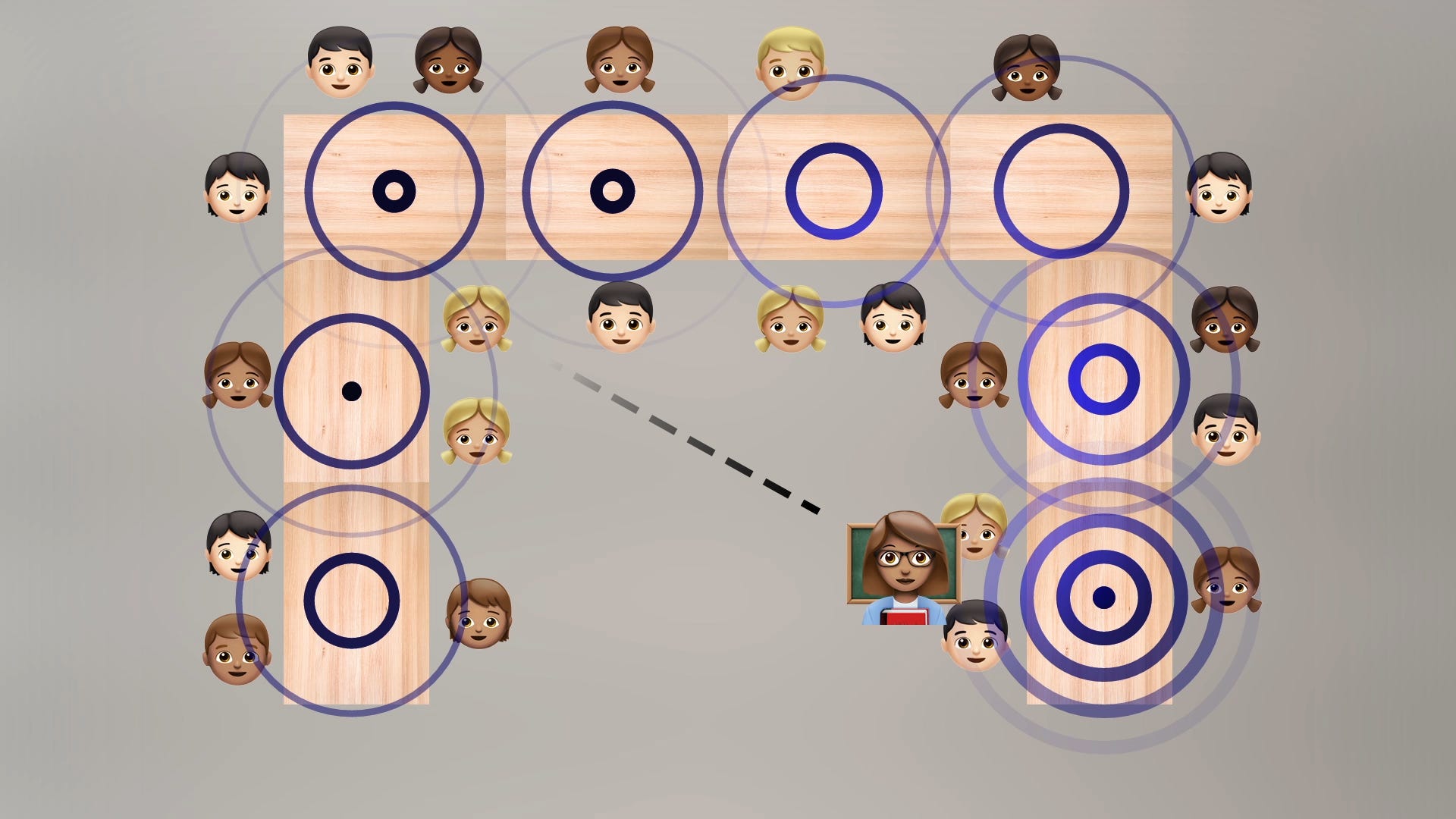
I’m watching the teacher circulate around the room. As she moves, every student inside a two-desk radius locks in on their page, brows furrowed, scribbling or typing, but when the teacher moves on they relax.

A teacher has walked away from a group of students who were working hard. Now they are not.
This is what it’s like.

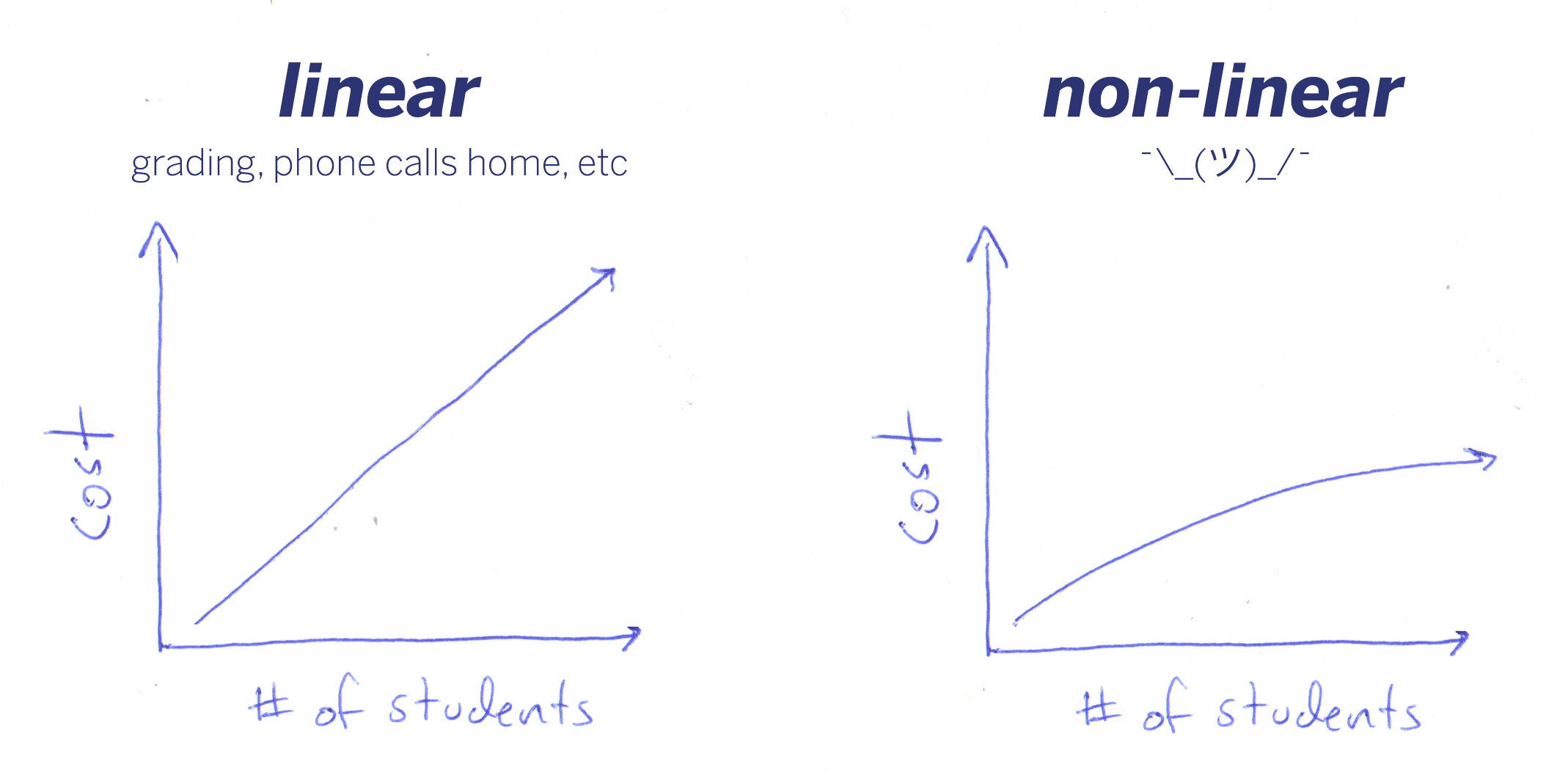
This is the challenge—making difficult cognitive work matter to kids. Teachers have lots of responses to that challenge, but most of them scale the time cost linearly with the number of students. Checking in with students in class. Grading each warmup. Grading each student for participation. Calling home. Grading all the essays. Double the students and you double the time cost for each of those interventions. This is burnout. Teachers need non-linear responses here, responses where doubling the students costs something far less than double the time.

A graph that shows a linear and non-linear graph of the cost of an intervention and how it scales with the number of students.

“I have been struggling with this post-COVID,” veteran educator Nick Corley told me recently. “The number of students who only work when watched or for a grade has increased significantly. I’d love to hear what is working for others.”

Five Friends

Me too, Nick. So I pulled in five friends—veteran educators, coaches, total pros, and asked them:

What is a reliable way you can let a bunch of students—students who outnumber you 20 or 30 to 1—know that their effort, their work matters?

Zak Champagne taught elementary math for years and recently became Chief Content Officer at Flynn Education. He said the key to getting kids to sustain their effort with students was giving kids permission to stop sustaining their effort.

Now this might sound counterintuitive, right? Walking away from a math problem sounds like they don’t have to show effort. However, it was my experience that when the young people in my room knew they could walk away, they were less likely to do that. And they would spend more time working through the tough stuff. Sometimes just knowing you have the option to walk away from something is the very thing that keeps you going. And providing that option communicates to them that you trust them.

Katrine Bryan has been a secondary math teacher in San Luis Obispo County, CA, a math teacher coach, and I’ve showcased her teaching here before:

Moving away from a viewpoint focused on teacher knowledge to a stance that celebrates student voice and student actions will build the foundation, showcasing that what a student does matters: to the teacher, to their peers and ultimately, to themselves.

Pam Seda has held down jobs from classroom teacher to district math supervisor. She consults and recently co-authored the book Choosing to See: A Framework for Equity in the Math Classroom, which seemed relevant to my question.

Students learn that their work matters when the audience shifts from the teacher to their peers. When a classroom moves from a group of individuals to a community of learners — where anyone can be an expert and anyone can contribute to the group’s collective knowledge — the stakes become real.

One example: when students do group work, instead of asking each group to present their own process to the class, have the class speculate about how a group was thinking based solely on the work they see. No presentation, no narration — just the work, doing the talking. In this way, the phrase “make your thinking visible” becomes far more meaningful when students know their peers — not just their teacher — are the ones doing the reading.

Dylan Kane is one of the most thoughtful and discerning math educators around, one who teaches at a high level and still somehow has energy to share his thoughts at his newsletter:

I think really hard about the first things students do when we’re launching into a new activity to build momentum. I often start with a simple, straightforward question on relevant prior knowledge, and ask students to answer on mini whiteboards. Students are most likely to see their learning matters when I meet a few basic conditions: I build off of what they already know, I begin with something students can do successfully and that makes them feel smart, and I check to make sure students are learning and adjust when they are not. Mini whiteboards are the best tool I’ve found to help me meet students where they are, adjust on the fly, and build momentum at the start of class.

Tracy Zager is a former classroom teacher, current coach, author of Becoming the Math Teacher You Wish You’d Had, and perhaps most importantly, the editor of my book (still forthcoming):

I need to do the slow and careful and authentic work of creating a community where each student’s thinking and work really does matter–to the student, to their classmates, and to the learning of the class as a whole. My first thought is there are three big components:

  • I need to choose curriculum and tasks that are worthy of my students’ time and thinking.

  • I need to give a why behind everything we do–what is the purpose? If I don’t have a good purpose for a task, into the bin it goes.

  • And I need to teach students how to listen and learn together.

Three of my five friends name the same solution—community development—the slow, halting process of investing one student into the presence and ideas of another. This strikes me as one of those non-linear responses. As the class size grows larger, so too does the size of the community, the number of people who are, potentially, vested in your work. It’s also a solution that runs counter to the prevailing wisdom that what these kids all need is their own individual AI tutor.

I’m trying not to be a reactionary here, complaining about Kids These Days and yelling at clouds, but there does seem to be a dramatic vibe shift post-COVID that I am sure is multi-faceted and I’m grateful to these five friends (and anyone in the comments) each working to understand that shift and work to change it.

Thanks for reading Mathworlds! Put your email in the box to get a new post about teaching, technology, and math on special Wednesdays. <3 -DM

Odds & Ends

Tim Daly recently brought useful data to the question of what it takes to get kids to try hard.

What makes kids try harder? Teachers, mostly. Strong teachers motivate students to elevate their effort as the material gets more challenging. A positive school culture - the sum of many teachers and support staff aligned to the same standard - ensures consistency across classrooms and magnifies the effect.

EdSurge reports on a perspective towards AI among teachers that I also find quite common—not optimism, not pessimism, just indifference.

When teachers consider introducing AI tools to students during class time, the calculations they make change. The relevant question becomes: What student learning problem does this tool solve? Many educators are still trying to answer this question, even after several years of exposure to generative AI in some capacity.

Bill McCallum, a lead author of the Common Core State Standards and the Illustrative Mathematics curriculum, is publishing a newsletter. In a recent post, he re-opens a 20-year-old paper from Sweller, et al, celebrating direct instruction and criticizing discovery learning. McCallum checks the citations and finds something interesting in Sweller’s praise for worked examples:

Here is the irony. The strongest evidence-based use of worked examples—carefully designed, presented in contrasting pairs, with structured opportunities for analysis and discussion—looks a lot like the kind of instruction that Kirschner et al would dismiss as constructivist-based minimal guidance. It manages cognitive load, yes, but through thoughtful task design, not by eliminating the need for student reasoning. It is, in fact, a form of productive struggle.

¶ Just a bonkers survey out from RAND. Student use of AI for homework help is up 14%. The majority of those students use AI in spite of their belief that it’s hurting them:

As of December 2025, 67 percent of students endorsed the statement “The more students use AI for their schoolwork, the more it will harm their critical thinking skills” — up more than 10 percentage points from ten months earlier.

Peps Mccrea writes about the ways lesson plan design and user interface design inform one another.

The principles behind great UI are often relevant to the classroom. We could even think of teaching as Learner Interface Design. Here’s what that looks like:

Teachers have to think ten steps ahead of 30 other people, imagining dozens of possible futures, many of them quite bad. It’s fantastic preparation for the work of designing technology.

Read the whole story
mrmarchant
8 hours ago
reply
Share this story
Delete

Be Weird

1 Share

Teaching is weird. More specifically, humans are weird, and teachers spend their days trapped in a room with a bunch of little humans. Weird things happen.

Fierce Feats of Problem Solving

I shared a classroom with an English teacher over a decade ago who did something he called “Fierce Fridays.” I don’t remember the details, it was some type of close reading routine. And to get students excited, each Friday he would show a picture of something “fierce.”

Fast forward to today.

I adapted the idea into what I call “Fierce Feats of Problem Solving.” I wrote a few months ago about how I incorporate math puzzles, games, and problem solving activities into my classes. Before we do these, I frame the activities as “Fierce Feats of Problem Solving” and show students a picture of something fierce.

The first fierce picture of the year is always this one:

Environment.Exit – don't use it | Coding IT

I use all sorts of pictures. Humans, animals. Whatever. If it looks vaguely fierce, it’s in.

Over time, students started contributing. They send me pictures of their pets, or their younger siblings, or weird memes. I’ve accumulated a massive collection of fierce photos. Now I sometimes get stuff like this in my email inbox:

I think a student opened this weird double baby picture on their cracked Chromebook screen, then took a picture with their phone and sent it to me. I don’t know what it means. Probably my fault for showing a picture of a fierce baby.

If You’re Not Cracking...

Like many teachers, I love lame little catchphrases. Something I say sometimes is “Let’s get cracking,” as in “Let’s get started.” I think that’s a pretty normal phrase. Check me for a second here. Am I right? Does “get cracking” mean “get started” in this context?

My students this year told me that “cracking” actually means “to do crack.”

Now let’s be clear. My students are wrong. That is not what “cracking” means. I will not let a bunch of 12-year-olds change the meaning of a cherished phrase.

So I turned it into a little call-and-response. As class starts and students sit down to begin their Do Now, I say, “Let’s get cracking! If you’re not cracking...” and students (reluctantly) respond, “you’re lacking!”

Bootytickled

Ok this one is really weird. Brace yourself.

My students recently started saying “bootytickled.” Bootytickled seems to be a synonym for “bothered,” so “Bro why you so bootytickled” would mean something similar to,“Hello friend, why is this bothering you so much?”

Anyway, students started saying that word. I requested they not say it. Seems reasonable, right? This is math class. We should be talking about math, not booties.

A student wondered aloud why I was so bootytickled by the word bootytickled. I observed that it was, in fact, a bit ironic. Turns out many of my students don’t know what “ironic” means, so I taught a little impromptu lesson about irony. I thought I was being clever. Teachable moment, amirite?

This was a mistake. By engaging sincerely with the idea of being bootytickled, I gave the word legitimacy. Now I can’t eradicate it.

Like many teachers I get frustrated or annoyed on a pretty regular basis. Word has spread. When Mr. Kane gets annoyed, make a joke about him being bootytickled.

Happily, this faded after a few weeks and students went back to making 6-7 jokes. But for a while, any time I was visibly annoyed with something, a student would comment that I was bootytickled. For me, it became a kindof weird little reminder. I would get annoyed at someone flipping their water bottle. A student would say, “Mister why you so bootytickled?” And I would say to myself, “Hey, I’m not going to let this bother me.” I would take a little moment to find serenity, push down the annoyance, take the water bottle, and keep teaching.

Be Weird

I don’t recommend copying what I do. Every teacher is weird in their own way. Let your personality shine through in whatever way works for you.

I do think there’s a lesson here. Lean into weirdness. Be human.

One of my perpetually unpopular opinions is that school is good. Age-graded classrooms, one-size-fits-all curriculum, and factory-model schools are easy to hate. Hate them if you like! School is far from perfect, but it’s the best we have. It’s the worst way of educating ever invented…except for all the others.

I think one key reason is the weirdness. A bunch of kids are required to come to my class every day and I give them some math to do. For 50 minutes they’re stuck with me and I’m stuck with them. All the inside jokes and weird little moments are what change an obligation into a ritual. Am I a complete loser in my students’ minds? Absolutely. But I’m a complete loser who students are, more often than not, willing to work hard for. That sounds pretty cool to me.

Read the whole story
mrmarchant
14 hours ago
reply
Share this story
Delete
Next Page of Stories