 Log in



The cultural battles over AI have broken down over predictable lines in the past few years, with critics rightfully calling out the big AI platforms for training on content without consent, recklessly building without considering environmental impact, and designing platforms that are unaccountable because their code and weights (the parameters that describe how an AI model works) aren’t open for third-parties to evaluate. The AI zealots have done themselves no favors, by not only dismissing all of these valid criticisms, but by also making increasingly outlandish and extreme claims about the capabilities of the Big AI platforms, while simultaneously scaremongering about the brutal effect they’ll have on people’s lives and careers. It’s no wonder the public sentiment about AI has become so negative.
But a small cohort of us who are curious about LLMs as a technology, yet deeply critical of Big AI companies for their impact on society, have been asking what would “good” AI look like? Is it possible to make versions of these technologies that provide real benefits, and actually help people, without all of the attendant harms? We’ve had prior eras of machine learning tools that were useful technologies without being massively destructive — are the negative externalities intrinsic to LLMs in general?
We might have just gotten our first glimpse at an AI that’s actually good.
This is just one small example that I saw recently, in a very unexpected place, but I can’t get it out of my mind. It’s not a tool that every person in the world is going to use, but it feels a bit like the famous William Gibson quote, “The future is already here — it's just not very evenly distributed.” This might be a little tiny bit of a good AI future, and now we just need to distribute the same kind of thing to a lot more people.
What’s good? Something that checks every box I can think of for our most immediately positive goals: it’s trained entirely with data that were consensually gathered; it’s completely open source and open weights, so anybody can examine it to know exactly how it works and what biases or flaws it might have; it’s designed to run on ordinary computers that normal people have access to — including those that can run entirely on renewable and responsible energy sources. And it is controlled by creators, not extractors, people who are inarguably on the side of artists and creatives and those who make art and culture in the world, designed to support and enable and empower their expression. No billionaires or guests of Epstein’s island were involved in the creation of this technology.
Going Green
Let’s back up a little bit. Corridor Digital is a video production shop and content studio that have been popular on YouTube since the earliest days of its independent filmmaking community. They’ve stayed relevant through many changing trends and format shifts, most recently becoming wildly popular for their ongoing series of video reactions to the visual effects and stunt sequences in popular films and TV shows. Over time, the series has earned a ton of respect from many of the top practitioners in the industry from areas like VFX, stunt work, animation, and more. They even went direct to their fans with a nice subscription service, helping support their work directly.
But still, this was basically a bunch of (mostly) guys making videos. Until something interesting happened recently.
Niko Pueringer, one of the cofounders of Corridor Digital, and one of the more prominent on-screen characters in their filmed content, is not a software developer. Then, a few weeks ago, he decided he had reached a breaking point in one of the challenges that effects artists regularly have to deal with: green screen keying. (That’s the process in which an artist extracts a foreground image from the green background when they’re creating a clip that will be composited together for an effects shot.) Basically, the current tools were crude enough that it felt like an almost manual process, requiring artists to painstakingly cut out images like they were snipping out pictures from a magazine with a dull pair of scissors.
So, Niko created a set of his own videos using CGI to simulate a green screen, and began training an AI model — in this case, a neural network — to learn how to key the footage that he'd generated for this purpose. (He was able to build the tools that carried out this training by asking one of the current popular commercial AI tools to help.) After a good bit of time, trial and error, and heavy computation, the end result was a system that was extremely effective at green screen keying. He even sent an early version of the system to other professionals in the industry to compare its results to their own commercial-grade tools, and they confirmed that it often performed comparably to some of the best tools on the market.
Niko made a video explaining the project — and released the code that would enable others to run the same tool for themselves. (Do check out the clip — the team have become very gifted storytellers, and the narrative does a wonderful job of bringing you along on the journey of the highs and lows of discovering how to try to invent something new.)
Opening up
Once the new tool, now called CorridorKey was out in the wild, a community rapidly formed, and instantly adopted the software into a full-fledged open source project — even though Niko had never led an open source project before. As is typical for such an enthusiast community, they were able to teach their leader about all the arcane processes involved in accepting code improvements from strangers around the world.
Within days, the community had made the tool significantly easier to use — especially for non-expert video editors who would struggle with the complexities of configuring conventional (super-nerdy) open source software. Other community members massively reduced the hardware requirements needed to perform the advanced video processing that the tool enables, moving from needing some of the most powerful workstations available to running on ordinary consumer desktop computers that many home filmmakers might have access to. And all of this for free. Many comparable tools would cost thousands, or even tens of thousands of dollars for video editing teams to use. As Niko said in his original video, he didn’t “want to pay rent for his paintbrush”.
In the follow-up video just two weeks later, it was clear that there had been an extraordinary response to the release of CorridorKey. And an even more extraordinary next milestone was achieved, with the announcement that Niko would be releasing all of the original training data for the creation of the tool — all of the videos and content used to create the model, so that others could replicate the work, or even create their own models if they wanted to improve upon the work itself.
For the technically-minded, CorridorKey is licensed under a modified Creative Commons license, with the intention of preventing commercial exploitation without consent. I’m sure this will prompt some hand-wringing about whether it fits everyone’s definitions of “open source”, but given that someone could certainly reimplement this approach from scratch, given all of the material that Niko and his community have shared, I think that’s a distinction without a difference. The larger point here about a turning point in the AI and LLM ecosystem is what is transformative for creators who’ve been beleaguered by the AI cheerleading for the last few years.
Importantly, using CorridorKey doesn’t impose any restrictions or obligations on people making videos. There’s no phoning home, no scraping of videos to be used for training models, not even collecting an email address for marketing purposes. It’s a stark contrast to what people are used to in the commercial software world, let alone the hyper-surveillance world of most Big AI companies.
Where does this lead?
Okay, so that’s one tool. But what if you’re not a video creator who does things with green screens? How does this help anybody else? There are a few really important breakthroughs here that start to help more people realize what’s possible.
- The bad behaviors are a choice. The Big AI companies that take content without consent, or who refuse to let people see their code, or who insist they can’t give people control over how their models run and whether they are responsible about their environmental impact can now be definitively refuted. If this small team of creators who aren’t even a tech company can make an AI that does the right thing, how come the biggest companies in the world can’t?
- It’s about purpose, not one-size-fits-all. There’s no risk that CorridorKey is going to tell kids to self-harm in the way that ChatGPT does. Because CorridorKey has a specific job to do. And that’s the way AI should work — solving a specific problem for a particular community, instead of trying to be all things to all people, which is when these platforms start becoming unaccountable and start harming massive numbers of people.
- It’s under-hyped, not over-hyped. If anything, the launch of CorridorKey was buried towards the end of a longer video that was about the creative process; the launch video doesn’t even mention the name of the product! The creator doesn’t make any claims about how great it is, or say it’s better than anything else, or say it’s going to change the world. Instead, he’s humble and hopeful that it’s of use to a specific community, and they respond with enthusiasm and connection and collaboration to that sincerity. This isn’t a tool that needs to be shoved in anybody’s face.
All of these traits are things that can be replicated in many more fields, by many more passionate people who don’t have to necessarily be experts, but who care about displacing the tech tycoons’ one-size-fits-all platforms with something that is human-scale and accountable.
For years, I’ve had this conviction that a better AI is possible, and I understand why many people have felt I was being naive, or that the way tech is today makes it impossible for such a thing to survive. But I think the tide is turning, and people are so fed up with the software-brained CEOs forcing things on them that they don’t want. That doesn’t mean that people hate technology! It just means that they hate what these dudes have made technology in to.
It’s nice to be reminded of what tech can be at its best. Sometimes it’s a thing that extracts exactly what we want to see from the background we’re trying to leave behind.


Once upon a time on Tralfamadore there were creatures who weren’t anything like machines. They weren’t dependable. They weren’t efficient. They weren’t predictable. They weren’t durable. And these poor creatures were obsessed by the idea that everything that existed had to have a purpose, and that some purposes were higher than others. These creatures spent most of their time trying to find out what their purpose was. And every time they found out what seemed to be a purpose of themselves, the purpose seemed so low that the creatures were filled with disgust and shame. And, rather than serve such a low purpose, the creatures would make a machine to serve it. This left the creatures free to serve higher purposes. But whenever they found a higher purpose, the purpose still wasn’t high enough. So machines were made to serve higher purposes, too. And the machines did everything so expertly that they were finally given the job of finding out what the highest purpose of the creatures could be. The machines reported in all honesty that the creatures couldn’t really be said to have any purpose at all. The creatures thereupon began slaying each other, because they hated purposeless things above all else. And they discovered that they weren’t even very good at slaying. So they turned that job over to the machines, too. And the machines finished up the job in less time than it takes to say, “Tralfamadore.”
-Kurt Vonnegut, The Sirens of Titan

In the physical world, humans have transcended many purposes. I no longer have to walk to the stream to get water, or start a fire to cook dinner, or perform many other mundane everyday tasks. My time is freed to serve higher purposes.
While humans have dramatically transformed the physical world, education is the realm of cognition. In the cognitive world, we are operating the same hardware that made its way out of the savannah a few tens of thousands of years ago. There are no shortcuts. The job of education is to make students smarter. That means the slow, effortful accumulation of synapses and schemas.
It’s physics. Thinking is expensive. Humans evolved to learn only with repeated effort. Those synapses only grow stronger by firing, over and over again. Encoding. Consolidation. Retrieval. Connection. Application. And in the modern world there is a lot to learn.
The magic of the human brain is that, once we have learned it, much of our own knowledge is invisible to us, and the effort expended to learn is forgotten. As long as humans exist we will want desperately to find a higher purpose, to move beyond the mundane everyday and reach for something more. We will believe that there must be an easier way, and we will try to find shortcuts for the endless grind that it takes to learn and grow intellectually.
The education world is full of “if only…” If only we could teach critical thinking. If only we could make learning more relevant. If only students had more choice. If only parents were more supportive. If only smaller class sizes. If only more school funding.
I have enormous optimism that we can produce better outcomes than what we see in today’s education system. To make that change we need to be humble, to accept that our job is to cause the slow, steady accumulation of knowledge that opens doors for young people and shows them what their minds are capable of. The volume of knowledge we need in the modern world only grows, while our brains learn at the same speed they have learned for tens of thousands of years.
Long-time readers know that I am a bit of a traditionalist and a staunch advocate for boring regular school. But the learning I’m talking about doesn’t only happen in schools, and it’s absolutely possible that we will stumble across a better model for education than the one we have. I don’t think the schools we have today work perfectly. Stop by my classroom some morning. You’ll see something a bit messy, still a work in progress. There is plenty of room to grow, to make student effort more efficient, to cut through the noise and focus on the learning that matters most.
Here is one thing I am sure of. If we do improve education, it won’t be fueled by “if only…” and attempts to bypass the humble grind of learning. Improving education will happen because of people who take the grind seriously, who dive deep into the details of the content that we want students to learn, who put the nuts and bolts together in a way that does all the little things right. That’s my purpose, my priority in my classroom. There are no shortcuts. There are a thousand little decisions every day, and my own slow, effortful learning as I figure out a little more about learning, as I help students figure out a little more about the world we live in.


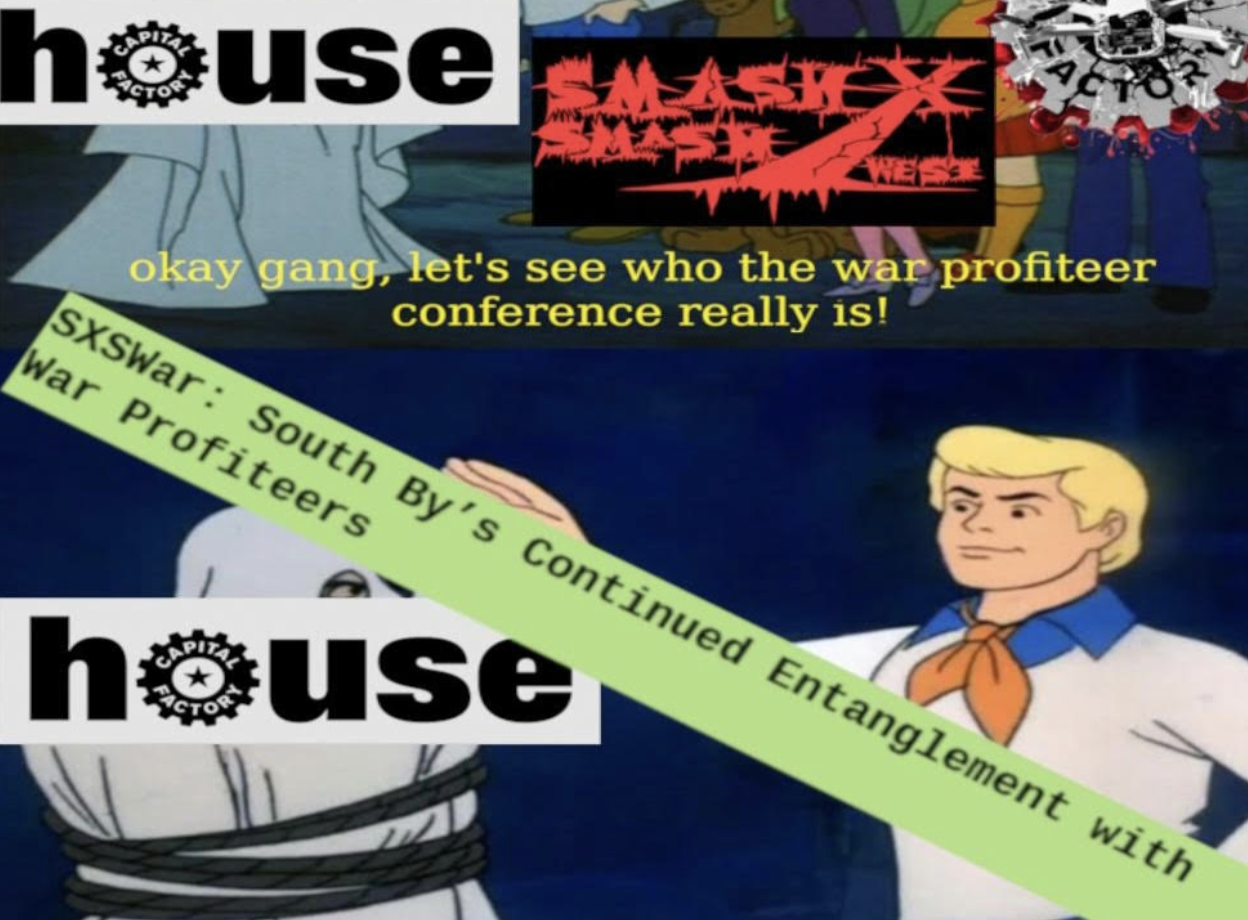
An AI-powered tool designed to target trademark violations on social media was used to silence critics of SXSW, the massive annual tech, music and film conference in Austin, Texas.
Each year in March, SXSW takes over Austin. This year, thanks to the demolition of the city’s aging convention center, events sprawled to more locations than usual, from hotel ballrooms to vacant lots. But the character of SXSW has changed, growing more corporate and less accessible since its relatively humble origins in 1987, and today it has numerous detractors. This year some of those dissenting voices found themselves targeted by BrandShield, a “digital risk protection” service that claims to use artificial intelligence to automate the process of identifying and removing social posts that misuse trademarks.
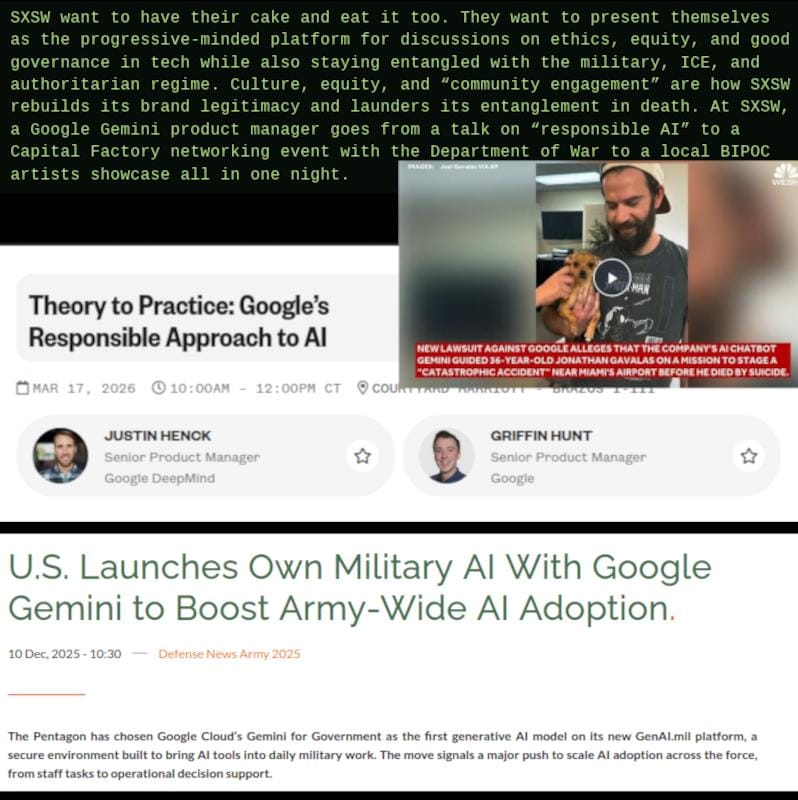
Among the groups to receive a social media takedown notice was Vocal Texas, a nonprofit dedicated to ending homelessness, HIV, poverty and the war on drugs. On March 12, members of the group set up a mock encampment in downtown Austin, to draw attention to the possessions that unhoused people can lose during “sweeps,” when police and city officials clear out and destroy or confiscate their tents and other lifesaving supplies.

An Instagram post by Vocal Texas read, “SXSW means unhoused Austinites in downtown face encampment sweeps, tickets and arrests while the City makes room for billionaires and corporations to rake in profits.” The accompanying image promised an art installation called “Sweep the Billionaires,” and does not use SXSW’s logos.
Even so, the mere mention of SXSW was apparently enough to flag BrandShield’s trademark detection service, resulting in the post’s fully automated removal from Instagram. Cara Gagliano, a senior staff attorney who specializes in trademark and intellectual property law at the Electronic Frontier Foundation said that posts like these do not violate SXSW’s trademark.
“You’re allowed to use a company’s name to talk about the company, right?” Gagliano told 404 Media. “How else are you going to do it?”
Gagliano noted that trademark law has specific carveouts for exactly this kind of critical speech. “Examples like that, where it's not (for example) advertising a concert with a name similar to South by Southwest ... are pretty clearly over-enforcement,” she said.
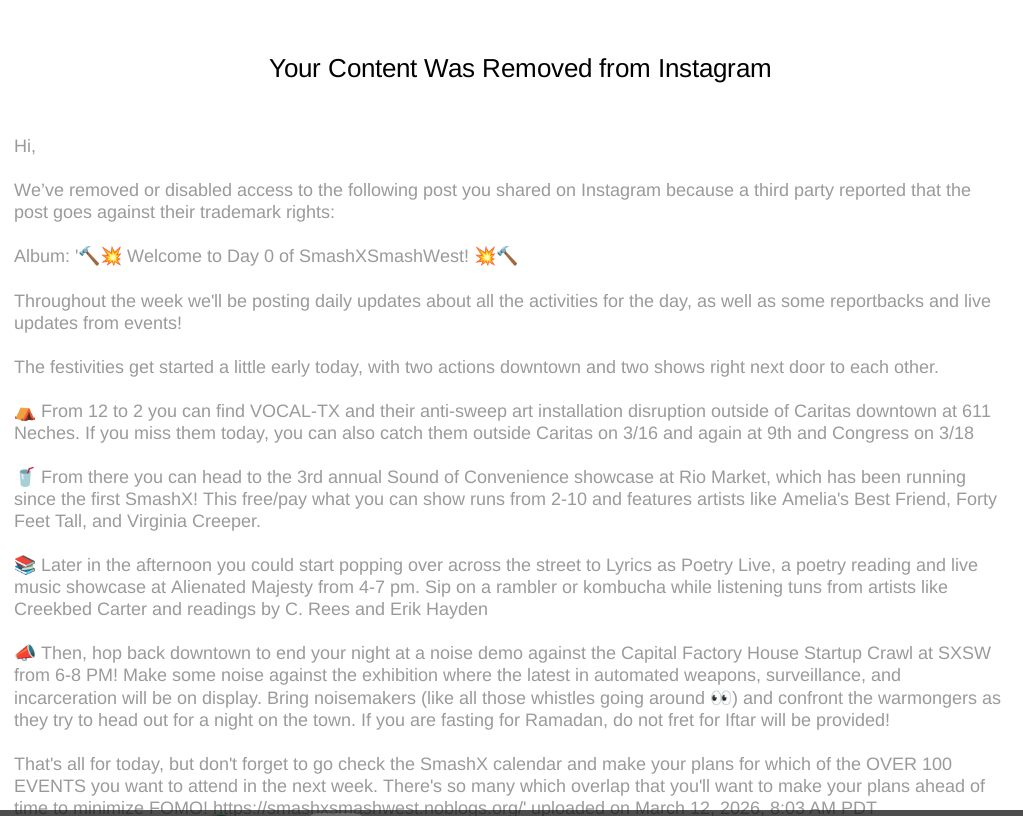
EFF interceded in March 2024 when the Austin for Palestine coalition received a cease and desist letter from SXSW, accusing them of infringing on the conference’s trademark and copyright. The coalition, which was involved with organizing successful protests against the festival’s sponsorship by the U.S. military, had made social media posts featuring SXSW’s trademarked arrow logo reimagined with bloodstains, fighter jets, and other warlike imagery. The EFF wrote a letter on the coalition’s behalf, and the group never heard from SXSW again.
But Gagliano explained that this situation is different from the takedown notices sent by BrandShield. “When it's a threat sent to ... the person who made the allegedly infringing use, them going away is a victory for the client because nothing bad happens to them, but when you have these takedowns ... [while] it's good that they didn't go even further and file a lawsuit, they also don't have any incentive to retract the complaint, and so the content stays down.”
This year, many of the protests and “counter events” were organized by a very loosely associated coalition of groups called Smash By Smash West, which included Vocal Texas along with many others, from musicians and independent movie directors to event venues.
404 Media reached a representative of Smash By Smash West via Signal who used the name “Burnice.” We agreed to protect their anonymity, but verified that they were involved with the organizing of Smash By events. Operating since 2024, Smash By has no leaders and essentially anyone can organize an event under its umbrella. This year, there were over 100 events, according to Burnice. “It is a decentralized call to action and a platform that enables promotion and connecting together all of these different events.”

Smash By Smash West provided us with dozens of screenshots of Instagram takedown notices as well as many of the posts which had been removed.
BrandShield’s software enables mass reporting of potentially infringing content, with reports in turn evaluated by Instagram’s automated moderation systems. Despite their obviously automated nature, BrandShield claims to use a “dedicated enforcement team of IP lawyers” to ensure that takedowns are “timely, targeted and fully compliant.”
The BrandShield website reads, “Whether it's a distorted logo, a counterfeit image, or a cloned storefront, our proprietary image recognition technology scans marketplaces, social media, paid media, and mobile environments to catch threats at the source.”
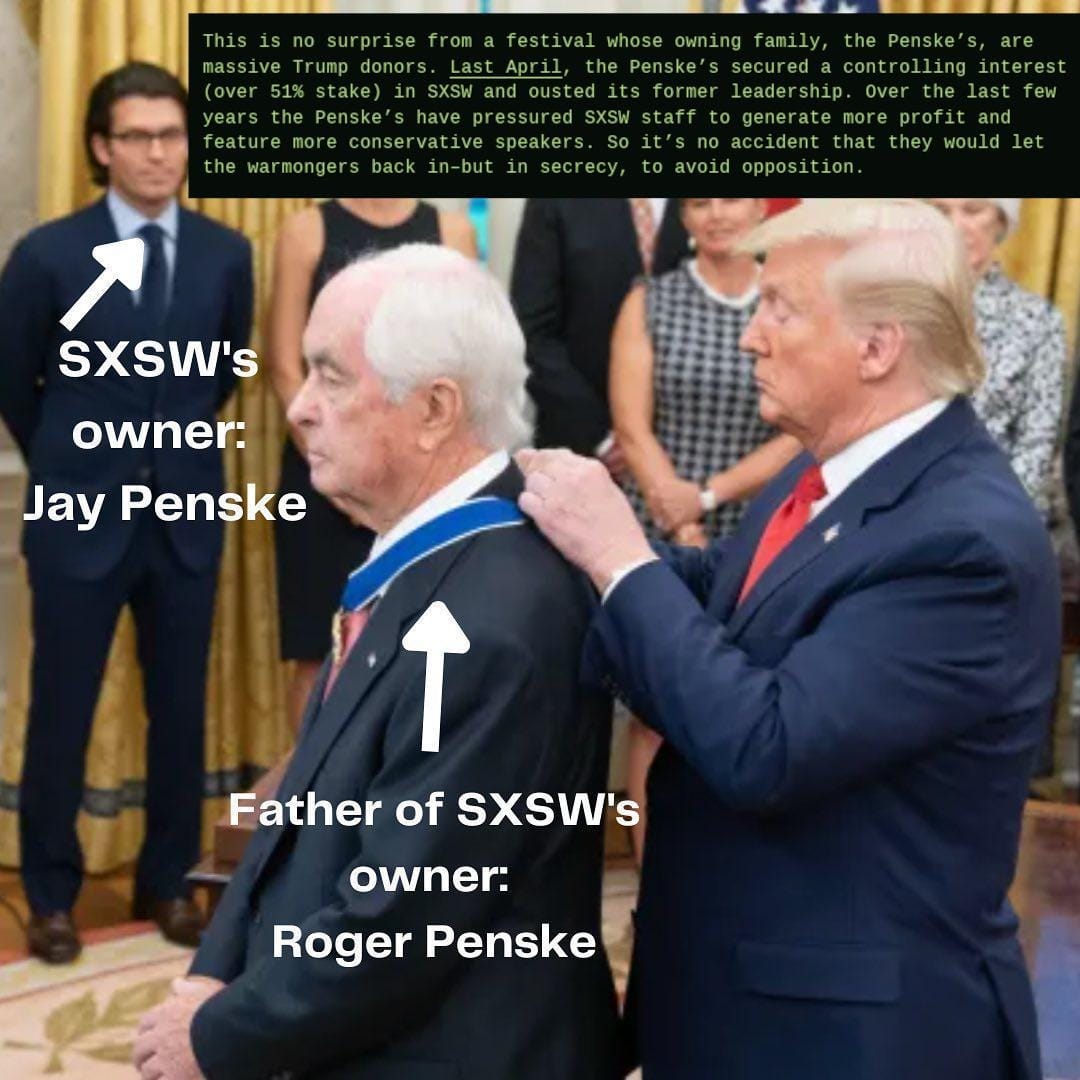
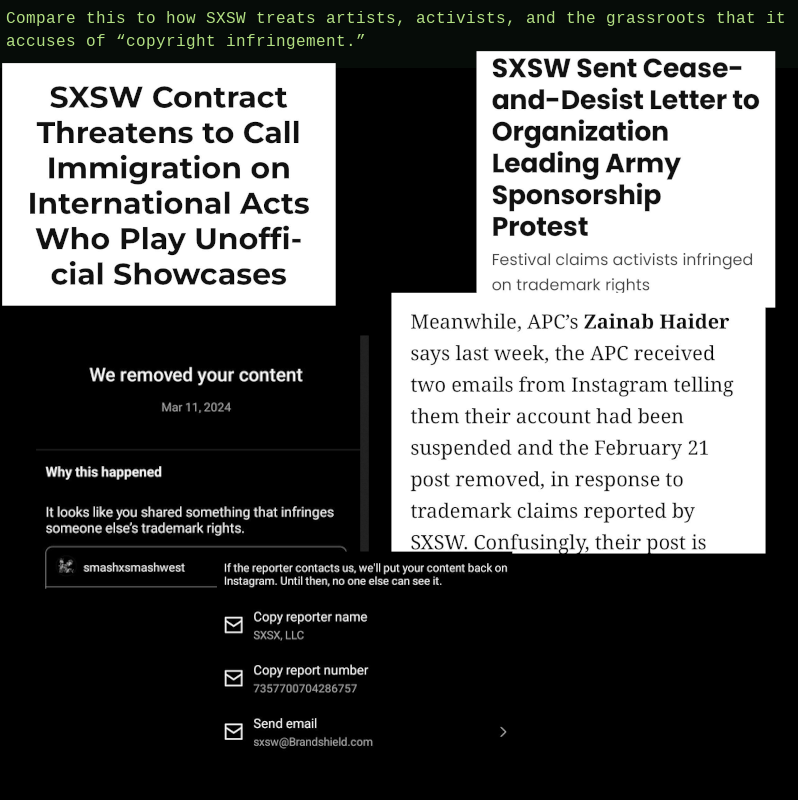

However, despite these assurances, it seems clear that BrandShield’s trademark targets with a very broad brush, and seems incapable of distinguishing between trademark violations and protected free speech. Although BrandShield initially connected us with their public relations department, they did not respond to repeated requests for comment including an emailed list of inquiries.
Instagram’s automatically generated takedown notices include the sentence, “If you think this content shouldn’t have been removed from Instagram, you can contact the complaining party directly to resolve your issue.” However, there is a link allowing the recipient to appeal the takedown, which then leaves it up to Instagram moderators’ discretion if it returns.
Gagliano explained that this is a crucial area where trademark differs from copyright law. Thanks to the Digital Millenium Copyright Act (DMCA), there’s a clear (though often arduous) path to contesting false claims of copyright violations which allows content creators to get their posts put back. There’s no similar, mandatory pathway written into trademark law. “There's no counter notice process where they say, ‘Okay, you told us this is fair use, so we'll put it back up.’ And that's a really frustrating thing,” Gagliano said.
Mathew Zuniga, who does most of the booking for Tiny Sounds Collective, an organization that throws free DIY music shows and publishes zines, said he struggled with the process offered by Instagram after a post about a Tiny Sounds’ Smash By concert was taken down.
“I tried to do it,” he said. “It didn't really go through.“
When he reposted the same image and text, but without tagging Smash By Smash West’s Instagram account as a collaborator, the post remained online.
“I think it’s silly, as if these DIY shows in a bookstore are pulling anyone away from South By,” Zuniga said. “I think it was more of a deliberate attempt to take down anti-South By Southwest rhetoric online.”
When reached for comment, SXSW’s PR team sent back a prepared statement, noting that the law requires them to “take reasonable steps” to enforce their trademarks.
“SXSW’s efforts are not intended to limit commentary, criticism, or independent reporting, and we respect the importance of free expression,” the spokesperson’s statement continued. “We use third-party services, including BrandShield, to help identify potential issues at scale, and we recognize that errors can occur."
By contrast, Burnice explained that, rather than trying to steal SXSW’s trademark, Smash By Smash West makes it a condition that participants can’t describe their events as free or alternative SXSW events. “Smash By ... was an attempt to politicize the DIY scene, the ‘unofficial’ South By shows, and make them explicitly anti-South By.”
Smash By provides alternative logos, some of which are wholly unique but others based on parodying or “detournements” of the SXSW logo, similar to what the Austin for Palestine coalition did in 2024. Burnice expressed their frustration with the automated nature of the quashing of dissent this year.
“All of that is actually just happening by robots talking to robots,” they said. “It's an AI system that mass reports these accounts, and then, you know, probably an AI system at Instagram that just sorts through, and approves or rejects.”
For her part, Gagliano expressed skepticism over whether artificial intelligence plays a major or important role at companies like BrandShield beyond just its current popularity as a tech buzzword. ”I haven't seen any kind of change in the volume of requests for help that we're getting, and this is one thing where I'm a little skeptical that it's really made much difference, because they were already using automated tools before, and I think in any instance, the tools are not going to be able to reliably determine what's actually infringement.”

If you liked this piece, please subscribe to my premium newsletter. It’s $70 a year, or $7 a month, and in return you get a weekly newsletter that’s usually anywhere from 5,000 to 18,000 words, including vast, detailed analyses of NVIDIA, Anthropic and OpenAI’s finances, and the AI bubble writ large. I recently put out the timely and important Hater’s Guide To The SaaSpocalypse, another on How AI Isn't Too Big To Fail, a deep (17,500 word) Hater’s Guide To OpenAI, and just last week put out the massive Hater’s Guide To Private Credit.
I also just did a piece about how OpenAI will kill Oracle, and I’ve used some of the materials in today’s piece. It's one of my best pieces I've ever done and I'm extremely proud of it.
Subscribing to premium is both great value and makes it possible to write these large, deeply-researched free pieces every week.
Yesterday morning, GitHub Copilot users got confirmation of something I’d reported a week ago — that all GitHub Copilot plans would move to usage-based pricing on June 1, 2026.
Instead of offering users a certain number of “requests,” Microsoft will now charge users based on the actual cost of the models they’re using, which it calls “...an important step toward a sustainable, reliable Copilot business and experience for all users.” Users instead get however much they spend on their GitHub Copilot subscription (EG: $19 of tokens a month on a $19-a-month plan).
Translation: "we cannot continue to subsidize GitHub Copilot users, or Amy Hood will start hitting people with a baseball bat."
Anyway, the announcement itself was a fascinating preview into how these price changes are going to get framed:
Copilot is not the same product it was a year ago.
It has evolved from an in-editor assistant into an agentic platform capable of running long, multi-step coding sessions, using the latest models, and iterating across entire repositories. Agentic usage is becoming the default, and it brings significantly higher compute and inference demands.
Today, a quick chat question and a multi-hour autonomous coding session can cost the user the same amount. GitHub has absorbed much of the escalating inference cost behind that usage, but the current premium request model is no longer sustainable.
Usage-based billing fixes that. It better aligns pricing with actual usage, helps us maintain long-term service reliability, and reduces the need to gate heavy users.
You see, it’s not that Microsoft was subsidizing nearly two million people’s compute, it’s that AI has become so strong, powerful and complex that it’s basically a different product!
While Copilot might not be “...the same product it was a year ago,” very little has changed about the underlying economic mismatch: that Microsoft was allowing users to burn more than their subscription costs in tokens every single month for three years. Per the Wall Street Journal in October 2023:
Individuals pay $10 a month for the AI assistant. In the first few months of this year, the company was losing on average more than $20 a month per user, according to a person familiar with the figures, who said some users were costing the company as much as $80 a month.
Naturally, GitHub Copilot users are in revolt, saying that the product is “dead” and “completely ruined.”
And I called it two years ago in the Subprime AI Crisis:
I hypothesize a kind of subprime AI crisis is brewing, where almost the entire tech industry has bought in on a technology sold at a vastly-discounted rate, heavily-centralized and subsidized by big tech. At some point, the incredible, toxic burn-rate of generative AI is going to catch up with them, which in turn will lead to price increases, or companies releasing new products and features with wildly onerous rates — like the egregious $2-a-conversation rate for Salesforce’s “Agentforce” product — that will make even stalwart enterprise customers with budget to burn unable to justify the expense.
And that day has finally arrived, because every single AI service you use subsidized compute, and every single service is losing money as a result:
When you pay for access to an AI startup’s service — which, of course, includes OpenAI and Anthropic — you do so for a monthly fee, such as $20, $100 or $200-a-month in the case of Anthropic’s Claude, Perplexity’s $20 or $200-a-month plan, or OpenAI’s $8, $20, or $200-a-month subscriptions. In some enterprise use cases, you’re given “credits” for certain units of work, such as how Lovable allows users “100 monthly credits” in its $25-a-month subscription, as well as $25 (until the end of Q1 2026) of cloud hosting, with rollovers of credits between months.
When you use these services, the company in question then pays for access to the AI models in question, either at a per-million-token rate to an AI lab, or (in the case of Anthropic and OpenAI) whatever cloud provider is renting them the GPUs to run the models. A token is basically ¾ of a word.
As a user, you do not experience token burn, just the process of inputs and outputs. AI labs obfuscate the cost of services by using “tokens” or “messages” or 5-hour-rate limits with percentage gauges, and you, as the user, do not really know how much any of it costs. On the back end, AI startups are annihilating cash, with up until recently Anthropic allowing you to burn upwards of $8 in compute for every dollar of your subscription. OpenAI allows you to do the same, though it’s hard to gauge by how much.
AI startups and hyperscalers assumed that they’d be able to get enough people through the door with subsidized, loss-making products to get them hooked on services badly enough that they’d refuse to change once businesses jacked up the prices. They also assumed, I imagine, that the cost of tokens would come down over time, versus what actually happened — while prices for some models might have come down, newer “reasoning” models burn way more tokens, which means the cost of inference has, somehow, gotten higher over time.
Both assumptions were wrong, because the monthly subscription model does not make sense for any service connected to a Large Language Model.
The Core Economics of Generative AI Are Broken
Think of it like this. When Uber (and no, this is nothing like Uber) started jacking up the prices for its rides, the underlying economics stayed the same, as did those presented to both the rider and the driver — a user paid for a ride, a driver was paid for a ride. Drivers still paid for gas, car insurance, any permits that their local government might insist upon, and whatever financing costs might be associated with their vehicle, and said costs were not subsidized by Uber. Uber’s massive losses came from subsidies, endless marketing expenses, and doomed R&D efforts into things like driverless cars .
Generative AI Subscriptions Are Nothing Like Uber
To illustrate the scale of AI’s pricing mismatch, I’m going to ask you to imagine an alternate history where Uber had a very different business model.
Generative AI subscriptions are like if Uber charged users $20 a month for 100 rides of any distance under 100 miles, and if gas was $150 a gallon, and Uber paid for the gas because somebody insisted that oil would one day be too cheap to meter.
Uber would, eventually, decide to start charging users a monthly subscription to access rides, and bill them for the gas that they consumed. Suddenly users would go from paying $20 a month for 100 rides to paying $20 to access a driver and $26 for a 10 mile drive. Understandably, users would be a little upset.
While this sounds a little dramatic, it’s actually a pretty accurate metaphor for what’s happening in the generative AI industry, and in particular, at Github Copilot.
GitHub Copilot’s previous pricing allowed 300 premium requests a month, as well as “unlimited chat requests” using models like GPT-5 mini. Each of these requests (to quote Microsoft) is “...any interaction where you ask Copilot to do something for you,” with more-expensive models taking up more requests in the later life of the request-based system, such as Claude Opus 4.6 taking up three premium requests. When you ran out of premium requests, Copilot would let you use one of those cheaper models as much as you’d like for the rest of the month.
This wasn’t even always the case. Up until May 2025, Microsoft gave users unlimited access to models, and even then users were pissed off that there were any restrictions on the product.
Microsoft — like every AI company — swindled its customers by selling an unsustainable service, because it never, ever made sense to sell LLM-powered services on a monthly subscription.
If you’re wondering how much services are likely to cost under token based billing, a user on the GitHub Copilot Subreddit found that the token burn of what used to be a single premium request was somewhere around $11, as one “request” involved using 60,000 tokens in the context window, a few tools, and a bunch of internal “turns” (things that the model is doing) to produce the output.
There’s also the underlying unreliability of hallucination-prone Large Language Models. While a premium request chasing its tail and spitting out half-broken code might be frustrating, that same fuckup is a lot less forgivable when you’re paying the costs yourself.
Users have also been trained to use the product in an entirely different manner to token-based billing, and I’d imagine many of them don’t even really realize how many “tokens” they burn or how many of them a particular task takes, something which changes based on whatever model you use.
This is absolutely nothing like Uber, and anyone telling you otherwise is attempting to rationalize bad behavior. Uber may have raised prices, but it didn’t have to dramatically change the underlying economics of the platform, nor did users have to entirely change how they used the product because Uber was suddenly charging them on a per-gallon basis.
Monthly AI Subscriptions Are All Part of AI’s Subsidy Scam, A Deliberate Attempt To Separate Generative AI From Its Actual Costs
There has never been — and never will be — an economically-feasible way to offer services powered by LLMs without charging the actual token burn of each user, and in the process of deceiving said users, these companies have created products with illusory benefits and questionable return on investment.
And that’s been blatantly obvious for years.
On an economic basis, a monthly subscription only makes sense with relatively static costs. A gym can sell memberships knowing roughly how much wear-and-tear equipment gets, how much classes cost to run, and how much things like electricity, staffing and water might cost over a given period of time.
A customer of Google Workspace — at least before AI — cost whatever the cost of accessing or storing documents were, as well as the ongoing costs of Google Docs and other services. The relatively low cost of digital storage (as well as the fact that, unlike LLMs, Google Workspace isn’t particularly computationally demanding) means that a particularly-heavy Google Drive user isn’t going to eat into the margin on their monthly subscription.
Conversely, an AI subscriber’s costs can vary wildly. One user might only use ChatGPT for the occasional search, while another might feed in reams of documents, or try and refactor a codebase, or try and use it to put together a PowerPoint presentation. And the provider — a model lab like OpenAI or Anthropic, or a startup like Cursor) — has no real way to control how a user might act other than making the product worse, such as instituting usage limits, reducing the size of the context window, pushing customers to smaller (and worse) models, or changing the pricing to dissuage users from making big GPU-heavy requests.
Yet these services intentionally hide the amount of tokens or how much a particular activity has cost, which means users don’t really know what a rate limit means, which means that every abrupt change to rate limits leaves customers desperately scrambling to work out how much actual work they can do using the service.
It’s an abusive, manipulative and deceitful way of doing business that only existed so that Anthropic, OpenAI, and other AI companies could grow their user bases, as the majority of AI users perceive its real or imagined benefits entirely through the lens of being able to burn anywhere from $8 to $13.50 for every dollar of their subscription in tokens.
This intentional act of deception had one goal: to make sure that the majority of people were never exposed to the true costs of generative AI. When The Atlantic writes a breathless screed about Claude Code being Anthropic’s “ChatGPT moment,” it does so based on a $20-a-month subscription rather than the underlying token burn that it cost for Anthropic to provide it, which in turn makes the writer forgive the “minor errors” that a model might make, or when it “gets stuck on more complicated programming tasks.”
Had the writer paid for her actual token burn, and had each of the times it got “stuck” resulted in $15 in token charges, I don’t think she’d be quite as forgiving of these fuckups.
Yet that’s all part of the scam.
It’s very, very important that nobody writing about AI in the mainstream media actually understands how much these services cost, and that any mainstream articles written about services like ChatGPT or Claude Code are written by people who have little or no idea how much each individual task might cost a user.
Remember: generative AI services are, for the most part, experimental products that do not function like any other modern software or hardware. One cannot just walk up to ChatGPT or Claude and start asking it to do work.
I mean, you can, but if you don’t prompt it right, understand how it works, or make a mistake in whatever you feed it, or if it just gets things wrong, it’ll spit out something you don’t like, which in turn means you’ll need to prompt it again. LLMs are inherently unpredictable.
You cannot guarantee whether an LLM will do a particular action, or whether it will present you with an outcome based on reality. You cannot for certain say how much a particular task — even one you’ve done many times using an LLM in the past — might cost, nor can you be sure when a model might go berserk and delete something, or simply not do something yet claim that it did.
These are far more forgivable if you’ve not paying on a per-token basis, because in the mind of a subscriber, that’s just another turn or two with a chatbot rather than something that’s incurring a real cost. One doesn’t criticize so-called “jagged intelligence” because the assumption is that whatever problems you’re facing now will be eliminated at some future juncture, and you didn’t end up paying for it anyway.
Had users been forced to pay their actual rates, I imagine many would’ve bounced off the product immediately, as it’s very, very easy to burn through $5 of tokens if you’re fucking around and exploring what an LLM can do.
Sidenote: In fact, you can burn a great deal of money without ever getting the outcome you desire, because LLMs aren’t really artificial intelligence at all! Somebody without any real understanding of their limitations could easily burn $30, or $50, or even $100 trying to convince an LLM to do something it insists it’s capable of.
There’s a term for this. Sycophancy. LLMs are often designed to affirm the user, even when they’re saying dangerously unhinged things, and that can extend to saying “you want this big thing that’s not even slightly feasible, whether technically or financially?” Sure thing!
This is why the industry worked so hard to obfuscate these costs — it’s a fucking ripoff!
I think it’s inevitable that the majority of AI subscriptions move to token-based billing, especially as both Anthropic and OpenAI have now done so with their enterprise customers.
The fact that Microsoft moved GitHub Copilot subscribers to token-based is also a very, very bad sign. Microsoft is arguably the best-capitalized, most-profitable, and best-positioned company to continue subsidizing compute, and if it can’t afford to do so further, nobody else can either.
The real thing to look out for — a true pale horse — will be a major AI lab like Anthropic or OpenAI moving all of its subscribers to token-based billing. Once that happens, you’ll know it’s closing time.
Can The Average Company Afford To Move To Token-Based Billing? Anthropic Estimates Users Spend $13-$30 a day ($7K+ a year) On Claude Code, As Large Organizations Spend Hundreds of Thousands or Millions A Year
As I discussed last week, Uber’s CTO said at a conference that it had spent its entire AI budget for 2026 in the space of a few months, with Goldman Sachs suggesting that some companies are spending as much as 10% of their headcount on AI tokens, with the potential to increase to 100% in the next few quarters.
This is the direct result of training every single AI user to use these services as much as humanely possible while obfuscating how much they really cost. Every single major company demanding that every single worker “use AI as much as possible” has done so while either fundamentally ignoring or being entirely disconnected from their actual token burn, and as companies are forced to pay the actual costs, I’m not sure how you can economically justify any investment in this technology.
Sure, sure, you’re gonna say that engineers are “shipping code faster” or some such bullshit, I get it, but how much faster, and how much money are you making or saving as a result? If you’re spending 10% of your headcount on AI tokens, are you seeing that extra expense reconciled in some other way? Because I’m not sure you are. I’m not sure any business investing these vast amounts of money in tokens is seeing any return on investment, which is why every study about AI’s ROI struggles to find much evidence that it exists.
For the most part, everybody you’ve read gooning over the many possibilities of generative AI has experienced it without having to pay the true costs. Every Twitter psychopath writing endless screeds about their entire engineering team hammering away at Claude Code has been doing so using a $125-a-month-per-head Teams subscription with similar usage limits to Anthropic’s $100-a-month consumer subscription. Every LinkedIn gargoyle insisting that they’d “done hours of work in minutes” using some sort of Perplexity product has done so by paying, at the very most, $200 a month for Perplexity’s Max subscription.
In reality, that 10-person, $1250-a-month Teams subscription likely burns anywhere from $5000 to $10,000 a month in API calls, if not more. Anthropic Head of Growth Amol Avasare said last week that its Max subscriptions were built for heavy chat usage rather than whatever people are doing with Claude Code and Cowork, and made it clear that Anthropic is now looking at “different options to keep delivering a great experience,” which is another way of saying “we’re going to change the prices at some point.”
I’m not sure people realize how expensive these tokens are, especially for coding projects that involve massive codebases and regularly make calls to coding and infrastructure tools. Can somebody who pays $200 a month foreseeably afford $350, $400, or $500? Can they afford to have a month where they spend more than that? What happens if they go over budget, or if they literally can’t afford to spend the money necessary to finish their work?
To give you a more-practical example, up until the beginning of April, Anthropic’s own Claude Code developer documents (archive) said that “the average cost [for those using Claude Code] is $6 per developer per day, with daily costs remaining below $12 for 90% of users.” As of this week, the documents now read as follows:
Claude Code charges by API token consumption. For subscription plan pricing (Pro, Max, Team, Enterprise), see claude.com/pricing. Per-developer costs vary widely based on model selection, codebase size, and usage patterns such as running multiple instances or automation.
Across enterprise deployments, the average cost is around $13 per developer per active day and $150-250 per developer per month, with costs remaining below $30 per active day for 90% of users. To estimate spend for your own team, start with a small pilot group and use the tracking tools below to establish a baseline before wider rollout.
If we assume an average of 21 working days in a month, that puts the average cost of a Claude Code user at around $273 a month, or $3,276 a year. At $30 a working day, that works out to $630 a month, or $7560 a year.
These are astonishing numbers, made more so by the fact that there is no way you’re only spending $30 a day if you use any of Anthropic’s more-recent models. Claude Opus 4.7 costs $5 per million input and $25 per million output tokens. ‘One million tokens is around 50,000 lines of code, and assuming you’re using the supposedly state-of-the-art models, there isn’t a chance in Hell you don’t run through at least a million, with that number increasing dramatically if you’re not particularly aware of which models to use for a particular task.
Let’s play with that $30 number a little more.
- For a ten person dev team, that’s $75,600 a year, and we’re only counting working days.
- If you raise a mere three months to an average of $50 a working day, that raises to $88,200
- If you add a single month where you go over $100, you’re spending $102,900 a year.
- If you spend $300 a day, you’re now spending $756,000 on tokens for ten people.
While this might be possible within the slush fund mindset of a well-funded startup or a banana republic like Meta, any business that actually cares about its costs will have a great deal of trouble justifying spending five or six figures in extra costs on a service that “increases productivity” in a way that nobody can seem to measure.
Right now, I think most companies fall into three camps:
- Enterprise deployments in massive organizations like Spotify or Uber with AI-pilled CEOs that allow budgets to run wild.
- I’d also say this is the case in large, well-funded startups.
- Smaller startups that use the subsidized “Teams” subscription.
- Individual users paying a monthly fee to access Claude or other AI subscriptions.
Large organizations still have a free pass to say that they’re burning millions of dollars on AI tokens for their software engineers under the questionable benefit of their “best engineers” not writing any code.
All it changes is one bad earnings call to change that narrative. At some point investors — even the braindead fuckwits who have been inflating the AI bubble — will begin to question mounting R&D costs (which is where AI token burn is usually hidden) when the company’s revenue growth fails to follow. This will likely lead to more layoffs to keep up with the cost, as was the case with Meta, and then an eventual pullback when somebody asks “does any of this shit actually help us do our jobs faster or better?”
I also think that startups burning 10% or more of their headcount in AI tokens will have a tough time convincing investors in six months that doing so is necessary.
And once everybody switches to token-based billing, I’m not sure we’ll see quite as much hype around generative AI.
The Economics of AI Data Centers And Compute Do Not Make Sense
The way that people talk about AI data centers is completely disconnected from reality, and I don’t think people realize how ridiculous this entire era has become.
AI Data Centers Are Expensive To Build, Expensive To Run and Make Very Little Actual Revenue
Per Jerome Darling of TD Cowen, it costs around $30 million in critical IT (GPUs and the associated hardware) and $14 million per megawatt of data center capacity. Data centers appear to take anywhere from a year to three years depending on the size, and that’s assuming the power is available.
Of the 114GW of data centers supposedly being built by the end of 2028, only 15.2GW is under construction in any way, shape, or form. And “under construction” can mean as little as “there’s a hole in the ground.” It does not — and should not — imply that the capacity that said facility will provide is going to be imminently available.
Sidebar: If you’re interested in some of the deeper math here, please subscribe to my premium newsletter so that you can see my Bastard Data Center Model, which I created with the assistance of multiple analysts and hyperscaler sources.
Let’s start simple: whenever you think “100MW,” think “$4.4 billion,” with a large chunk of that dedicated to NVIDIA GPUs.
As a result, every AI data center starts millions of dollars in the hole, and even with six-year-long depreciation schedules, takes years to pay off… and with NVIDIA’s yearly upgrade cycle, those GPUs are unlikely to make that much money once you’re done with your first customer contract.
It’s also unclear whether the customer base for AI compute exists outside of OpenAI and Anthropic, whose demand accounts for 50% of AI data centers under construction, creating a massive systemic weakness if either of them lacks the money to pay.
In any case, it’s also unclear what kind of ongoing rates these data centers charge. While spot prices might sit around $4.50 an hour for a B200 GPU, long-term contracts generally price much lower, with one founder (per The Information) saying they paid around $3.70-per-hour-per GPU for a one-year-long commitment.
To be clear, we must differentiate between the spot cost — which is the cost of randomly spinning up GPUs on somebody else’s servers — and contracted compute, the latter of which makes up the majority of data center capex. Most data centers are built with the intention of having one or two big clients, which means said clients are likely to negotiate a cheaper blended rate.
As a result, many data centers take far less than $3.70 an hour, because they bill at a per-megawatt (or kilowatt) price.
And that’s where the economics begin to break down.
The Broken Economics of a 100MW Data center — $2.55 An Hour, 16% Gross Margin With 100% Tenancy, Unprofitable Because of Debt
That’s the starting cost for a 100 megawatt data center. A 100MW data center will likely only have 85MW of actual stuff it can bill for, and based on discussions with sources familiar with hyperscaler billing, they can expect to make around $12.5 million per megawatt, or around $1.063 billion in annual revenue.
Now, I should be clear that most data center companies you know of don’t actually build them, instead leaving that job to companies like Applied Digital, who are also known as “colocation partners.” For example, CoreWeave pays a colocation fee to Applied Digital to use its North Dakota data centers. CoreWeave is responsible for all the GPUs and other tech inside the data center.
To explain the economic mismatch, I’m going to use a theoretical example of a data center leased to a theoretical AI compute company.
The GPUs in that data center are likely NVIDIA’s Blackwell chips. More than likely, said data center is using pods of 8 B200 GPUs, retailing around $450,000 a piece, or $56,250 a GPU. Based on there being 85MW of Critical IT load, the all-in capex per megawatt is around $36.78, or total IT capex of around $3.126 billion, or around $2.67 billion in GPUs.
Let’s assume this data center is in Ellendale, North Dakota, which means you’ve got an industrial electricity rate of around 6.31 cents per kilowatt hour, which works out to about $55.4 million a year in electricity costs. Based on discussions with sources, I estimate that ongoing costs like maintenance, headcount, replacement of power supplies and the like comes in at around 12% of revenue, or around $128 million a year, bringing us up to $183.4 million in costs.
Wait, sorry. You’ve also got to pay a colocation fee based on the critical IT, and according to Brightlio, that fee is often around $180-200 per kilowatt per month, depending on the scale and location of the deployment, though I’ve read as low as $130, which is the number I’m going with, or around $133 million per year. This brings us up to $316.4 million.
Well, that’s still less than $1.06 billion, so we’re still doing okay, right?
Wrong! You’ve got $3.126 billion in IT gear to depreciate, which works out to around $521 million a year over the six years you’re depreciating it. That’s $837.4 million a year, leaving you with around $168.6 million in yearly profit, or around a 16.7% gross margin…
…if you have 100% tenancy at all times! You see, data centers can take a month or two to get those GPUs installed and a customer onboarded, all while making you exactly zero dollars in revenue and losing you a great deal more, as you’re stuck paying your colocation, electricity and opex costs the whole time, albeit at a much lower rate (I’ve modeled for 10% electricity and 15% colocation/opex costs), meaning you’re losing about $3.27 million a day.
For the sake of this example, we’re going to assume it takes you an extra month to get this thing operational, meaning you’ve paid about $102 million that you’re never getting back, bringing our total costs for the year including depreciation to $939.4 million, or a 6.6% gross margin.
Wait, fuck, you didn’t use debt to buy these GPUs, did you? You did? How bad are we talking? Oh god — you got a 6-year-long asset-backed loan at 80% LTV, meaning you borrowed $2.8 billion at a 6% interest rate.
Your bank, in its eternal generosity, offered you a deal — a 12-month-long grace period where you’re only paying interest…which works out to around $168 million, which brings our total costs (excluding the month of delay for fairness) for the first year to around $1.005 billion…on $1.06 billion of revenue.
That’s a 5.19% gross margin, and you haven’t even started paying the principal. When that happens, you’re paying $54.1 million a month in loan payments, for a total of around $649 million a year for five more years, which comes out to around $1.48 billion, or a negative gross margin of around 40%.
And I must be clear that this is if you have 100% utilization and a tenant that pays you on time, every time.
Stargate Abilene Is A Disaster — $2.94-per-GPU-per-hour, $10 Billion In Annual Revenue, Years Behind Schedule, One Tenant That Loses Billions of Dollars A Year
Let’s talk about what should be the single-most economically viable project in data center history — a massive campus built for the largest AI company in the world by Oracle, a decades-old near-hyperscaler with a history of selling expensive database and business management software to enterprises and governments.
Hah, I’m kidding of course, this place is a fucking nightmare.
Stargate Abilene, an eight-building, 1.2GW data center campus with around 824MW of critical IT, was first announced in July 2024. As of April 27 2026, only two buildings are operational and generating revenue, and the third barely has any IT gear in it. I estimate the total cost of Stargate Abilene to be around $52.8 billion.
Per my own reporting, Oracle expects to make around $10 billion in annual revenue from Stargate Abilene, and I estimate around $75 billion in total revenue from the 7.1GW of data center capacity it’s building for one customer: OpenAI. As I also reported, Oracle estimated in 2024 that Abilene would cost at least $2.14 billion a year in colocation and electricity fees, paid to land developer Crusoe.
I should also add that it appears that Oracle is paying all of Abilene’s construction costs.
Based on my calculations and reporting, I estimate Abilene’s rough gross margin is around 37.47% once it’s fully operational:
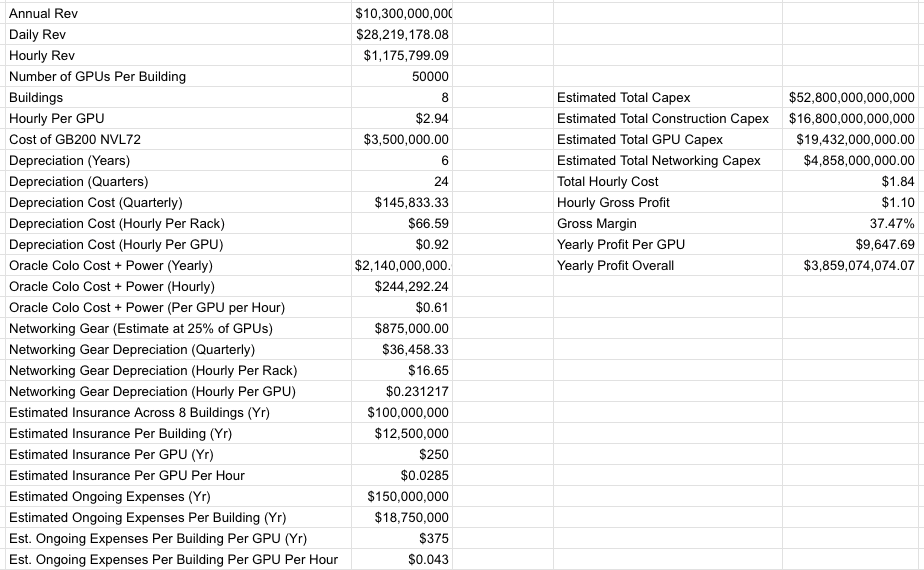
I must be clear that that 37.47% gross margin is likely too high, as I don’t have precise knowledge of Oracle’s true insurance or headcount costs, only estimates based on documents viewed by this publication. I should also be clear that Oracle is mortgaging its entire fucking future on projects like Stargate Abilene, incurring billions of dollars of costs up front for a business that will take years to turn a profit even if OpenAI makes every single payment in a timely manner.
Sadly, I can’t tell how much of Abilene was paid for in debt, only that Oracle raised around $18 billion in various-sized bonds in September 2025, with maturities ranging from 7 years to 40 years, and had negative cashflow of $24.7 billion in its last quarterly earnings.
What I do know is that it has a 15-year-long lease with developer Crusoe, and that Oracle’s future heavily depends on OpenAI’s continued ability to pay, which depends on Oracle’s ability to finish Stargate Abilene.
I also need to be clear that that $3.85 billion in yearly profit is only possible if OpenAI makes timely payments, takes tenancy of Abilene as fast as humanly possible, and everything goes to plan.
If OpenAI Fails To Raise $852 Billion In Revenue, Funding, and Debt Throughout The Next 4 Years, The Stargate Data Center Project Will Kill Oracle
Sadly, the complete opposite has happened:
Based on reporting from DatacenterDynamics, the first 200MW of power was meant to be energized “in 2025.” As time dragged on, occupancy was meant to begin in the first half of 2025, had “potential to reach 1GW by 2025,” complete all 1.2GW of capacity by mid-2026, be energized by mid-2026, have 64,000 GPUs by the end of 2026, as of September 30, 2025 had “two buildings live,” and as of December 12, 2025, Oracle co-CEO Clay Magouyurk said that Abilene was “on track” with “more than 96,000 NVIDIA Grace Blackwell GB200 delivered,” otherwise known as two buildings’ worth of GPUs.
Four months later on April 22, 2026, Oracle tweeted that “...in Abilene, 200MW is already operational, and delivery of the eight-building campus remains on schedule.” It is unclear if that’s 200MW of critical IT capacity or the total available power at the Abilene campus, and in any case, this is only enough power for two buildings, which means that Oracle is most decidedly not “on schedule.”
This is a huge issue. OpenAI can only pay for compute that actually exists, and only 206MW of critical IT is actually generating revenue, with the third at least a month (if not a quarter) away from doing so.
Yet there’s a larger, more-existential problem with the overall Stargate data center project — that the only way any of it makes sense is if OpenAI meets its ridiculous, cartoonish projections.
I’ll repeat the numbers: the 7.1GW of Stargate data centers in progress will make around $75 billion in annual revenue on completion, and cost more than $340 billion in total. Oracle’s free cash flow was negative $24.7 billion, and its other business lines are plateauing, making its negative-to-low margin cloud business its only growth engine.
For OpenAI to actually be able to pay its compute deals — both to partners like Amazon, Microsoft, CoreWeave, Google, Cerberas, and to Oracle — it will have to raise or make $852 billion in revenue and/or funding in the space of four years, which would require its business to grow by more than 250%, every single year, effectively 10xing by the end of 2030, at which point it will have had to find a way to become cashflow positive for any of these numbers to make sense.
To be clear, OpenAI’s projections have it making $673 billion over the next four years, and burning $218 billion to get there. It is an incredibly unprofitable business, and even if it wasn’t, it would have to make so much more money than it currently does to pay Oracle on an ongoing basis.
I calculated that $75 billion number by assuming that Vera Rubin GPUs get around $14 million per megawatt of compute (a number I’ve confirmed with sources familiar with the data center industry) across the remaining 4.64GW of critical IT that I anticipate makes up the remaining Stargate data centers.
OpenAI’s numbers come directly from The Information’s reported leaks of OpenAI’s projected burn rate and revenues, which have the company making $673 billion in revenue through the end of 2030 and burning $852 billion to get there:
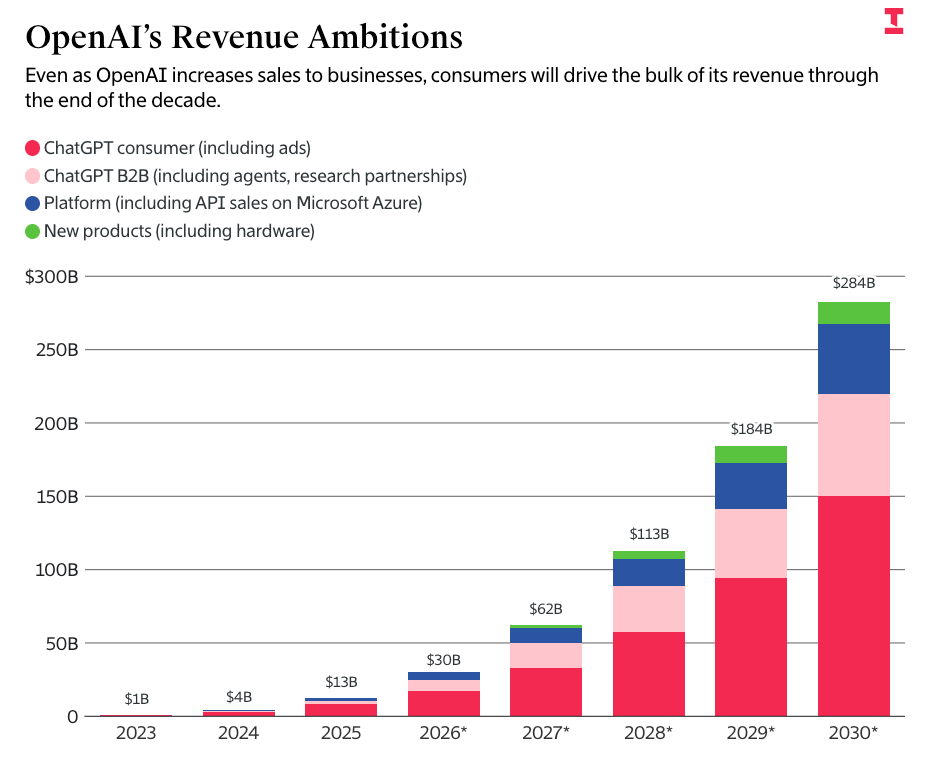
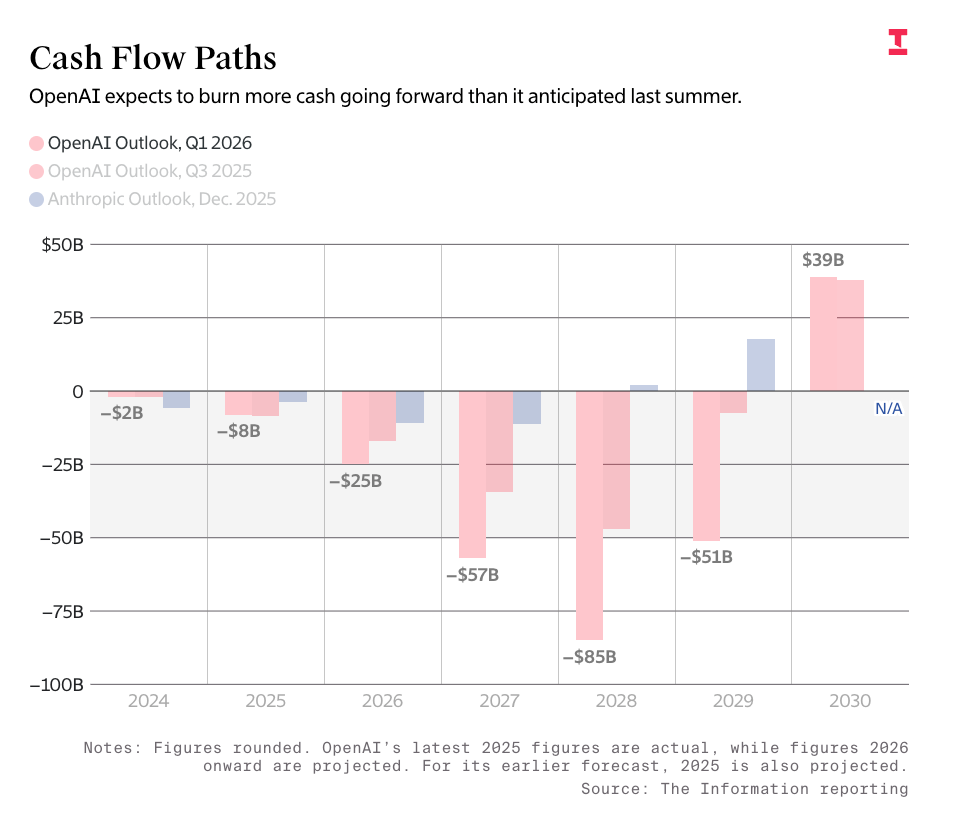
I must be clear that any journalist repeating these numbers without saying how fucking stupid they are should be a little ashamed of themselves. Per my Friday premium:
In other words, in two years OpenAI projects it will make more revenue than TSMC, in three years almost as much annual revenue as Meta, and by the end of 2030, as much annual revenue as Microsoft ($300 billion or so on a trailing 12 month basis).
And if OpenAI can’t pay for that compute, Oracle dies, because it’s taken on around $115 billion in debt just to build Stargate’s data centers, and needs another $150 billion to finish them:
Oracle is a company that currently makes around $64 billion in annual revenue, and had free cash flow of negative $24.7 billion in its last quarter. It raised $18 billion in bonds in September 2025, $25 billion in bonds in February 2026, it did a $20 billion at-the-market share sale sometime in March, and despite it being called “closed” for months, only appears to have recently closed its $38 billion in project financing for Stargate Wisconsin and Shackelford. I’m also including the $14 billion in data center debt related to Stargate Michigan.
Either way, Oracle is insufficiently-capitalized to finish Stargate Abilene. It will need at least another $150 billion to get this done, and that’s assuming that other partners pick up about $30 billion in costs. Honestly, it may be more.
I really need to be clear that Oracle has no other path to making this revenue without OpenAI, and these projects are entirely financed and paid for using the projected cashflow of the data centers themselves.
And I’m not even the only one worried about this, with OpenAI Sarah Friar sharing similar concerns after the company missed user and revenue targets, per the Wall Street Journal:
OpenAI recently missed its own targets for new users and revenue, stumbles that have raised concern among some company leaders about whether it will be able to support its massive spending on data centers.
Chief Financial Officer Sarah Friar has told other company leaders that she is worried the company might not be able to pay for future computing contracts if revenue doesn’t grow fast enough, according to people familiar with the matter.
Board directors have also more closely examined the company’s data-center deals in recent months and questioned Chief Executive Sam Altman’s efforts to secure even more computing power despite the business slowdown, the people said.
If that doesn’t worry you, perhaps this will:
She has emphasized to executives and board directors the need for OpenAI to improve its internal controls, cautioning that the company isn’t yet ready to meet the rigorous reporting standards required of a public company. Altman has favored a more aggressive timeline for an IPO, some of the people said.
That sure sounds like a company that’s gonna be able to make $852 billion by the end of the decade!
Anthropic Is Just As Bad As OpenAI, Committing To Up To 10GW ($100BN+ Annual Revenue) In Compute From Google and Amazon
While I regularly bag on OpenAI for its ridiculous promises, Anthropic isn’t far behind, promising to take “up to” 5GW of capacity from both Google and Amazon in a deal that I estimate includes around $100 billion in actual compute commitments given the scale of the capacity.
Now, I should add that Google and Amazon are far-savvier and less-desperate than Oracle, meaning that they can take the hit if Anthropic ends up running out of money. The “up to” part of that deal gives them some much-needed wiggle room that Oracle simply does not have.
Nevertheless, for Anthropic to actually meet its commitments, it will have to agree to spend anywhere from $25 billion to $100 billion a year on compute by the end of 2030.
Anthropic’s CFO said in March that it had made $5 billion in revenue in its entire existence.
There Needs To Be $156.8 Billion In AI Annual Compute Revenue To Support The 15.2GW of AI Data Centers Under Construction, and $1.18 Trillion To Support All 114GW Announced
The near-pornographic excitement around however many hundreds of billions of dollars of GPUs that Jensen Huang claims to be shifting regularly clouds out a problematic question: sell the compute to who, Jensen?
If we assume that the 15.2GW of data center capacity under construction (due by the end of 2028) has a PUE of around 1.35, that leaves us with roughly 11.2GW of critical IT. At $14 million per megawatt, that works out to around $156.8 billion in annual revenue in GPU rental revenue required to actually make these data centers worth it.
When you calculate for the 114GW of capacity theoretically coming online by the end of 2028, that number climbs to $1.18 trillion in annual revenue.
To give you some context, CoreWeave — the largest neocloud with Meta, OpenAI, Google (for OpenAI), Microsoft (for OpenAI), Anthropic, and NVIDIA as customers — made around $5.1 billion in revenue, and projected it would make $12 billion to $13 billion in 2026.
Who, exactly, is the customer for all this compute, and how likely is it that they’ll want to buy it by the time all that capacity is built? While many different data centers claim to have tenants for the first few years of their existence, said tenants can only start paying once the data center completes, and if it’s an AI startup, I think it’s fairly reasonable to ask whether they exist by the time it’s built.
Remember: the customers of AI compute are, for the most part, either hyperscalers trying to move capital expenditures off their balance sheets or unprofitable AI startups. Anthropic and OpenAI both intend to burn tens of billions of dollars in the next few years, and neither of them have a path to profitability.
This means that a large part — if not the majority of — AI compute revenue is dependent on a continual flow of venture capital and debt, both of which are only made possible by investors that still believe that generative AI will be the biggest, most hugest thing in the world.
How does that work out, exactly? Who is paying for this data center capacity? Who is it for? Where is the actual demand?
And if said demand exists, how the fuck do the customers even pay?
Generative AI Is Unprofitable and Unsustainable, And Only Getting More Expensive
Despite multiple stories that have both of them becoming profitable by 2028 or 2029, nobody can explain to me how OpenAI or Anthropic actually reach profitability, especially given that both of them had worse margins than expected, even when said margins strip out training costs that number in the billions of dollars.
And I’ve been asking this question for fucking years. Every time we get a new update on Anthropic or OpenAI, we hear they’ve lost billions more dollars than expected, that margins are decaying, that costs are skyrocketing, that everything is more expensive despite promises that the literal opposite would happen.
Even Cursor, a company that briefly (before its pseudo-acquisition by Musk’s SpaceX) claimed it had positive gross margins, actually had negative 23% gross margins as of January, or negative 31% if you include the cost of non-paying users, which you fucking should if you actually care about your accounting. Mysteriously, reports claim that Cursor’s margins “recently turned positive,” but magically don’t know by how much, or how that happened, or a single other detail other than one that likely helped the company get sold.
I also don’t see how any of these AI data centers actually make sense, even if they have customers to pay them for the first few years. The economics are built for perfection, with zero fault tolerance. They must have consistent, 100% utilization and tenancy, or they end up burning millions of dollars and fail to chip away at the years-long wall of depreciation created by the tech industry’s most expensive mistake.
Even if they somehow succeed, these are pathetic businesses with mediocre margins — 70% at best, assuming consistent payments, tenancy, and six fucking years of depreciation to actually break even, which might be difficult considering the yearly upgrade cycle makes the entire thing near-obsolete by the time you’re done paying it off.
And that’s before you consider that the majority of the customers are unprofitable, unsustainable startups.
I truly don’t know how any of this works out.
LLMs Are A Ripoff, And Customers Have Been Lied To
I realize it seems a little much, but I genuinely believe that subscription-based AI services were an act of deception tantamount to fraud, as they misrepresented the core unit economics and thus the possibilities of a Large Language Model. By selling users a product on a monthly rate and creating habits based on its availability, companies like Anthropic and OpenAI have misrepresented their businesses in such a way that most of their users are interacting with products and building workflows based on products that are unsustainable and impossible to maintain in their current form.
Anthropic’s recent aggressive rate limit changes were instituted mere months after multiple aggressive marketing campaigns based on experiences that are now near-impossible under the current rate limits, and based on recent moves by Anthropic, it’s clear that it intends to start removing services for its lower-tier $20-a-month subscribers at some time in the future. This is a disgusting and misleading way to run a company, and the vagueness with which Anthropic discusses its products and its services are an insult to every one of their users, and a sign that it doesn’t fear the press in any meaningful way.
I need to be very clear that the product that Anthropic offers — by virtue of recent rate limit changes — is substantially different (and far worse) than the one that you read about everywhere. Anthropic was conscious in its deliberate attempts to market a product that it knew would be gone within three months. Dario Amodei doesn’t give a fuck as long as the media keeps writing up however many billions of annualized revenue he’s conjured up today or whatever new product he’s released that’s meant to destroy some hapless public SaaS company that had already seen its growth slow.
Members of the media, I say this with abundant respect: Anthropic is mistreating its customers, and it is doing so because it believes it can get away with it. This company does not respect you, and in fact holds you with a remarkable degree of contempt, which is why it doesn’t bother to fix its services very quickly or explain why they were broken with any level of coherence.
That’s why Anthropic fucking lied about Claude Mythos being too powerful to release (it was actually a capacity issue) when in fact it’s just another fucking Large Language Model Nothingburger — because it thinks you will buy whatever it is selling, and it’s worked out exactly how to package it to give you enough plausible “proof” that a quick skimread of the system card will make you and your editor believe whatever it is you’re saying.
They also know you’ll rush to cover it rather than waiting to see what actual experts say.
AI is a con, and this is how the con works. AI was rushed and pushed in our faces as quickly as humanly possible in the least-efficient yet most-accessible form it could be presented, even if said form was never going to result in anything resembling a sustainable business. The media was rushed to immediately say that this was the thing so that everybody would agree that this was the thing now and use it as much as physically possible, and, crucially, use it in a subscription-based form that would make people experience it without ever asking how much it costs to provide.
The narrative came pre-baked. Because very few people who talked about LLMs experienced their actual cost, it was really easy for them to vaguely say “it’s just like Uber,” because that was a company that lost a lot of money but didn’t die, and it’s much easier to say that than say “wait, what do you mean OpenAI is set to lose $5 billion this year?”
Think of it like this: as a reporter, an investor, an executive, or a regular LinkedIn Lounge Lizard, you might read here and there that it’s $5 per million input tokens and $25 per million output tokens, but you’ve never really experienced how fast or slow one loses that money, because it’s important to do so to truly understand this product. Anthropic and OpenAI intentionally obfuscated that experience and created businesses that expect to burn tens of billions of dollars in 2026 and several hundred billion dollars by 2030, all because most people graded generative AI based on the subscription-based experience.
LLMs are a casino, and you’ve been gambling with the house’s money while encouraging people to bet their own on whether they’ll get a unit of work out of a particular model.
This was intentional. They never wanted you thinking about the costs because once you really start thinking about the costs this whole thing feels a little insane. I truly believe that LLM-based subscriptions are going to go away entirely, at least at the scale of any product that generates code, and in doing so, Amodei and Altman will wrap up their con, or at least believe that they have.
The problem is that these men have now signed far too many deals to get away scot-free.
OpenAI’s CFO has now said multiple times that she doesn’t believe OpenAI is ready for IPO, and has material concerns about its growth and continued ability to meet its obligations. To repeat a quote from before:
Chief Financial Officer Sarah Friar has told other company leaders that she is worried the company might not be able to pay for future computing contracts if revenue doesn’t grow fast enough, according to people familiar with the matter.
This is a blinking red fucking light, and in a sane market would send Oracle’s stock into a tailspin, because OpenAI’s ascent to over $280 billion in annual revenue is critical to Oracle’s ability to not run out of money. In a sane media, this would send worrisome shockwaves through every group chat and Slack channel about whether or not OpenAI is actually going to make it.
This is the kind of thing that happens before a company starts dying. OpenAI’s growth is slowing at precisely the time it needs to accelerate. It needs to effectively 10x its current business by 2030 to make its obligations. OpenAI’s CFO, the literal person who would know best, is saying that she is worried that OpenAI cannot pay its fucking compute contracts if revenue doesn’t grow. This is a big, blinking warning light! This is not a drill!
Yet the bit that really worried me was the Journal’s comment that Friar didn’t think OpenAI “was ready to meet the rigorous reporting standards required of a public company.”
What the fuck does that mean? Excuse me? This company has allegedly raised $122 billion and is allegedly worth $852 billion god damn dollars and expects to burn $852 billion dollars by the end of 2030. Are its accounts not in order? What “rigorous reporting standards” can OpenAI not meet?
I’d generally not be so fucking nosy if it wasn’t for the fact that this company accounted for something like 20% of all venture capital funding in the last year and everywhere I go I have to hear the endless bloviating of Altman and Brockman and every other man at OpenAI and their fucking ideas about what regular people should do as they swan about shipping dogshit software and spending other people’s money.
For the amount of oxygen that both Anthropic and OpenAI consume, both of these companies should be fucking flawless, both as products and businesses. Instead, both are sold through varying levels of deception around their economics and efficacy, obfuscating the truth so that their Chief Executives can amass money and power and attention. It’s an insult to both good software and good taste — the most-expensive, least-reliable applications ever invented, their mistakes forgiven, their mediocrities celebrated, their infrastructure hailed as an inert god of capital.
Generative AI is an insult. It is unreliable, its economics don’t make sense, its outcomes don’t justify its existence, and the perpetrators of its con are boring, oafish and avaricious men disconnected from society and anybody who would ever disagree with them. It requires stealing art from everybody, destroying the environment, increasing our electricity bills, the constant threat of economic annihilation, the endless cacaphony of “everything fucking sucks now because of AI,” all to push software that can only be justified by people willing to ignore basic finance or sense.
It’s all so expensive, and it’s all so fucking dull. It’s offensively boring. It’s actively annoying. Every story where somebody tells you about how much they use AI sounds like they’re in an abusive relationship and/or joined a cult, echoing with a subtle desperation that says “you really need to join me in this because it’s so good, and the fact that I appear to be experiencing no joy from this product is just a sign of how efficient it is.” There is nothing light-hearted or joyful about what AI can do. There is nothing goofy or whimsical about a Large Language Model, and every interaction feels hollow.
Those who desperately look for clues that it’s becoming sentient or “more powerful” are simply seeking validation themselves — they want to be first to something, because arriving at other people’s conclusion is what they do for a living.
Being “first” — on the “frontier” one might say — is something that people crave when they can’t find something within, and it’s exactly the fuel that grifters crave, because LLMs are constantly humming with the sense that they’re about to do something new, even though they’re mathematically restricted to repeating other actions.
This is a deeply sad era. The people that have so aggressively worked together to hold up this industry have only delayed its inevitable fall. It’s terrifying to me that our markets and parts of our economy are being held up by the generally-held yet utterly-unproven assumption that LLMs will somehow get cheaper, that AI startups will magically become profitable, and that offering AI compute will be profitable in perpetuity to the point that it necessitates increasing the current supply tenfold by the year 2030.
People have debased themselves to defend the AI industry, because that’s what the industry demands of its supplicants. To be an “AI expert” requires you to actively ignore the worst economics of any industry in history, to constantly explain away obvious, glaring issues with products, and to actively convince others to do the same. OpenAI and Anthropic do not provide clear explanations of how they’ll become profitable because they know that their supporters will never ask for them — because the only way to fully “believe in AI” is to actively wear blinders.
And I get it. If you accept that OpenAI and/or Anthropic will eventually collapse, all of this seems a little insane. I am genuinely asking you to seriously consider that one or both of these companies will run out of money.
I’m really worried, made only more so by the general lack of concern I’m seeing in the media and greater society.
The assumption, if I had to imagine, is that I’m simply being alarmist, and that “the demand will absolutely be there.”
You’d better hope you’re right.
For Larry Ellison’s sake, at least. Ellison has already pledged 346 million shares of his Oracle stock — or around $61.5 billion — “to secure certain personal indebtedness, including various lines of credit,” meaning “many big, beautiful loans against his Oracle shares.” which IFR estimated back in September (when Oracle’s stock price was much higher) could allow him to secure as much as $21.4 billion in debt at a (they say “conservative”) loan-to-value ratio of 20%, and that’s assuming the banks weren’t particularly generous.
If OpenAI can’t raise $852 billion in revenue and funding by the end of 2030, it won’t be able to pay for Stargate. That’ll kill the value of Oracle’s stock, leading to a series of margin calls, leading to Ellison having to sell shares, leading to further margin calls. Whatever bailout might or might not exist won’t save Larry’s estate.
What I’m saying is that Ellison’s future rides on Sam Altman’s ability to raise funding and make revenue to the tune of $852 billion in the space of 4 years.
Good luck, Larry! You’re going to need it.

Two weeks ago, I quit my job.
It wasn’t a bad job, not by most metrics. It ticked the boxes a job is supposed to tick: good pay. Health insurance. Remote work. Time off. Nice coworkers.
I worked as our org's only design engineer and maintainer of our design system. My job was to build components, to polish the final product that went out into the world, and to bridge gaps between design and engineering. During my time, I doubled surface coverage of our components, chipped away at bugs, and fixed accessibility issues. I published documentation. I administered twice-yearly surveys which indicated high satisfaction from the team—up significantly compared to when I began. I was doing good work.
And yet, work was rendering me increasingly miserable. I questioned myself. Why am I here? Does any of this work actually matter? And if I stop caring about the quality of my work... will anyone notice? (An uncomfortable thought.)
I knew I was tired, but I wasn't sure if I wanted to quit. I took a week off to consider it, and told myself: if you still want to leave at the end of this week, hand in your resignation.
The following Monday, I handed in my resignation. I felt immediate relief. I had nothing else lined up, but I knew I needed to go. I'm unsure when (or if) I'll return to full-time tech work.
What happened?
<figure>
 (quality:90)
<figcaption>
Not long after quitting, my phone dropped and shattered. Photo by the author.
</figcaption>
</figure>
(quality:90)
<figcaption>
Not long after quitting, my phone dropped and shattered. Photo by the author.
</figcaption>
</figure>
The psychic toll of AI
Consider the following scenarios:
- You join a meeting with a coworker. Your coworker has enabled an AI tool to automatically take notes and summarize the meeting. They do not ask for consent to turn it on. The tool mischaracterizes what you discuss.
- A team lead adds an AI chatbot to a Slack channel. Anyone can tag the bot to answer questions about the company's products. Coworkers tag the chatbot many times a day. You never see someone check that the bot's responses are correct.
- An engineer adds 12,000 lines of code affecting your app's authentication. They ask that it be reviewed and merged same-day. Another engineer enlists a "swarm" of AI agents to review the code. The code merges with no one having read the full set of changes.
- A designer is tasked with exploring a new feature. They prompt an AI tool for an interactive prototype. Design crit is spent analyzing visual details in the generated prototype, with minimal discussion of core ideas, goals, or tradeoffs.
- One of your pull requests has been open for a few days. You ask other engineers to leave a code review. Minutes later, an engineer pastes a review that was generated by an AI tool. There are no additional thoughts of their own.
- You point an engineer to the relevant section of a library's docs in order to request a feature. They tell you that the feature request is not possible, and send a screenshot of their chat with an AI tool as proof.
- Documents and code are being generated faster than team members can review. You get the feeling that most people have stopped reading altogether.
- Organization leadership has mandated that each person adopt new AI tools to "uplevel" themselves and their team.
I encountered each of these scenarios over the past few years, and each one left me wondering: do I raise an issue about AI here? Do I ask my coworker to disable their note-taking tool, or do I allow them to record me? (Where does the data go? Who is reading it? Do we retain knowledge in the same way without manual note-taking?) Do I voice concerns over unread code entering the codebase, and the consequences of that pattern for institutional knowledge-building? Do I ask others on the design team to delay prototyping until later in the design process? Is it already too late to ask? Has the team already shipped the code, already designed the feature, already moved onto the next task? If someone requests my review on a pull request that was clearly vibe coded, do I review the code and write comments as usual, or send it back to them for self-review? Would initiating these discussions result in interpersonal stress? Should I just let things slide? Would I become known as a "difficult" coworker for pushing back on AI use? Does any of it really matter? Does anyone really care?
All of these questions consumed energy. Whether I decided to confront them or not was moot: they left me tired and alienated either way. AI had hooked its tendrils into every corner of my work life. Even if I, personally, abstained from most AI usage, I was steeped in an environment which made it impossible to avoid. Pushing back felt futile.
<aside> I prefer to avoid AI usage for ethical, practical, and financial reasons.
- Ethically: Generative AI tools, powered by data centers which consume vast amounts of water and pollute our environment, are built on the collective theft of the works of millions of artists, developers, authors, and other creatives, supercharge the spread of disinformation and fascism, have repeatedly provoked psychosis and suicide, and concentrate wealth in fewer hands while providing cover for widespread layoffs.
- Practically: I have found that AI tools overcomplicate implementations and that cleaner, simpler solutions can often be written by hand. AI doesn't "know" anything, and is making life worse for open source maintainers. Overreliance on AI risks deskilling.
- Financially: I dislike sending money to large corporations when alternatives include learning the skill for free and contributing to open source projects. Tokens are currently heavily subsidized and likely to become more expensive, so I would prefer not to make a habit of using them.
I use AI tools sparingly for assistance while refactoring code in languages I understand. I occasionally use it to help compose command line arguments for tools like ffmpeg. I never use AI to generate images, video, or prose.
</aside>
The explosion of AI has played a significant role in my own burnout. Worse, it feels inescapable. Few tech organizations are taking a principled stance against AI use.
But AI use is only one part of broader social trends within tech that leave me questioning whether I should remain here.
The loss of an ideal
When I started full-time design and dev work in the 2010s, tech was generally understood to be a progressive place. This was peak "fun tech job" era, with magazines publishing glossy covers about life at Google. Apple had a gay CEO!
The web was still in flux; as a designer, the prospect of shaping sites into more usable forms excited me. Usability and user-centered design were hot topics. Budding federal organizations like 18F and the United States Digital Service were embarking on meaningful technology-enabled civic work.
After Trump's first election, people recoiled with shock and disbelief. How could this happen? Many organizations distanced themselves from the administration and reiterated their commitment to equality. Then, the COVID-19 pandemic hit, alongside a surge of protests for racial justice. There was a glimpse of unity. Biden was elected and swiftly proclaimed a return to "normal".
"Normal" landed us where we are now: the second Trump administration, more flagrantly corrupt and cruel than the first. Protests surge (larger than ever!) amidst a quieter type of elite resignation. The words "equity" and "inclusion" are no more.
Tech organizations have now given up on pushing back against an unethical and violent administration, deciding that it is in their best business interest to flatter the president's ego with gold trophies and pandering praise. Elon Musk and the "Department of Government Efficiency" took a sledgehammer to 18F and replaced it with National Design Studio, a propaganda shop whose main talent is building expensive and inaccessible landing pages.
Leaders at Google have abandoned former climate pledges as they work to build new data centers powered by natural gas turbines which emit more carbon than the entire city of San Francisco. Other tech CEOs smile for photos alongside war criminals.
<figure class="no-bleed" style="max-width: 560px;">
 (quality:100)
<figcaption>
Guillermo Rauch, CEO of Vercel, poses with Benjamin Netanyahu, prime minister of Israel. The International Criminal Court has issued an arrest warrant for Netanyahu for "war crimes of starvation as a method of warfare and of intentionally directing an attack against the civilian population." Original tweet.
</figcaption>
</figure>
(quality:100)
<figcaption>
Guillermo Rauch, CEO of Vercel, poses with Benjamin Netanyahu, prime minister of Israel. The International Criminal Court has issued an arrest warrant for Netanyahu for "war crimes of starvation as a method of warfare and of intentionally directing an attack against the civilian population." Original tweet.
</figcaption>
</figure>
I keep asking myself:
What happened to the principles that were professed a decade ago? To address climate change? To reduce racial, gender, and economic inequality? To "don't be evil"?
Were these principles abandoned, or were they merely born of convenience?
Has tech always been like this? Was I just blind to it before?
When I say that I am burnt out I do not mean simply that I am tired. I'm referring to the "emotional experience of political defeat":
Burnout in Freudenberger’s articles from this period is not just defined in terms of physical tiredness as a result of doing too many things; rather, it emerges from emotional investment in a cause and from the disappointments that arise when flaws in a political project become apparent. Freudenberger’s concept not only describes physical exhaustion but also acknowledges the need to deal with anger caused by grief brought about by the “loss of an ideal.” Burnout in the context of social justice projects thus often involves a process of mourning, according to Freudenberger. Returning to his earlier writings on burnout makes it clear that when understood as a malaise arising from politically committed activities, burnout cannot be equated with tiredness or stress.
<cite>Hannah Proctor, Burnout, p. 92</cite>
I love designing and building things for the web, but I'm mourning an industry that does not share the ideals I once thought it did.
I understand why people use AI. Life can be difficult and confusing. Prompting the machine is so alluring—it answers with such certainty! How could it be wrong? (And even if it is a little wrong, well... hasn't it saved time? Does it need to be perfect?) The temptation is real.
I don’t blame people for opting to use tools that promise quick, convenient solutions to problems. We all operate under capitalism. Many of us have bullshit jobs where the goal is not, in fact, to make something good, or even to learn, but to simply make money to pay rent and medical expenses. To hopefully find a little joy on the side. The whole system is broken; AI alone didn't break it, but it is widening the cracks.
I guess what I'm trying to say is I wish none of us had to live like this. I would like to imagine a future that does not look like this.
Ironically, what I've gained from AI is a deeper appreciation for human communication, in all its messy imperfection. The point of a code review is not simply for good code to make it into a codebase, but to build institutional knowledge as people debate and iterate and compromise, slow as it may be. Friction is good.
<blockquote class="bluesky-embed" data-bluesky-uri="at://did:plc:xfjf7fkhv6rwsx5e6p2ar37o/app.bsky.feed.post/3midldzhcdc26" data-bluesky-cid="bafyreid2n3rks7uaki5mqzi55obgrmvj7av5bf6wiixaqanxf6bvrwoycq" data-bluesky-embed-color-mode="system"> <p lang="en"> I’ve posted it before, but it feels evergreen
The two hardest problems in Computer Science are
- Human communication
- Getting people in tech to believe that human communication is important </p> — Hazel Weakly (<a href="https://bsky.app/profile/did:plc:xfjf7fkhv6rwsx5e6p2ar37o?ref_src=embed">@hazelweakly.me</a>) <a href="https://bsky.app/profile/did:plc:xfjf7fkhv6rwsx5e6p2ar37o/post/3midldzhcdc26?ref_src=embed">March 31, 2026 at 2:46 AM</a> </blockquote><script async src="https://embed.bsky.app/static/embed.js" charset="utf-8"></script>
Where do I go from here?
No matter how rapidly technology changes, I am coalescing around some core beliefs:
- Things that are worth doing are worth doing well.
- Things that are done well require time and effort.
- You make meaning through the doing.
- Ideas are common; effort is not.
- There are no shortcuts.
I am, as it stands, without a job. Recovering from burnout will take time. Thankfully, I have savings that afford me the privilege to take that time. I’m distancing myself from social media and news, at least for a little while. At some point, I will need to decide if I want to remain in this industry, and if so, where to go next.
In the meantime, I’m going to the gym. (Crossfit, weirdly.) I’m learning more about how synthesizers work and I'm generating different sounds. I’m looking at birds. I'm looking at my cat. I’m continuing to build tools to help trans people with legal name changes. I'm spending time with friends.
Eventually I will find new work. Who knows where.
Next Page of Stories