1363 stories
·
1 follower

The relentless rule of my fitness tracker

1 Share

At a time when we’re all blaming digital devices for ruining our attention spans, our children’s mental health and even the future of democracy itself, let’s give credit where it’s due: my cheap fitness watch has changed my life.

Three and a half years ago I started running at my local Parkrun, taking more than half an hour to limp around the 5k course for the first few weeks. After a few months of consistently showing up I made the kind of progress one might expect. But when I bought an entry-level runner’s watch, things really started to change.

Urged on by the watch, I began training several times a week and lengthening the runs to 10k, 10 miles and beyond. My wife got the bug — and her own watch. Our daughter described us as “running mad”. You be the judge: mad or not, I’m running the London Marathon in April next year. As a stubborn non-runner for the first 49 years of my life, there’s no way I’d have signed up for that sort of insanity without the watch.

These fitness trackers are not without their downsides, and I’ve become fascinated by the way they’re a microcosm of our increasingly quantified lives. The most obvious objection is that they are a privacy nightmare. They track our location and make sharing it easy and tempting. Stanislav Rzhitsky, a Russian submarine commander, was assassinated while going for a run in his local park; he was in the habit of posting his running routine on Strava. In the US, a man was convicted of murdering his wife after her Fitbit data contradicted his account of events.

And it is not just location: Carissa Véliz, the author of Privacy is Power, warns that with the right technology, heartbeat data can be as distinctive as a fingerprint. It’s unclear how much is already up there in the cloud, waiting to be abused by someone or other.

Fitness watch manufacturers would rather focus on these trackers as tools for performance. Even in this respect, there is a mixed picture. Like any good performance metric, my watch provides me with structure and helps me optimise my running. I can feed in a goal — a distance, a time — and it will generate a training program. Once-difficult tasks, such as running at a consistent pace, become straightforward.

Yet like many performance metrics, the watch can also nudge me into counter-productive activity such as overtraining to the point of injury. The sleep-tracking function tempts many people into thinking too much about sleep, which is the sort of thing that can make it hard to drift off. There’s a term of art, “orthosomnia”. It means that you’re losing sleep because you’re worried that your sleep tracker is judging you.

There is another subtle effect at work, something called “quantification fixation”. A study published last year by behavioural scientists Linda Chang, Erika Kirgios, Sendhil Mullainathan and Katherine Milkman invited participants to choose between a series of two options, such as holiday destinations or job applicants. Chang and her colleagues found that people consistently took numbers more seriously than words or symbols. Whether deciding between a cheap, shabby hotel or an expensive swanky one, or between an intern with strong management skills or one with strong calculus skills, experimental subjects systematically favoured whatever feature had a number on it, rather than a description such as “excellent” or “likely”. Numbers can fixate us.

“A key implication of our findings,” write the researchers, “is that when making decisions, people are systematically biased to favour options that dominate on quantified dimensions. And trade-offs that pit quantitative against qualitative information are everywhere.”

They may or may not be everywhere, but they are certainly in my fitness regimen. My watch takes walking, cycling and running seriously — especially outside rather than on a treadmill — but a hard session at the gym barely registers. It will count my steps for me, but I have to count my own pull-ups. The result is an incessant tug away from exercise that may be good for my body or my spirit, but which doesn’t “count” — and towards the kind of aerobic, trackable activity that the watch rewards.

Management theorists have long known about this problem. Steve Kerr’s essay in the Academy of Management Journal, “On the Folly of Rewarding A While Hoping for B”, is 50 years old and the folly seems more common than ever, perhaps because we now have an ever easier selection of automatically generated metrics upon which to fixate.

Quantification fixation may explain an early, infamous study of using fitness trackers for weight loss, published in 2016, which found that the trackers made it harder rather than easier to lose weight. That might be a statistical fluke, but it might also reflect the fact that when you exercise more you may be inclined to eat more. The fitness tracker monitors and therefore encourages extra exercise, but turns a digital blind eye to extra calories — this is quantification fixation in automated form.

A different aspect of the same problem is when I face a choice between the run prescribed by my watch, or an opportunity to run with a friend — possibly over the wrong terrain, for the wrong distance, at the wrong pace. “Wrong”, of course, being defined by the sensors in the watch. It is almost always better to seize the opportunity for a sociable run, but do I always seize it? I do not. It’s a shame to let down a friend, but it’s a disaster to let down the watch.

We live in a quantified world and in many ways our lives are better as a result, whether the metrics have been used to create more effective medicines or more efficient delivery vans. My watch may be a punctilious little wrist-worn box of tricks, but my running, and indeed my overall fitness, is far better than it was before I bought it.

Still, we would do well to keep the quantification revolution in its proper place. I never would have started running in the first place without the friends who encouraged me to show up at Parkrun, a movement that relies on community spirit, deftly seasoned with just the right amount of quantification.

And I’m not running a marathon because my watch told me to do it; I’m running in memory of a young woman who died of cancer at the age of 20. The fitness watch is a means to an end, not the end in itself. All I need to do is to remember that.

Written for and first published in the Financial Times on 11 Sep 2025.

Loyal readers might enjoy the book that started it all, The Undercover Economist.

I’ve set up a storefront on Bookshop in the United States and the United Kingdom. Links to Bookshop and Amazon may generate referral fees.

Read the whole story
mrmarchant
3 hours ago
reply
Share this story
Delete

tobiasdrake: gutsygills:mold pisses me off so muchoh you have to eat your produce the moment it...

1 Share

tobiasdrake:

gutsygills:

mold pisses me off so much

oh you have to eat your produce the moment it leaves the store or the fuckin Hungering Dust will get it. and. poison your food

I ran into this post years ago and to be honest, it has completely reoriented the way I engage with food.

Like. I’ve always sorta understood that things grow moldy or stale or sour or such if left out, but I never really internalized it in a meaningful way.

But now I’m just like.

Yeah. The hungering dust. There exists omnivorous dust in the air that will eat my food if I don’t.

Those bagels have been sitting there for a week. Are we going to eat them soon or are we leaving them for the hungering dust?

Pizza’s been sitting out on the counter for an hour. Everyone’s enjoying the pizza, but if we don’t want “everyone” to include the hungering dust then we should probably put it away soon.

That’s just. That’s how food works to me now. There exists an invisible predator in the air that hungers for your yummies, and it will not hesitate to eat your food if you don’t make the effort to protect and preserve it. And eat what can’t be preserved before the dust can.

Life-changing.

Read the whole story
mrmarchant
17 hours ago
reply
Share this story
Delete

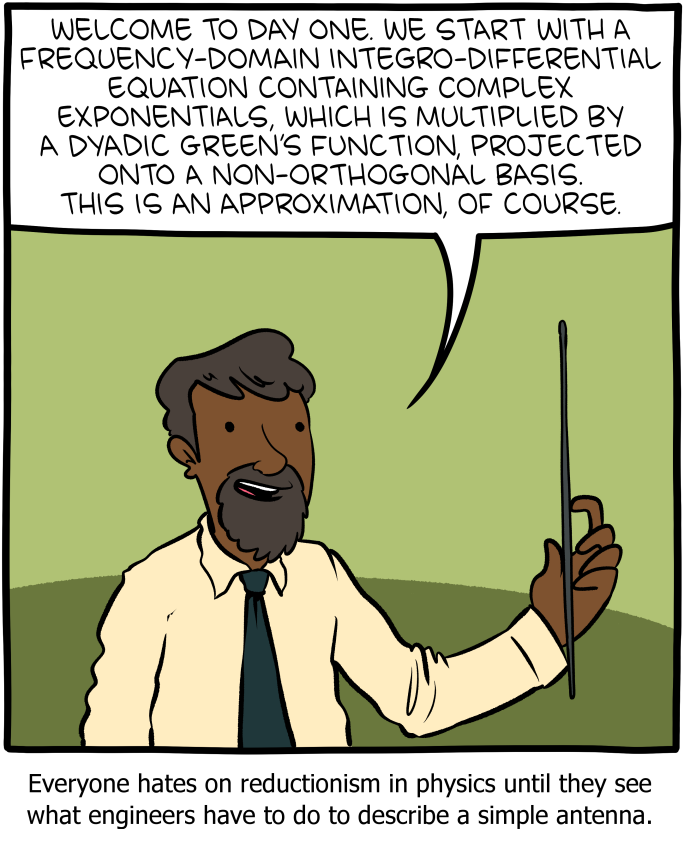
Saturday Morning Breakfast Cereal - Frequency

1 Comment and 3 Shares


Click here to go see the bonus panel!

Hovertext:
At first they fear that the antenna is a probe, but after about thirty minutes they wish it was merely probe day.


Today's News:
Read the whole story
mrmarchant
18 hours ago
reply
Share this story
Delete
1 public comment
GaryBIshop
14 hours ago
reply
Good one! Antennas are hard.

Slop is Everywhere For Those With Eyes to See

1 Share

Slop is Everywhere For Those With Eyes to See

The size of your plate can influence how much food you eat. The absence of a clock on a casino wall can keep you gambling through the early morning. On social media, our For You Pages give us the illusion of infinite content. How our environments are designed influences how we consume. And wouldn't you know it, everything around us is designed for maximum consumption.

Open TikTok, and you can easily burn through a hundred videos or more before you glance at the time. It doesn't help that the For You Page hides the time on our phones.

We are over consuming content on the FYP. The sudden surge of low-quality, AI-generated content, i.e. “AI slop,” is a byproduct of that overconsumption. We don't see it because, well, we're conditioned not to, but slop always arrives on time. Slop is inevitable. Slop is quintessential. Slop is everywhere for those with eyes to see.

Olive oil, wasabi, saffron, vanilla, Wagyu, honey, champagne, and truffle,...reality TV, all hold examples of what happens when demand exceeds supply— companies fill the gap with slop. The free market loves a good filler. So, why should the digital realm be any different?

The For You page is designed to keep us playing the dopamine slot machine for as long as possible. The Average Time on Site metric is still the goose that lays the golden eggs, and both TikTok and Meta are reporting that their egg baskets have never been fuller.

But, there's a problem. On any given platform, only 1-3% of users publish content. It's called the 90-9-1 rule, and platforms that rely on free user generated content have been trying to solve this problem since the beginning of the commercialized web. The introduction of the For You Page, and the illusion of endless content, has only exasperated the inequity.

Curation used to be part of our media consumption process. We would hop from website to website looking for a laugh. We used to click on hyperlinks for Christ's sake. Now, all we must do is sit at the trough and let daddy Zuck feed us.

In a recent essay, Joan Westenberg makes a complementary argument that the algorithm has “flattened” curiosity by eliminating the need to “hunt” for our content. They go on to say:

There’s a concept in behavioral science called the “effort heuristic.” It’s the idea that we tend to value information more if we worked for it. The more effort something requires, the more meaning we assign to the result. When all knowledge is made effortless, it’s treated as disposable. There’s no awe, no investment, no delight in the unexpected—only consumption.

(I'm reminded of the scene in Jurassic Park when the tour Jeep pulls up to the Tyrannosaurus rex exhibit. Doctor Grant says “The T-Rex doesn't want to be fed. It wants to hunt.”)

This type of mindless consumption is not only harming our curiosity, it's helping to cheapen creativity for the people who produce what we consume.

Creativity isn't scalable. Content creation has a hard productivity ceiling. Every human-created video on our feeds require some level of writing, production, and editing. Yet the For You Page has made the content consumption so efficient, that perhaps demand has exceeded supply.

If you're a product manager for a social media platform, you can reduce the friction of publishing content to the app, or ship better editing tools, but you can't optimize creative spark. You can't treat humans like content-generating machines (as much as they have tried). Despite the illusion of infinite scrolling thanks to the FYP, art remains a finite resource bound to the whims of human creativity.

You see their problem.

Mark Zuckerberg wants us on his platforms, flicking our thumbs, for as long as possible. But the more we open Instagram, the more creators he needs posting multiple times each day. Mark has very little control over this variable. Creators could suddenly post less, or simply stop posting all together, and there's nothing he could do about it. What's worse, creators could demand Meta pay them for their art.

Could you imagine?

Actually, yes. And it turns out, you could rather effectively kill a platform if you got a small group of top creators organized and angry.

Twenty on the Vine #

In the summer of 2016, twenty social media personalities took down one of the largest mobile video apps on the internet. They wanted money for their labor. The executives at Vine said no. The gang of twenty, who were the highest performing creators on the app, walked away. They stopped posting entertaining content to Vine, and instead repeatedly implored their followers to find them on competing apps.

Vine shut down for good just months later.

From Inside the secret meeting of Vine stars that ushered in the app’s demise:

Vine’s spectacular rise and fall showed the power of online creators. Its demise offers crucial lessons for platforms trying to engage with power users — and a deeper understanding of who ultimately controls a social product.

Vine creators exposed and exploited a weakness in Vine's conventional approach to social media. Follower count had power. Old-style discovery algorithms could be easily manipulated. Vine creators used that power to take over the app, and convinced users to migrate to other platforms.

You see why follower counts are less important today, and why black-box algorithms have full control over who goes viral and who gets “shadow banned.” TikTok saw the mistakes of its predecessor, and made it so content creators could never exercise collective influence again.

Because virality now feels more like gambling, I suspect people post more content today than a decade ago. But it's not enough. Our insatiable appetites for content is pushing for corporations to meet that demand with slop. 

If it were up to TikTok and Meta, our feeds would be exclusively robot-made. Humans are a variable they cannot control, and I think they despise us for it.

Anyway, I have good news. Outside of our FYPs you'll find a surplus of art, essays, articles, and videos just waiting to be discovered. And best of all, these artists and writers are making things on their own terms. We, too, can enjoy the products of their labor on our terms, while not giving a dime of our attention to big tech.

This is the open web. Or the social web. Or the open social web. Or the-- you get the point. To find it, you must reacquaint yourself with the lost art of surfing the web.

Surfing the web is very different than scrolling the FYP. You don't often hear the words ”mindful” and “internet” together but, surfing the web was an art of mindful consumption that doesn't much exist today. Not to get all old man yells at cloud at you, but maybe we should bring it back?

Up next: The Lost Art of Surfing The Web (coming soon)

Read the whole story
mrmarchant
1 day ago
reply
Share this story
Delete

America could have $4 lunch bowls like Japan—but our zoning laws make them illegal

1 Share

In Japan, workers rely on healthy lunch bowls for under $4. Japanese media literally tracks these prices because they're a daily staple for working people. The Japanese media reported on a surge in their price from $2.63 to $4.25 in 2021.

In America, we track grocery prices. Restaurants are luxury goods.

The U.S. lacks this budget restaurant tier! There's obviously demand for it. We'd buy $4 balanced meals if we had the option.

How does Japan’s restaurant market do this?

It’s not grocery prices; Japan’s grocery prices are ~18% higher than the United States.

It’s not hourly wages. Japan’s minimum wage ($6.68 an hour) is similar to America’s ($7.25).

Japan’s zoning and health codes allow tiny businesses!

Japan allows businesses that are only a few feet wide. Japanese restaurants can operate in small spaces, like one floor of a narrow single-stair case building (no wasted space or resources on a shared lobby).

"Koreatown manhattan 2009" by chensiyuan, CC BY-SA 4.0. Grabbed from Noah Smith.

In Japan, someone can even build a tiny coffeeshop in front of their home.

Because of small setups like these, many Japanese restaurants have only one or two staff. Some restaurants are physically so small that they can only seat two to five people. In some, you even eat standing up.

A tiny restaurant staffed by just a single person, their stove, and a rice cooker can sell you lunch for a similar price you'd pay at home.

The overhead is minimal.

But in the US, tiny restaurants are illegal.

Our zoning laws require almost every business to:

  • Maintain a large building footprint

  • Provide 2-4 parking spaces per business

  • Operate at a scale that requires multiple employees

Food trucks could help if they were allowed at scale. But the restaurant industry fights to limit food trucks. On average, food trucks must handle 45 separate regulatory procedures and spend $28,276 on associated fees.

Relatedly, our health code regulations also effectively outlaw people from opening restaurants in small spaces. Most jurisdictions require at least 3-4 different sinks—one for washing dishes (usually a large three-part sink), separate ones for washing hands, one for mopping, and often another for prepping food. This makes small commercial kitchens in under 200 square feet much harder.

America’s food regulations are also not set up for a single person to manage. The U.S. has 3,000 different agencies handling food regulations. The whole system, scattered across eight places in the municipal code, is basically uncoordinated and varies depending on where you are.

When you force every restaurant to be big, expensive, and car-dependent, cheap daily food becomes harder.

Density also drives prices down.

Singapore has $3 hawker center meals. Hong Kong serves $4 lunch boxes. Even Manhattan has 99 cent pizza slices. These use a tiny storefront model that maximizes foot-traffic volume.

Foot traffic from dense neighborhoods provides a constant source of customers, so restaurants can profit from high volumes of sales, rather than high prices.

Japanese cities let restaurants cluster in mixed-use buildings where people live, work, and transit. A 20-seat ramen shop near a station sees hundreds of potential customers during lunch rush.

American zoning typically separates commercial and residential areas.

Outside of New York City, most U.S. restaurants need customers to make destination trips via car. That friction means fewer total customers, requiring higher prices to stay profitable.

Zoning and city design doesn’t just impact housing supply.

Half of Americans spend nearly an hour a day cooking, partly because there's no sub-$4 option. A lot of us hate cooking but don’t want to spend $11 at Chipotle.

This category of restaurant is a form of basic infrastructure in Singapore, Hong Kong, and Japan.

When regulations prevent everyday people from starting businesses on small lots, we don't just lose those businesses. We lose the price points they make possible.

Individual regulations, each reasonable in isolation, can combine to lock out exactly the small-scale solutions that would help working families most. We can rewrite the rules to enable the neighborhood businesses that working families actually need.

Read the whole story
mrmarchant
1 day ago
reply
Share this story
Delete

Why There’s No Single Best Way To Store Information

1 Share

Just as there’s no single best way to organize your bookshelf, there’s no one-size-fits-all solution to storing information. Consider the simple situation where you create a new digital file. Your computer needs to rapidly find a place to put it. If you later want to delete it, the machine must quickly find the right bits to erase. Researchers aim to design storage systems…

Source


Read the whole story
mrmarchant
1 day ago
reply
Share this story
Delete
Next Page of Stories