Log in



Wendell Berry, who died at his home in Kentucky yesterday, was a rare combination of poet and farmer. That wasn’t always an unusual thing in the literary world, but the authenticity of agricultural and pastoral poetry has been in decline since the days of Hesiod. Even Virgil was a bit of a poser. But Berry was the real deal in every way.
That would set him apart in any age, but especially in our own time, when so many of us (writers included) are cut off from nature and the holistic ecosystems of agrarian life.
To mark his passing, I’m sharing this article from my archive on Berry’s nine rules for technology. It’s a simple list, but a profound one—and even more relevant today than when it was first published in 1987.
If you want to support my work, the best way is by taking out a paid subscription (just $6 per month).
Back then, Wendell Berry was living on a farm in Kentucky. He did his writing with pen and paper, and his wife Tanya would create typewritten drafts of his manuscripts on a Royal standard typewriter purchased in 1956. That manual tool was, he insisted, “as good now as it was then.”
I’m sure he said the same thing about the implements he used to sow and reap. But friends told Berry he needed a computer. It would make it easier to write, they insisted.
In response, Berry came up with his list of nine reasons to embrace new technology. Let’s revisit them, one by one.
Nine Standards for Technological Innovation
(1) The new tool should be cheaper than the one it replaces.
This is a very persuasive selling point for new technology. And for most of my life, tech companies worked hard to lower prices.
I still recall my parents scrimping and saving in order to buy a color television when I was seven years old. It cost almost $500—a huge amount in those days.
They probably should have waited. A few months later, RCA dropped prices to $399. Prices continued to drop in later years. You can buy a high tech TV today at Best Buy for less than what my parents paid in the 1960s.
Computers also got more affordable—at least until recently. I got my first computer (an Apple IIE) when I was in graduate school—it was an expensive gift from the Boston Consulting Group in exchange for accepting their job offer.
The list price back then was $1,400. I could never have afforded to buy it on my tight student budget.
But, over a period of many years, each subsequent computer I acquired was better and cheaper than my previous model. Alas, that happy trend has now ended.
When I buy a new computer now, I pay more. And the performance is not always better. I recently had to scrap a new desktop after only a few months, and go back to my previous model. The new computer didn’t work as well as my five-year-old one.
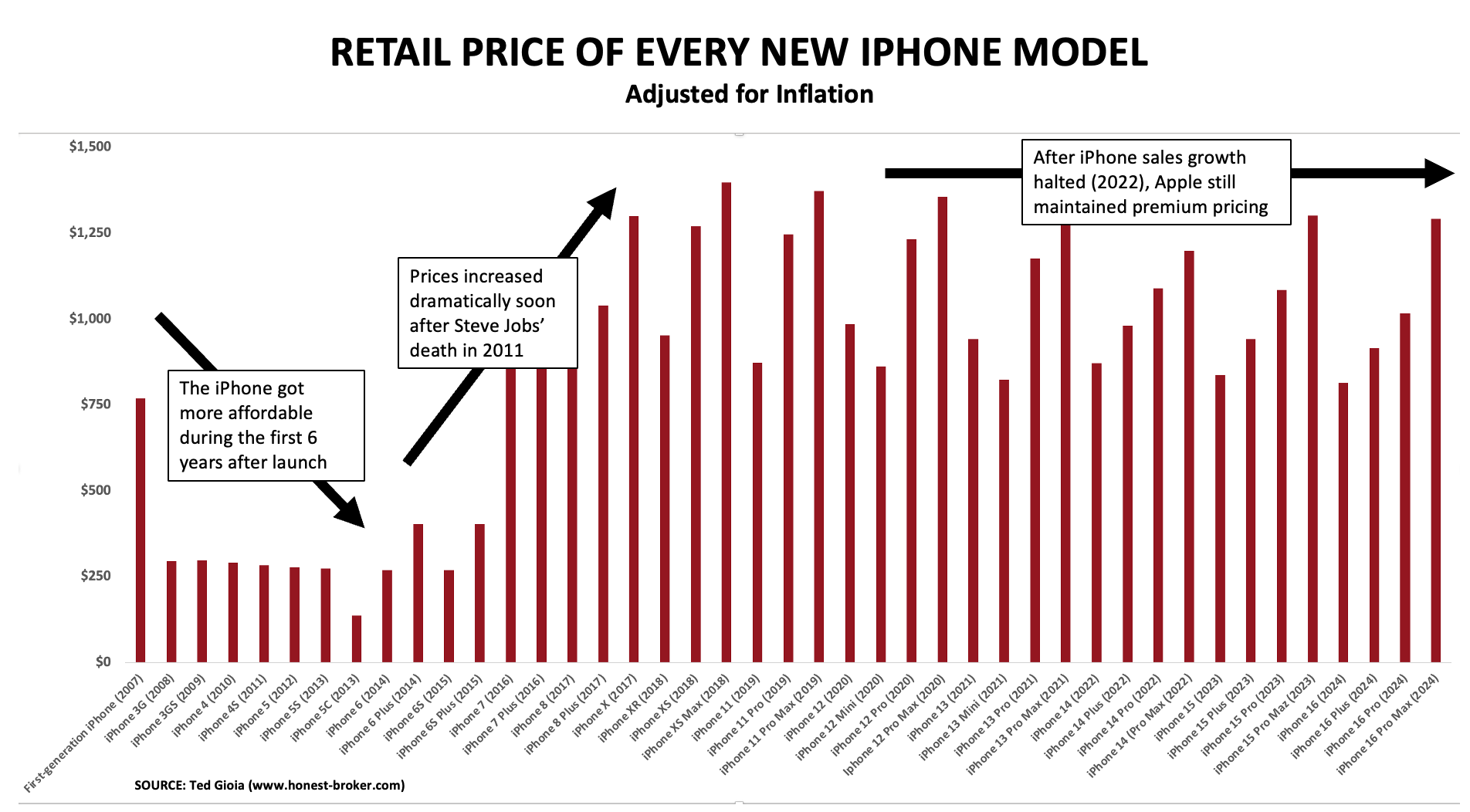
When did new tech stop getting cheaper and better?
I have a cranky answer, but an accurate one. It happened the day Steve Jobs died. Maybe not exactly on that date—but shortly afterwards.
Look at this chart of iPhone prices, adjusted for inflation, and you can see what I mean.
Now let’s go to the second reason to adopt new tech from Wendell Berry’s list.
(2) It should be at least as small in scale as the one it replaces.
This is another good reason to upgrade your setup. And tech did get smaller for many decades.
Guess who played a key role in that? Yes, Steve Jobs again. Because of his obsession with product design, we now carry a huge amount of advanced tech in our pocket.
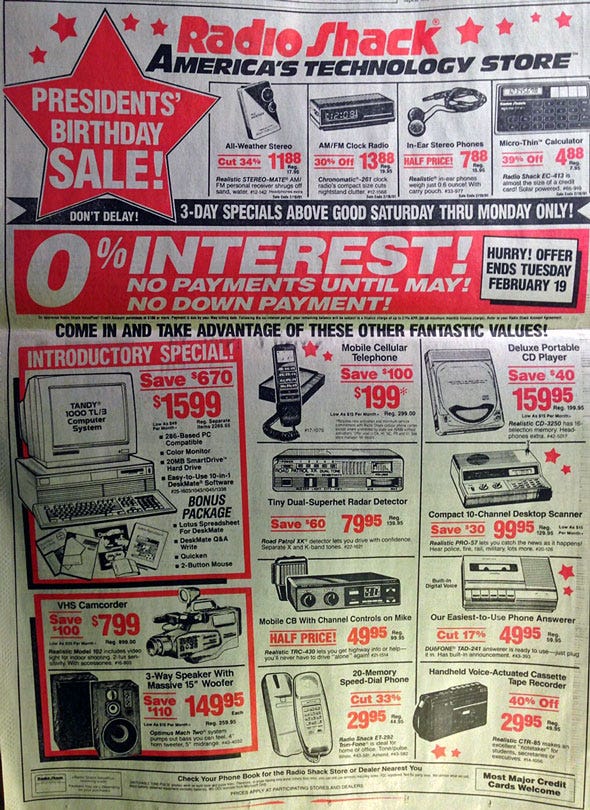
Just consider this remarkable fact: Every device featured in this Radio Shack advertisement from 1991 has been replaced by your tiny phone.
But this, too, changed soon after Jobs died. (Are you noticing a pattern here?)
The thinnest iPhone ever was the iPhone 6 (2014)—at a slim 6.9mm. The company continued to launch ‘mini’ models for a few years, but stopped after iPhone 13.
Tech is now bulking up. It’s not just the devices—wait until you see those AI data centers. A single facility can spread over two kilometers.

(3) It should do work that is clearly and demonstrably better than the one it replaces.
This is the most obvious requirement for new tech. It needs to work better than old tech.
But Silicon Valley has totally abandoned this ideal. Every web interface I use has gotten worse over time—from search engines to social media to software to shopping apps.
Google is worse than ever. Social media is worse than ever. Amazon is worse than ever. Facebook is worse than ever. Everything I get from Microsoft is worse than ever.
So here, too, we see that new tech previously fulfilled Berry’s requirement—but stopped doing so around the time Steve Jobs died.
(4) It should use less energy than the one it replaces.
Here, again, we see an ominous reversal. With the rise of AI, tech companies now use up more energy than ever before. They are sucking the power grid dry in many places.
And it’s going to get worse—much worse.

What makes this especially revealing is the fact the public intensely dislikes AI—surveys make this absolutely clear. So tech companies are destroying the environment solely to increase their dominance and control—not to please you and me.
(5) If possible, it should use some form of solar energy, such as that of the body.
Now Berry is asking for something our technocracy has never delivered. And here we encounter the exact opposite of the AI situation described above. The hot new plan is to construct nuclear reactors on site. What could possibly go wrong?
There’s another striking contrast here. AI depends on huge investment from corporations, while consumers are mostly indifferent. Solar energy is the opposite: It’s supported by investment from consumers—who use it to heat their homes, water, etc.—while corporations are mostly indifferent.
What a sad state of affairs. Private citizens have more prudent approaches to tech than the tech companies themselves.
(6) It should be repairable by a person of ordinary intelligence, provided that he or she has the necessary tools.
This, too, has changed during my lifetime. I once saw my father unscrew the back of our home TV set, and fix a malfunctioning part. Nowadays you can’t even open up those bad boys.
Tech providers create all sorts of obstacles to prevent repairs—unusual screws, arcane software, special tools, etc.
Consider the case of John Deere tractors, which wouldn’t start until a company-trained technician cleared out the error code. The company also refused to sell spare parts. Their practices got so abusive that politicians passed right-to-repair bills to protect farmers.
But the worst example happened during the COVID pandemic, when companies tried to prevent hospitals from fixing their malfunctioning ventilators. Manufacturers put software locks on this life-saving equipment to prevent repairs.
This represents a total failure on the part of the technocracy—and actual malfeasance by the executives who run these companies.
(7) It should be purchasable and repairable as near to home as possible.
Finally I can give some tiny credit to our tech titans. They do offer home delivery—even if the product is made in a sweatshop far, far away.
(8) It should come from a small, privately owned shop or store that will take it back for maintenance and repair.
This is a pipe dream. The tech product lifecycle is built on planned obsolescence, not simple repairs.
When your device or software stops working, you replace or upgrade—whether you want to or not.
In some instances, you aren’t even allowed to own, let alone fix, your tech—you just license or lease or subscribe. It’s almost like capitalism in Silicon Valley has turned into communism. You will own nothing, and will love it.
(9) It should not replace or disrupt anything good that already exists, and this includes family and community relationships.
This may be the biggest tech failure of them all.
The leading tech companies have deliberately promoted dysfunctional apps that destroy lives. And they know it.
Leaked internal documents from TikTok show that they were aware that teens get addicted to their app in just 35 minutes. They built it that way.
Facebook knew that Instagram use leads to depression, anxiety, eating disorders, and other problems.
Spotify insiders have confirmed the company’s systematic plan to reduce royalties to musicians by manipulating passive listeners.
For more examples, see my list of 52 indicators that technological progress is reversing.
This is the new normal for tech: It deliberately makes things worse, not better.
Here’s the entire list of Wendell Berry’s criteria. If this were a report card, your tech leaders would all get failing grades.

The curious fact is that the most up-to-date and forward-looking thing is this whole article is Berry’s list from 1987. Nothing on it is obsolescent or inappropriate or dysfunctional or harmful.
I wish our tech companies could say the same for their work. Maybe they could learn a thing or two from our poet-farmer—or at least take a look at his list. We can only hope.