When writing a technical blog, the first 90% of every article is a lot easier than the final 10%. Sometimes, the challenge is collecting your own thoughts; I remember walking through the forest and talking to myself about the articles about Gödel’s beavers or infinity. Other times, the difficulty is the implementation of an idea. I sometimes spend days in the workshop or writing code to get, say, the throwaway image of a square-wave spectrogram at the end of a whimsical post.
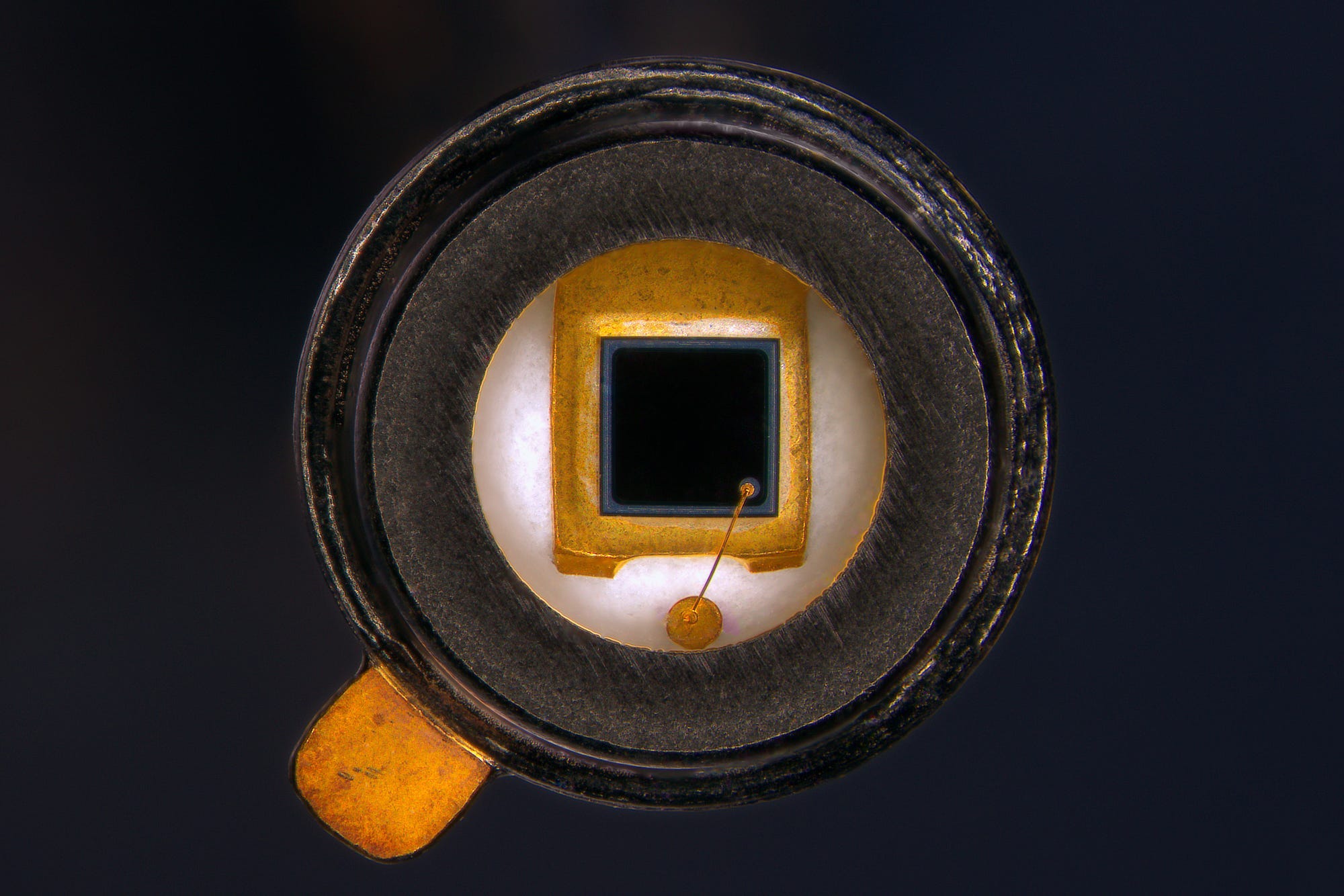
That said, by far the most consistent challenge is art. Illustrations are important, easy to half-ass, and fiendishly difficult to get right. I’m fortunate enough that photography has been my lifelong hobby, so I have little difficulty capturing good photos of the physical items I want to talk about:
A macro photo of a photodiode sensor. By author.
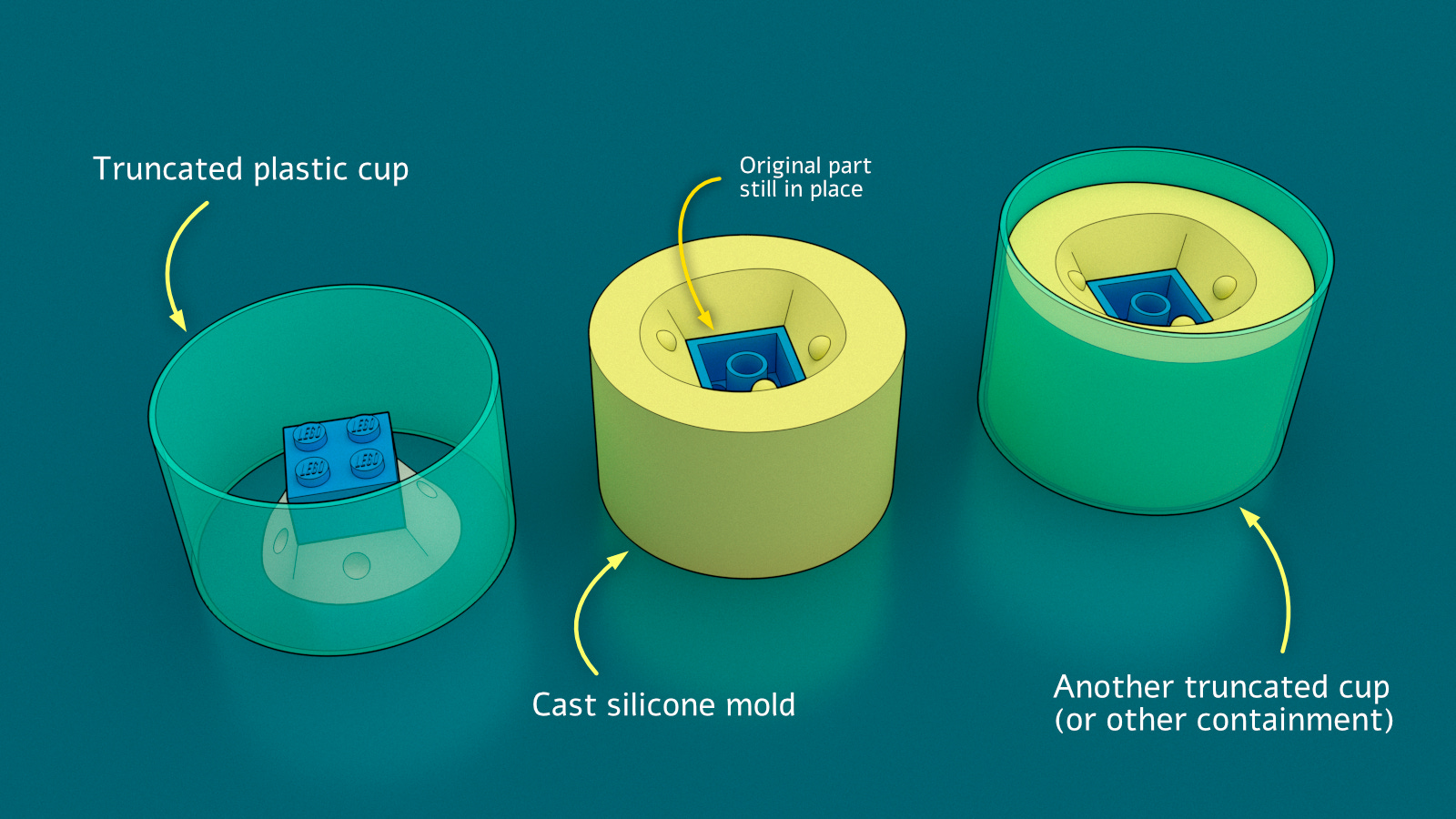
Similarly, because I’ve been interested in CAD and CAM for nearly two decades, I know how to draw shapes in 3D and know enough about rendering tech to make the result look good:
An explanation of resin casting, by author.
Alas, both approaches have their limits. Photography just doesn’t work for conceptual diagrams; 3D could, but it’s slow and makes little sense for two-dimensional diagrams, such as circuit schematics of most function plots.
Over the past three years, this forced me to step outside my comfort zone and develop a new toolkit for simple, technical visualizations. If you’re a long-time subscriber, you might have seen the changing art style of the posts. What you probably don’t know is that I often revise older articles to try out new visualizations and hone in my skills. So, let’s talk shop!
Circuit schematics
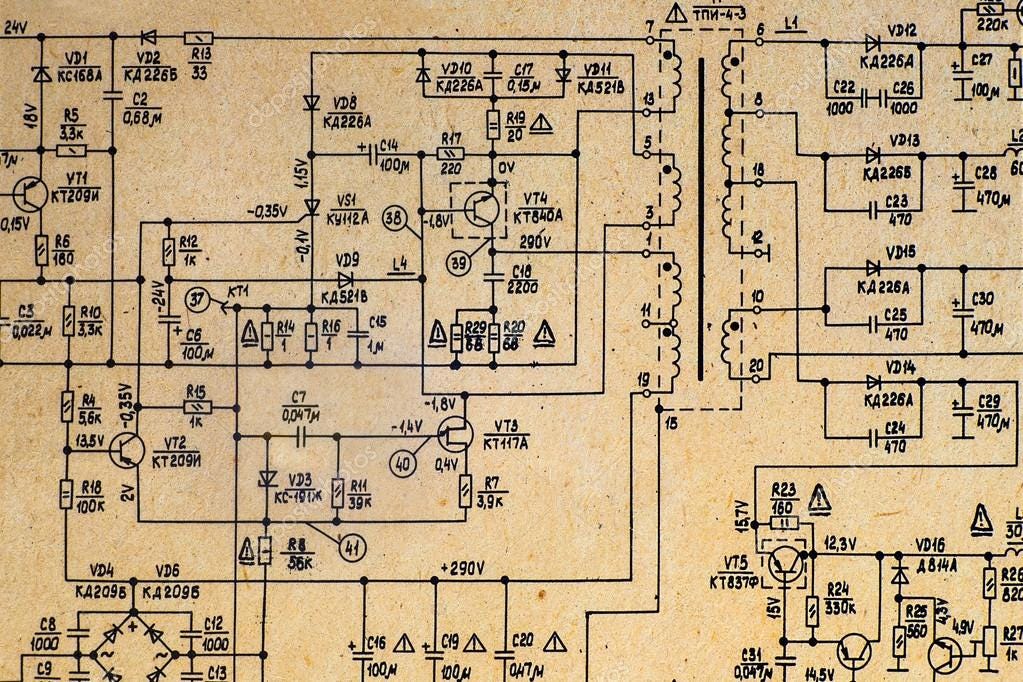
Electronic circuits are a common theme of my posts; the lifeblood of this trade are circuit schematics. I’m old enough to remember the beautiful look of hand-drawn schematics in the era before the advent of electronic design automation (EDA) software:
An old circuit schematic.
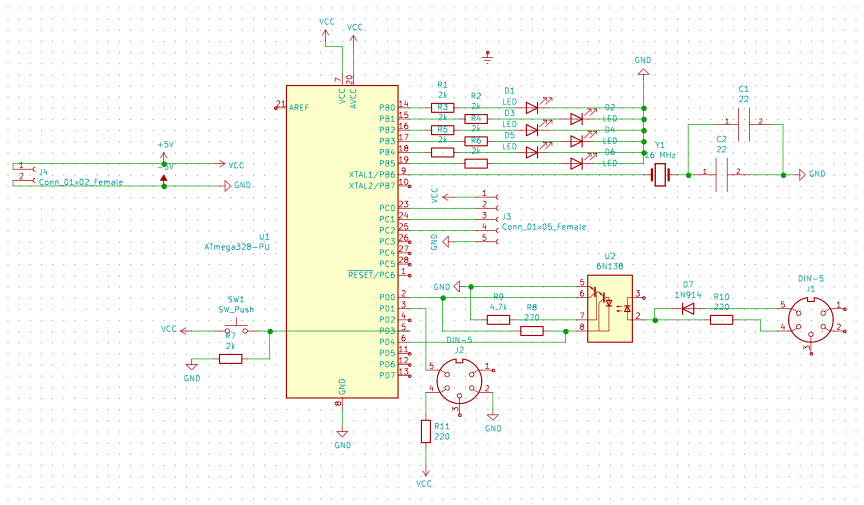
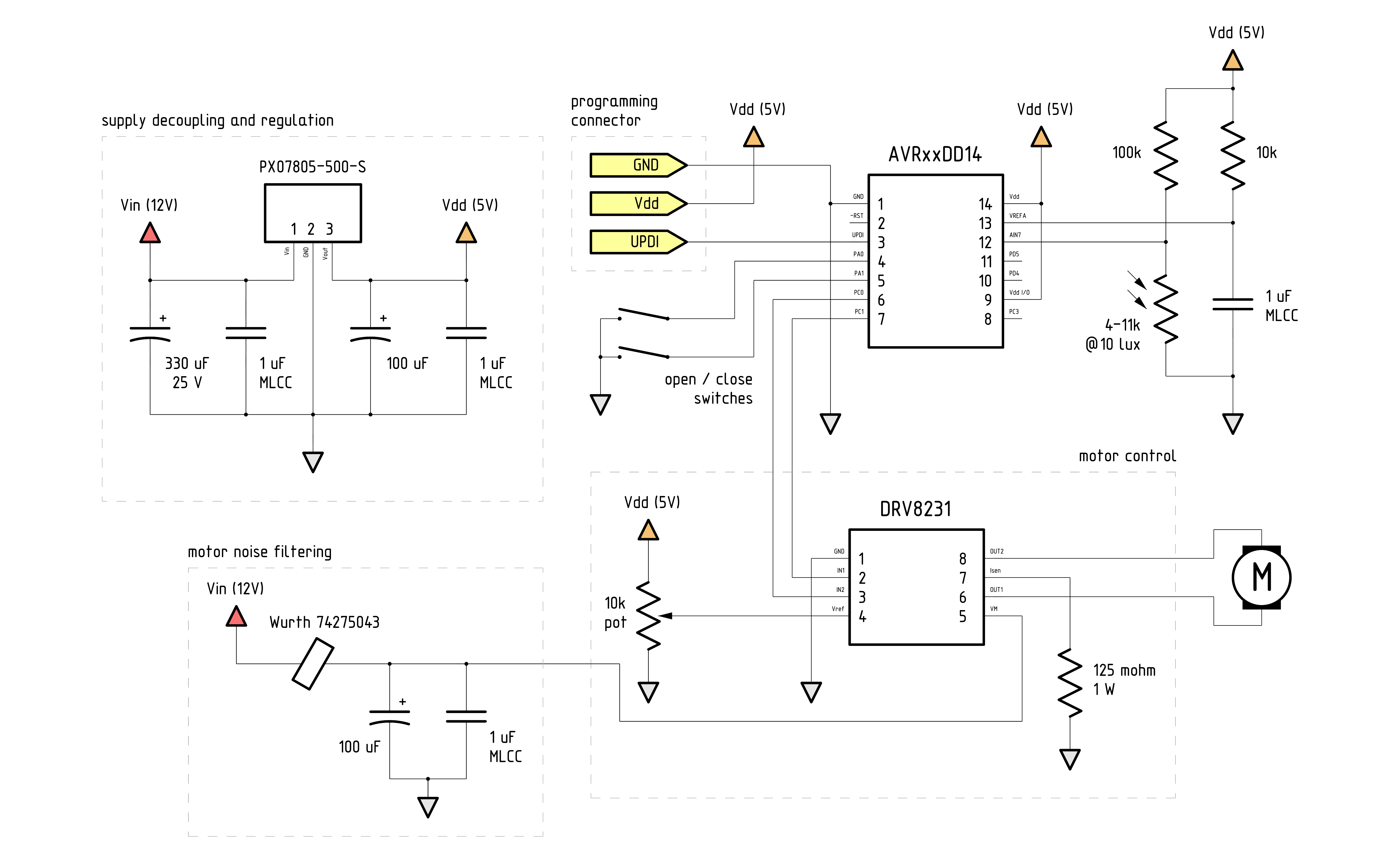
Unfortunately, the industry no longer takes pride in this craft; the output from modern schematic capture tools, such as KiCad, is uniformly hideous:
An example of KiCad schematic capture.
I used this style for some of the electronics-related articles I published in the 2010s, but for this Substack, I wanted to do better. This meant ditching EDA for general-purpose drawing software. At first, I experimented with the same CAD software I use for 3D part design, Rhino3D:
Chicken coop controller in Rhino3D. By author.
This approach had several advantages. First, I was already familiar with the software. Second, CAD tools are tailored for technical drawings: it’s a breeze to precisely align shapes, parametrically transform and duplicate objects, and so forth. At the same time, while the schematics looked more readable, they were nothing to write home about.
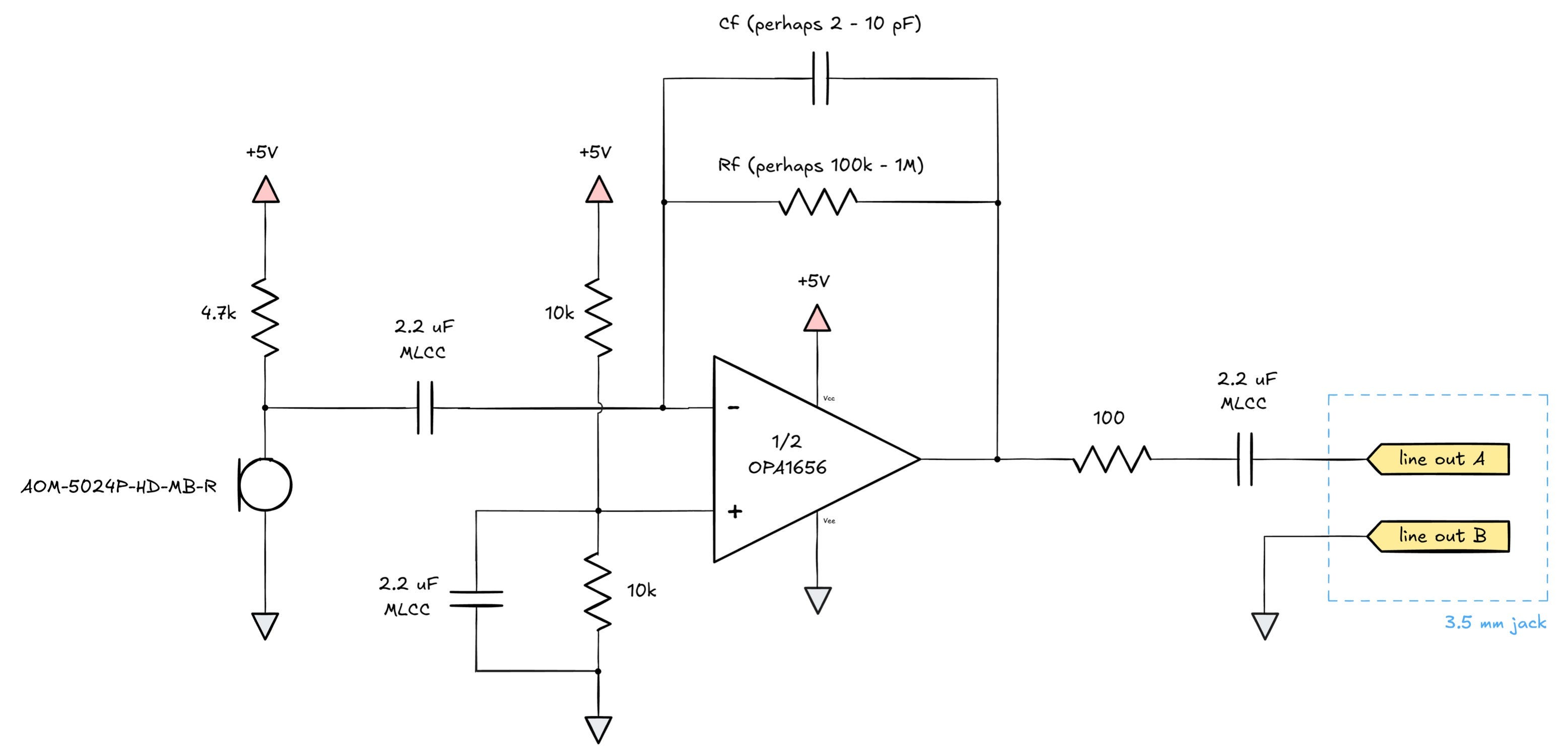
In a quest for software that would allow me to give the schematics a more organic look, I eventually came across Excalidraw. Excalidraw is an exceedingly simple, web-based vector drawing tool. It’s limited and clunky, but with time, I’ve gotten good at working around many of its flaws:
A schematic of a microphone amplifier in Excalidraw, by author.
What I learned from these two tools is that consistency is key. There is a temptation to start every new diagram with a clean slate, but it’s almost always the wrong call. You need to develop a set of conventions you follow every time: scale, line thickness, font colors, a library of reusable design elements to copy-and-paste into new designs. This both makes the tool faster to use — rivaling any EDA package — and allows you to refine the style over time, discarding failed ideas and preserving the tricks that worked well.
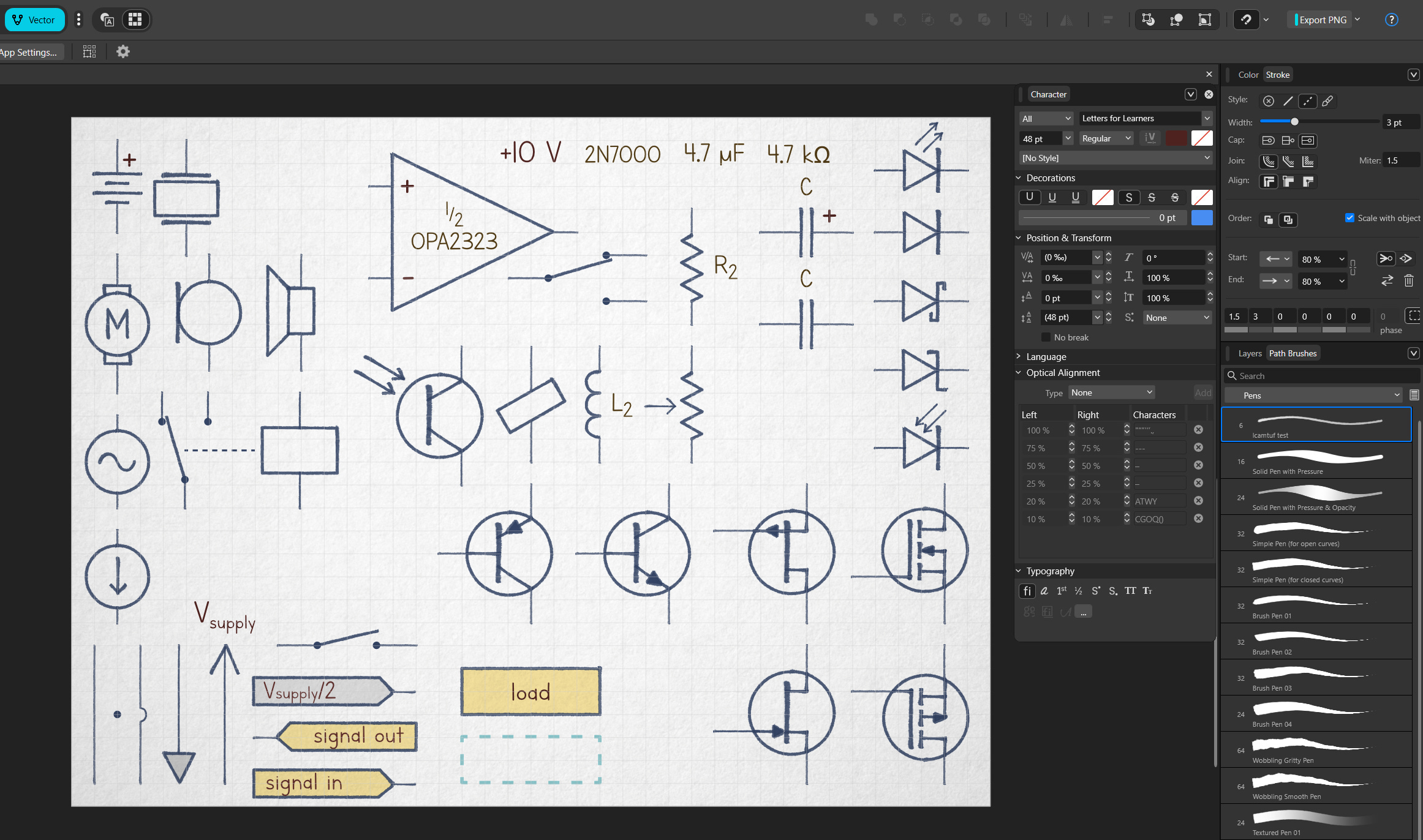
This brings us to Affinity. Affinity is a “grown-up” image editing suite that supports bitmap and vector files; I’ve been using it for photo editing ever since Adobe moved to a predatory subscription model for Photoshop. It took me longer to figure out the vector features, in part because of the overwhelming feature set. This is where the lessons from Rhino3D and Excalidraw paid off: on the latest attempt, I knew not to get distracted and to focus on a simple, reusable workflow first.
My own library of electronic components in Affinity.
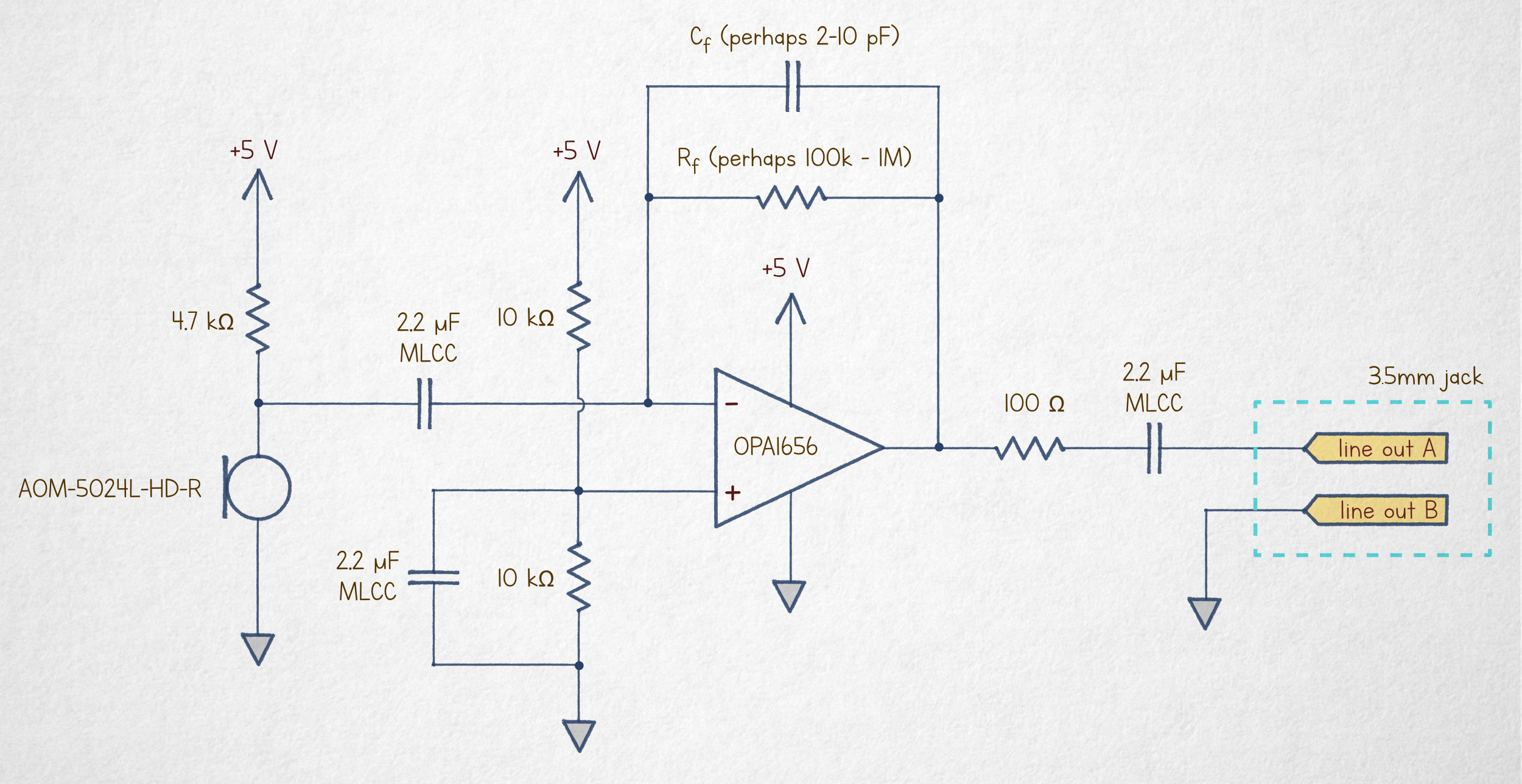
This allowed me to finally get in the groove and replicate the hand-drawn vibe I’ve been after. The new style hasn’t been featured in any recent articles yet, but I’ve gone ahead and updated some older posts. For example, the earlier microphone amplifier circuit now looks the following way:
A decent microphone amplifier. By author.
Explanatory illustrations
Electronic schematics are about the simplest case of technical illustrations. They’re just a map of connections between standard symbols, laid out according to simple rules. There’s no need to make use of depth, color, or motion.
Many other technical drawings aren’t as easy; the challenge isn’t putting lines on paper, it’s figuring out the most effective way to convey the information in the first place. You need to figure out which elements you want to draw the attention to, and how to provide visual hints of the dynamics you’re trying to illustrate.
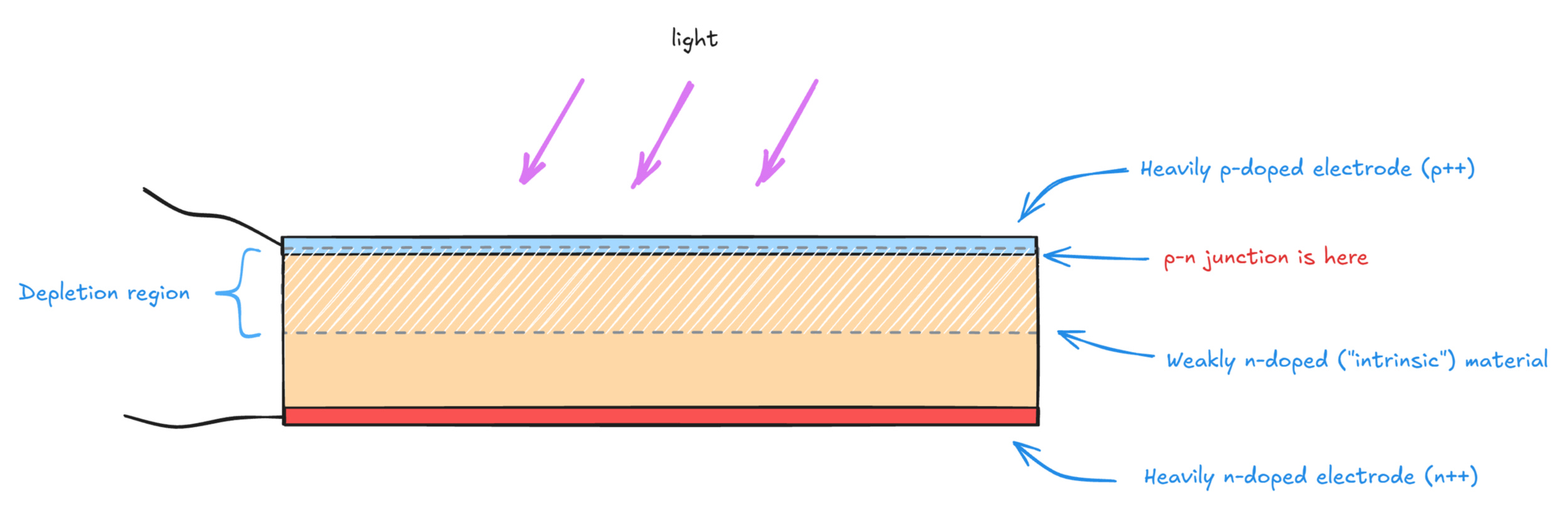
I confess that I wasn’t putting much thought into it early on. For example, here’s the original 2024 illustration for an article on photodiodes:
Photodiode structure.
It’s not unusable, but it’s also not good. It’s hard to read and doesn’t make a clear distinction between different materials (solid color) and an electrical region that forms at the junction (hatched overlay).
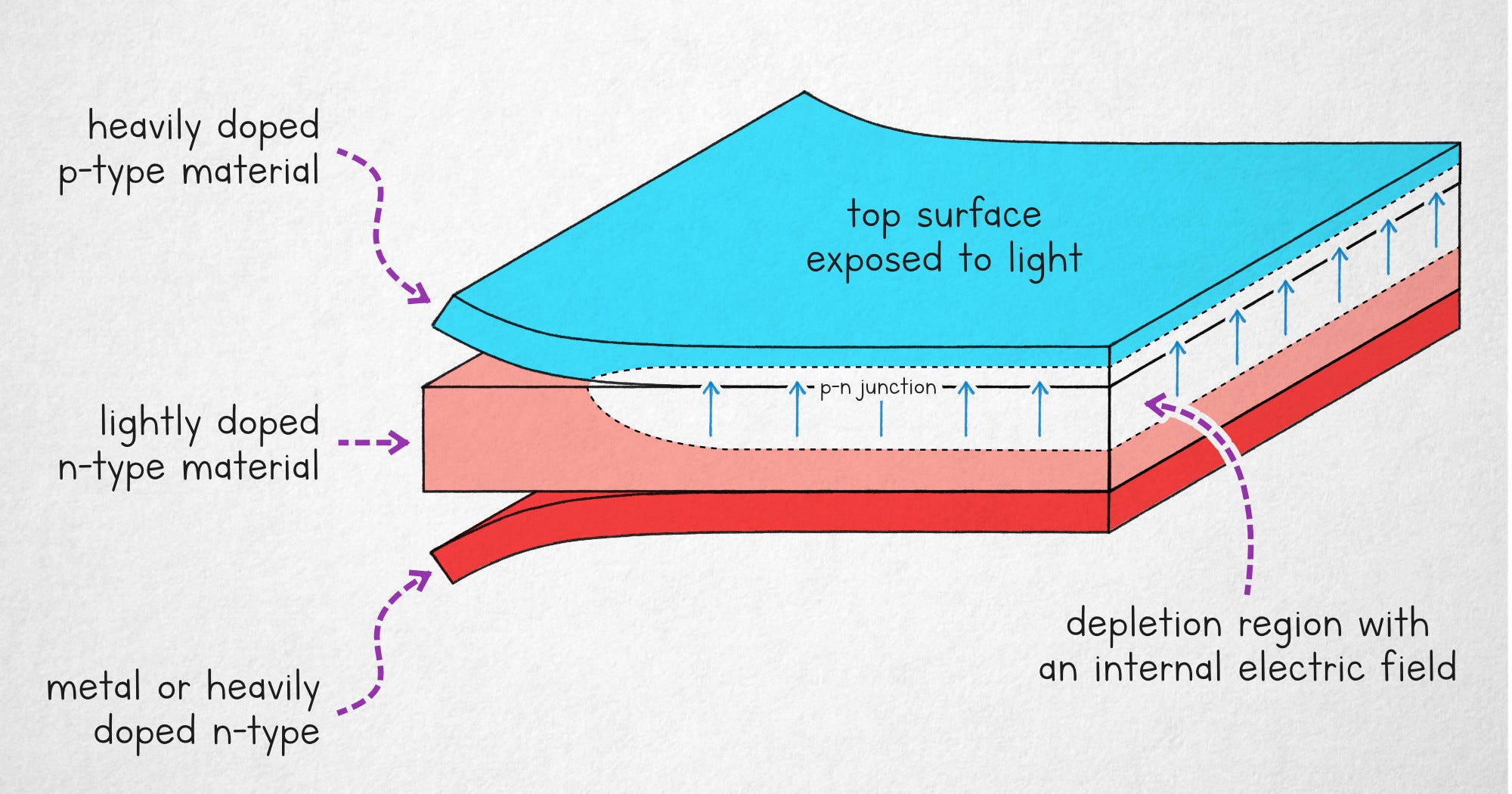
Here’s my more recent take:
A better version of the same.
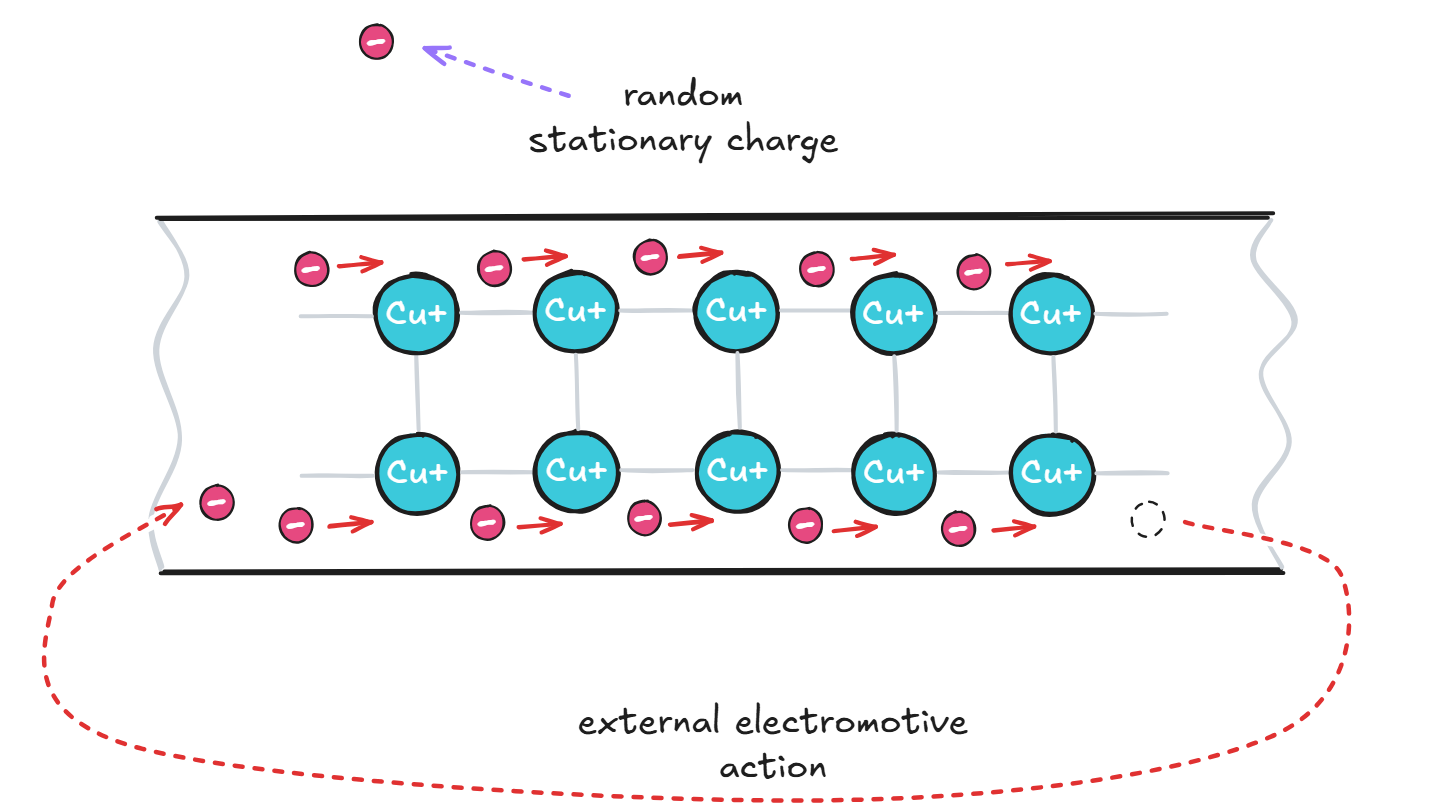
Once again, the trick isn’t pulling off a single illustration like this; it’s building a standardized workflow that lets you crank out dozens of them. You need to converge on backgrounds, line styles, shading, typefaces, arrows, and so on. With this done, you can take an old and janky illustration, such as the following visual from an article on magnetism:
A simple model of a conductor.
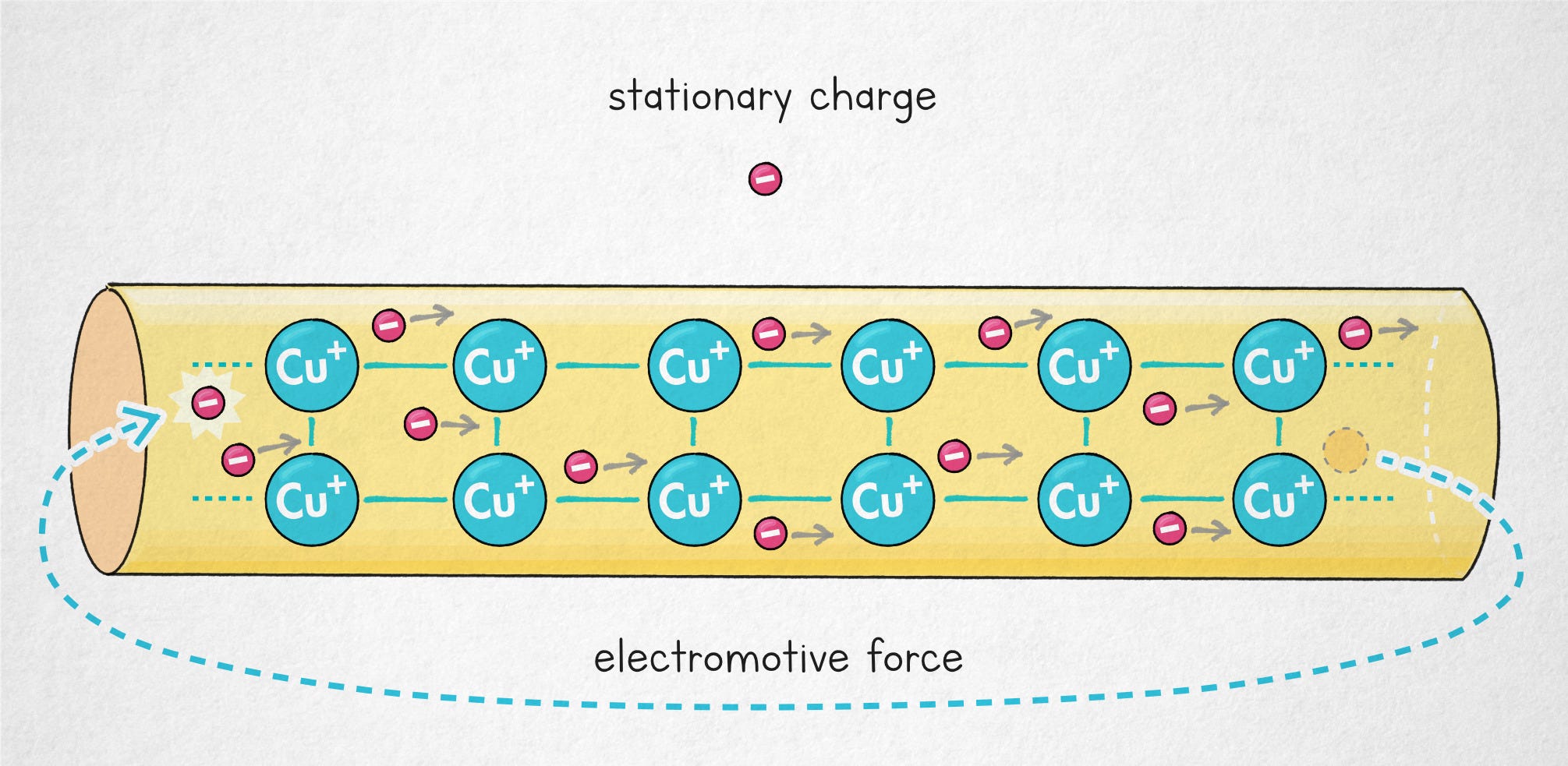
…and then turn it into the following:
A prettier model of the same. By author.
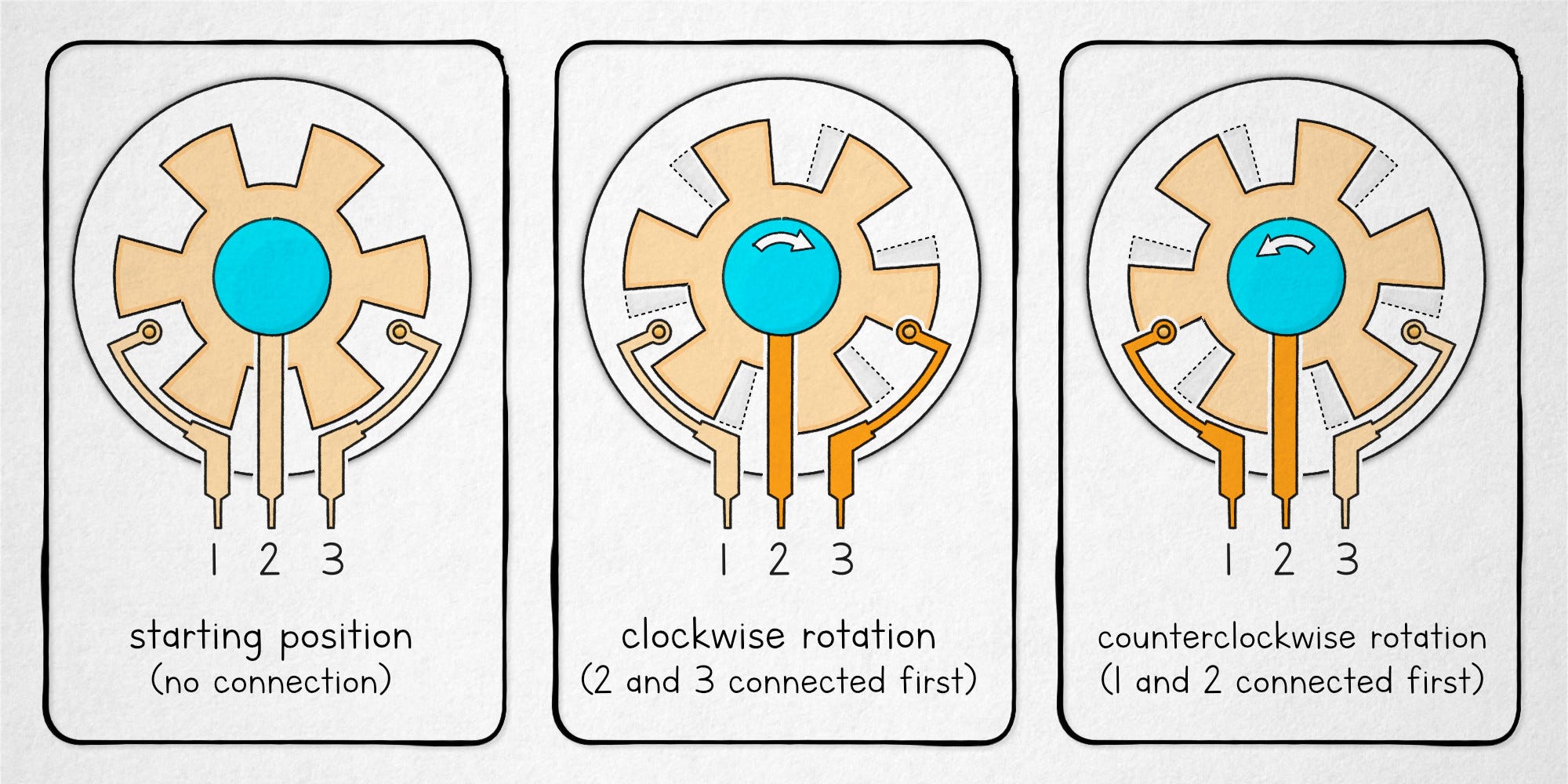
As hinted earlier, in many 2D drawings, it’s a challenge to imply a specific three-dimensional order of objects or to suggest that some of them are in motion. Arrows and annotations don’t always cut it. After a fair amount of trial and error, I settled on subtle outlines, nonlinear shadows, and “afterimages”, as shown in this illustration of a simple rotary encoder:
Explaining a rotary encoder.
The next time you see a blog illustration that doesn’t look like 💩 and wasn’t cranked out by AI, remember that more time might have gone into making that single picture than into writing all of the surrounding text.
For two grand I can buy a laptop with unfathomable levels of computational power. Stock, that laptop comes with silicon made of resistors so impossibly tiny, it operates under different laws of physics. For just a few hundred dollars more, I get a hard drive that stores more documents than I can write if I wrote 24 hours a day for the rest of my life. It fits in my pocket. If I'm worried about losing those documents, or if I want them synced across all my devices, I pay Apple for iCloud. Begrudgingly.
If I were on a budget, any two-hundred-dollar laptop and a twenty-dollar USB, could handle the computational load required for the drivel I pour daily into plain text files (shout / out / to / .txt).
Yet, the average note-taking app charges ten bucks per month in perpetuity. It stores my writings in proprietary file formats that lock me into the app. In exchange, I get access to compute located 300 miles away, storage I don't need, and sync-and-share capabilities that I already pay for. Now, I can also expect a 20% hike on all my subscriptions for BETA-level AI solutions desperately searching for a problem to solve.
Welcome to the Computational Web.
I define the “Computational Web” by the increasingly gargantuan levels of computational power (compute) required to run the modern Internet, enacted by a small group of firms uniquely positioned to meet those demands.
The Computational Web is the commodification of computational power. The Computational Web marks the achievement of absolute control over the modern technology stack. The Computational Web signals a future where all of our personal computers devolve into mere cloud portals. These devices would be sleek, and thin, and inexpensive, and incapable of answering "how many 'R's are in the word strawberry” without an internet connection (and maybe not even then).
The cloud used to be the place we stored our files as backups, and kept our devices synchronized.
But increasingly, we are seeing the cloud takeover everything our computers are capable of doing. Tasks once handled by our MacBook's CPUs and GPUs are being sent to an edge server to finish. No product on the market facilitates this process better than cloud-based AI solutions.
Aside: (I think) Sam Altman fundamentally misunderstood the role his product plays in the Computational Web. Now he's scrambling, begging companies with infrastructure for more compute.
Artificial intelligence, manifested in Chatbots and agents, isn't the product. The product is the trillion-dollar data center kingdoms required to power those bots. ChatGPT might be OpenAI's Ford F150, but datacenters are Microsoft's gasoline. Without Microsoft's infrastructure, ChatGPT is a $500 billion paperweight. I don't know when Sam Altman realized AI is just a means to sell retail compute to the masses. Probably just before the ink dried on the pair's partnership agreement.
Compute is expensive and difficult to scale. AI is the most compute-hungry consumer technology in the history of the web. So, shoehorning AI features into our apps isn't just tech bros following their tail. It's setting the expectation that all consumer technology requires AI. If all technology requires AI, and only a handful of companies are equipped to handle the computational load that AI requires, then compute itself becomes a moat too deep for competition to enter, and consumers to flee from.
Compute is a scarce resource, turning the tech industry into a cloud-oligopoly (Google, Amazon, Microsoft, and Meta (GAMM)). Our devices—laptops, desktops, phones—have grown dependent on the cloud, not just for storage, but to complete the types of tasks that our devices are largely capable of handling.
Our level of dependency on cloud-computing has made, by and large, local-computing redundant. Something has got to go. Can you guess which it'll be?
An interesting side effect of late-stage capitalism is the gained ability to forecast business strategies. Some in the blogosphere loathe this type of navel-gazing, but I find it fun. Because all you must do to extrapolate big tech's strategies is realize that morality, ethics, and sometimes even the law, are not considerations when one develops a “corner the market“ business plan. It's Murphy's Law but for big tech. If it's possible and profitable; if it causes dependency and monopolies, then that's the plan. Competition is for losers, after all.
Each iteration of the web starts with a promise to the people, and ends with that promise broken, and more money in the pockets of the folks making the promises.
Through the early nineties, the “proto-web” promised us a non-commercial, interconnected system for cataloging the world’s academic knowledge. We spent millions in tax dollars building out the Internet’s infrastructure. The proto-web then ended with the Telecommunications Act of 1996— the wholesale redistribution of the people’s internet to the American Fortune 500.
Web 1.0, or the “Static Web,” promised a democratization of information, and the ability to order your Pizza Hut on the Net. The Static web ended with the dot-com bubble.
Web 2.0, or the “Social Web,” promised to connect the world, even if that meant people dying. So we gave them our contact info and placed their JavaScript snippets into our websites. The result of Web 2.0, an era that ended around 2020, is the platform era: techno-oligarchs and fascists who control all of our communication infrastructure and use black-box algorithms to keep us on-platform for as long as possible.
We are halfway into Web 3.0. The Computational Web has tossed a lot of hefty promises into that Trojan Horse we call AI—ending world hunger, poverty, and global warming just to name a few. But this is for all the marbles. Promises of utopia are not enough. They must scared the shit out of us, too, by implying that AI in the wrong hands can bring about a literal apocalypse.
So, how will Web 3.0 end?
On New Year's, I made a couple of silly tech predictions for 2026 (because it's fun guessing what our tech overlords will do to become a literal Prometheus).

The first prediction is innocuous enough. I think personal website URLs will become a status symbol on social media bios for mainstream content creators. Linktrees are out. Funky blogs with GIFs and neon typography are in. God, how I hope this one happens. Not even for nostalgia. In the hyper-scaled, for-profit web, personal websites are an act of defiance. It's subversive. It's punk.
My second 2026 prediction, something, for the record, I do not hope happens, is an attack on local computing. We'll see a mainstream politician and/or tech elite call for outlawing local computing. This is big tech's end goal—position AI (LLM, agentic, or whatever buzzword of the time) as critical infrastructure needed to run our software, leverage fear tactics into regulatory capture, then, the long game is to work towards a cloud-tethered world where local compute is a thing of the past. Thin clients with a hefty egress invoice each month. Google, Amazon, Microsoft, and Meta (GAMM) will become the Comcast of computational power. (Not all of this is happening in 2026. I kind of went off the rails a bit.)
To get that ball rolling, all big tech needs is a picture of a brown man next to a group of daisy-chained Mac Minis, and the headline AI-assisted Terrorist Attack.
“Hikeable” = a normal hiking route without ropes, glacier travel, or technical climbing. When a state high point is technical or dangerous, I list the best hikeable alternative.
00:00 The High Point Problem 00:44 Alaska: Denali vs Flattop Mountain 01:42 California: Mt Whitney Hike 02:27 Colorado: Mt Elbert Hike 03:00 Washington: Rainier vs Mt St Helens 03:44 Wyoming: Gannett Peak vs Medicine Bow Peak 04:30 Hawaii: Mauna Kea Hike 05:12 Utah: Kings Peak Hike 05:40 New Mexico: Wheeler Peak 05:56 Nevada: Boundary Peak vs Wheeler Peak 06:49 Montana: Granite Peak vs Trapper Peak 07:18 Idaho: Borah Peak vs Scotchman Peak 07:44 Arizona: Humphreys Peak 08:19 Oregon: Mt Hood vs South Sister 09:10 Texas: Guadalupe Peak 09:40 South Dakota: Black Elk Peak 10:06 North Carolina: Mt Mitchell 10:40 Tennessee: Kuwohi (Clingmans Dome) 11:07 New Hampshire: Mt Washington 11:38 Virginia: Mt Rogers 12:04 Nebraska: Panorama Point 12:25 New York: Mt Marcy 12:38 Maine: Katahdin 13:00 Oklahoma: Black Mesa 13:14 West Virginia: Spruce Knob 13:34 Georgia: Brasstown Bald 13:59 Vermont: Mt Mansfield 14:22 Kentucky: Black Mountain 14:48 Kansas: Mt Sunflower 15:00 South Carolina: Sassafras Mountain 15:30 North Dakota: White Butte 15:58 Massachusetts: Mt Greylock 16:24 Maryland: Hoye-Crest 16:48 Pennsylvania: Mt Davis 17:07 Arkansas: Mount Magazine 17:30 Alabama: Cheaha Mountain 17:48 Connecticut: Mt Frissell 18:00 Minnesota: Eagle Mountain 18:25 Michigan: Mt Arvon 18:49 Wisconsin: Timms Hill 19:04 New Jersey: High Point 19:31 Missouri: Taum Sauk Mountain 19:50 Iowa: Hawkeye Point 20:13 Ohio: Campbell Hill 20:31 Indiana: Hoosier Hill 20:41 Illinois: Charles Mound 21:00 Rhode Island: Jerimoth Hill 21:19 Mississippi: Woodall Mountain 21:29 Louisiana: Driskill Mountain 21:46 Delaware: Ebright Azimuth 22:04 Florida: Britton Hill
---
*Disclaimer:* Some of these links are affiliate links where I’ll earn a small commission if you make a purchase at no additional cost to you. I only recommend gear I actually use and trust.
It is harder to automate harvesting of lettuce than to send a human to the moon, to get any product in the world shipped to you within a few hours, to get vaccines for mumps, chicken pox, etc, to get a computer and connectivity in almost every person’s pocket, and many others.
I had the privilege to visit multiple harvesting operations during my visit to Yuma, Arizona, last week. I also had the chance to connect with other players in the ecosystem who have worked on various aspects of the problem.
These included forward-thinking Farm Labor Contracting (FLC) companies, local manufacturers, AgTech adoption services companies, research institutions, and, of course, many growers, shippers, and packers. Just as with any population, I encountered people with extremely strong opinions about how things should be done!
Harvesting lettuce (and many other specialty crops) is still very much a majority human-driven endeavor.
A brief history of automation and mechanization attempts
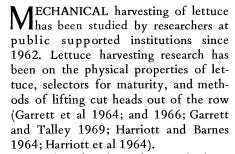
According to a 1973 research paper, serious attempts to mechanize lettuce harvesting at public research universities began in 1962. We have been trying to fully automate lettuce harvesting for almost 64 hours, but we have not succeeded yet.
And it is not for lack of trying.
There are multiple startups and other custom shops working to automate this process.
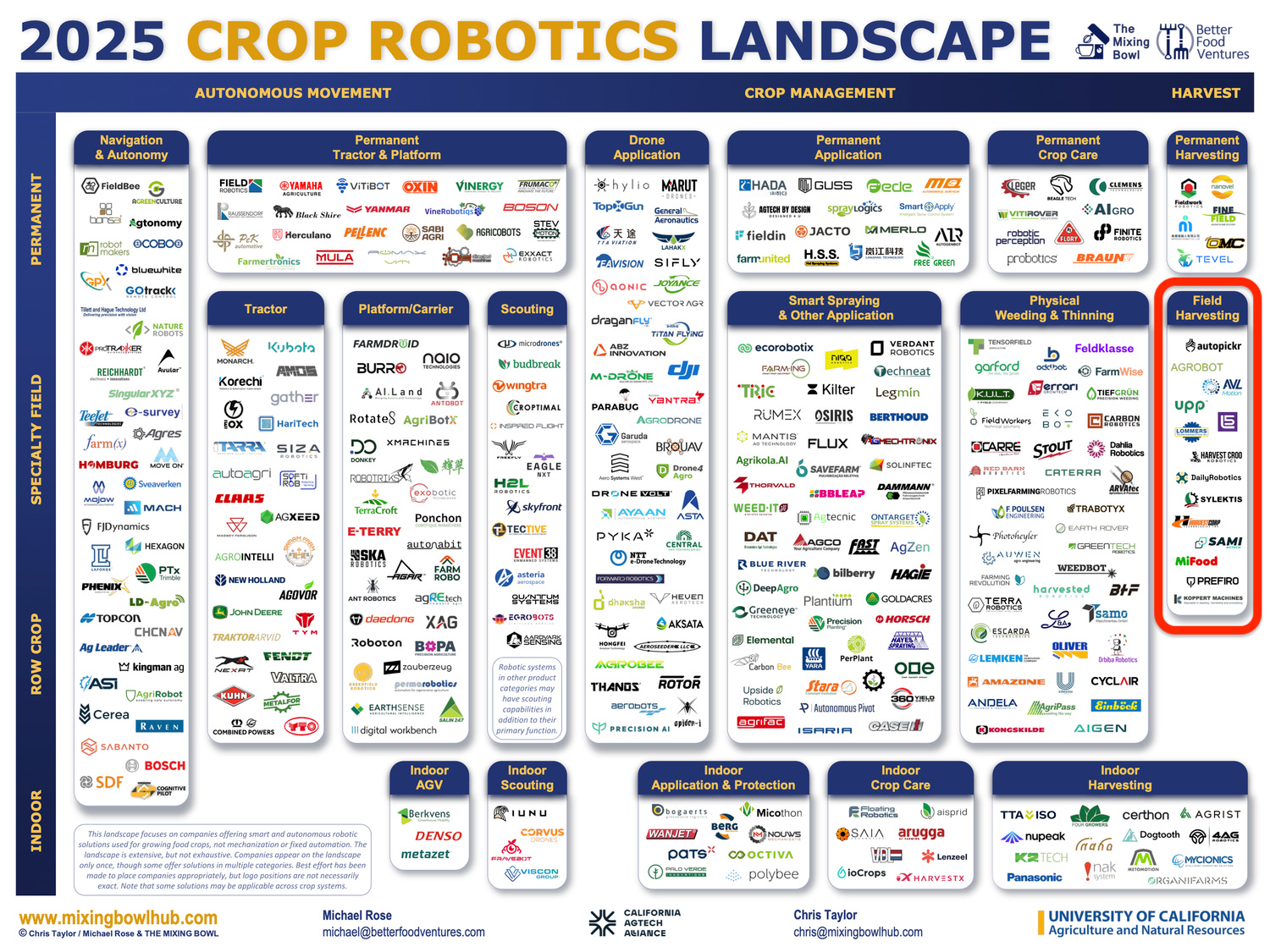
According to the latest crop robotics report from Better Food Ventures, there are more than 450 robotics companies, with many focused on harvesting operations.
US Growers, shippers, and packers prior to the 1960s benefited from the Bracero program.
This was a government-to-government agreement. The US government acted as the labor contractor in the early years, transporting workers to distribution centers. It was massive in scale and focused almost exclusively on Mexican nationals.
Growers paid low wages, and the program itself was accused of suppressing domestic wages. There was little financial incentive to replace Braceros with machines, since labor was so affordable.
The Bracero program was terminated in 1964. This created a huge challenge for growers, unless they had access to undocumented workers.
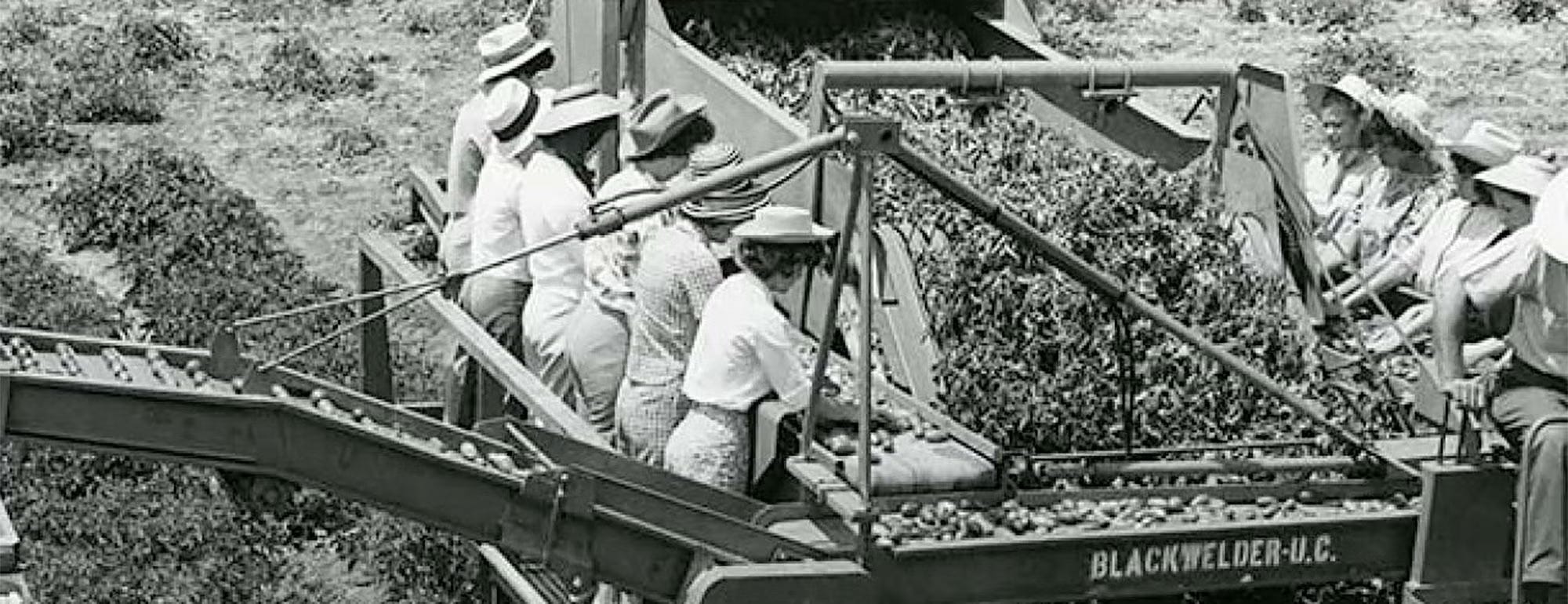
Right after the program was terminated, UC Davis began commercializing a tomato harvester for processed tomatoes, which was quickly adopted. Some acreage for labor-intensive crops, such as asparagus and strawberries, moved south to Mexico.
The Blackwelder Tomato Harvester, developed by the University of California, Davis, is supposed to have saved the processing tomato industry in California in the 1960s (Image Source: UC Davis)
The Bracero Program ended in 1964, and many farmers expected to continue to hire Mexican workers under the H-2 program. However, the DOL issued regulations on December 19, 1964, that required employers of H-2 workers to offer and pay the AEWR to any U.S. workers they employed (Martin, 2007, pp. 15–16). Unlike bracero employers, H-2 employers were also required to offer and provide U.S. workers with the same housing and transportation guarantees that were included in bracero contracts. At a time when U.S. farm workers were not covered by minimum wage laws, most U.S. farmers adjusted to the end of the Bracero Program by mechanizing or changing crops rather than continuing to rely on migrant workers (Clemens, Lewis, and Postel, 2018).
The post-Bracero period saw many attempts to mechanize lettuce harvesting. But these early machines were heavy, slow, and often crushed the lettuce. The technology of the time (analog sensors and hydraulics) lacked the finesse of a human hand.
With the rise in undocumented workers, the pressure to automate harvesting decreased a bit.
Thanks for reading Software is Feeding the World! Subscribe for free to receive new posts and support my work.
From the 1980s to the 2010s, the industry paused on full automation and switched to doing “harvest aid” machines.
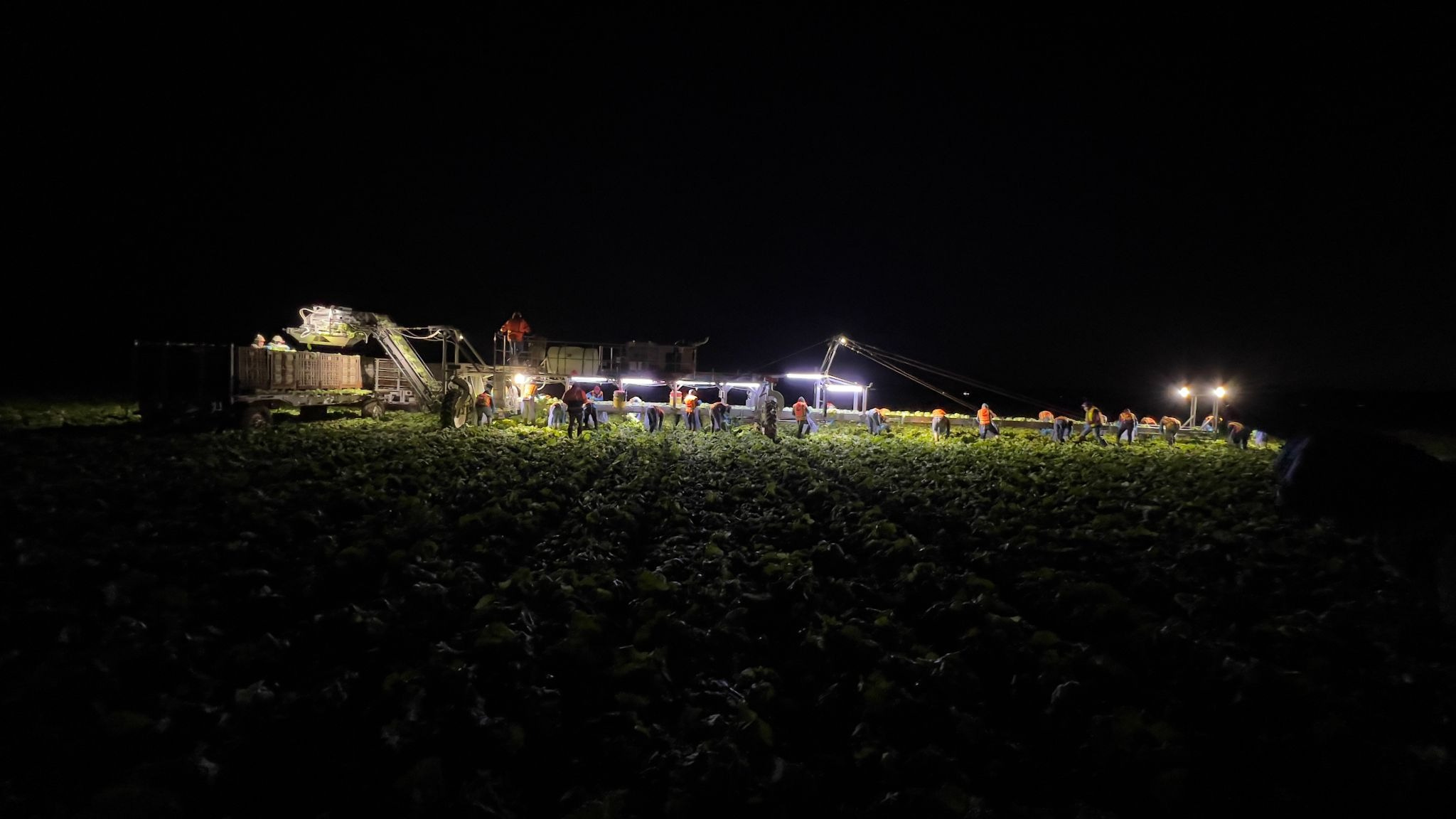
The harvest aid machine typically consists of a slow-moving tractor that pulls a long conveyor belt wing. A crew of about 20 people walks behind the conveyor belt. They continue to cut, trim, and place lettuce heads on a belt.
Harvesting can start in the middle of the night and can go till early in the morning (Photo by Rhishi Pethe)
On the right-hand side of the picture, you can see about 20-25 people selecting, cutting, and cleaning lettuce heads, then placing them on a conveyor belt that moves from left to right.
There are about 3-6 people at the end of the conveyor belt who are responsible for quality-checking the lettuce. The QC people are called “ojeros” as they keep an eye on the quality of produce coming through.
If the field has a high-quality product, the harvesting crew will have more cutters and fewer cleaners. If the product quality in the field is not top-notch, the harvesting crew will have more QC personnel and fewer cutters.
For shed pack products (as seen in the picture above, which will be used for processing, the lettuce heads are kept clean through a spray of water and then end up in large bins (left of the picture), which are then immediately moved to a cooling facility for further processing for salads, etc.
The two or three people standing by the bins make sure the bins are filled uniformly. This part of the harvesting crew is called “reinas” (queens, as they stand and work higher up on the machine).
For field packs, the lettuce heads are immediately wrapped in plastic and placed in boxes for shipping to a cooler.
Harvest aid machines reduce physical strain on workers by reducing walking and bending (depending on the product) and increasing harvesting speed.
The most critical process in harvesting lettuce requires the ability to spot a mature head, cut it at the right angle and at the right spot, and trim the bad leaves. The robotics capabilities of the 1990s and 2010s didn’t have the capabilities to replicate it cost-effectively, whereas a trained human can do it quite effectively.
(This should quell the notion that farming is an unskilled job)
As a result, human harvesting still accounts for more than 50% of the total production cost for specialty crops like lettuce and berries.
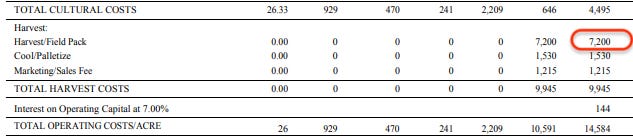
The University of California, Davis, publishes detailed cost breakdowns by different crop types in different parts of California. The table below shows a screenshot of the total operating costs per acre for field-packed iceberg lettuce.
I have highlighted the harvest/field pack costs of $7,200 per acre, out of the total operating costs/acre of $14,584. This data is for 2023 for iceberg lettuce in the Central Coast region of California. Labor costs will be slightly lower in Yuma, Arizona, but the percentages will remain the same.
H2-A program
The H-2A program began in 1986, though the first visas were not issued until 1992. The H2-A program's goals and structure were in sharp contrast to those of the Bracero program.
After the Bracero program was terminated for suppressing wages, the Department of Labor (DOL) implemented strict rules for H-2 visas. They created the Adverse Effect Wage Rate (AEWR).
AEWR is a minimum wage floor designed to prevent foreign workers from being paid less than US workers.
For example, today in Arizona, the hourly legal rate for an H-2A worker is around $18, and they are required to have housing and other amenities, which bumps the hourly rate to $25 to $30 per hour.
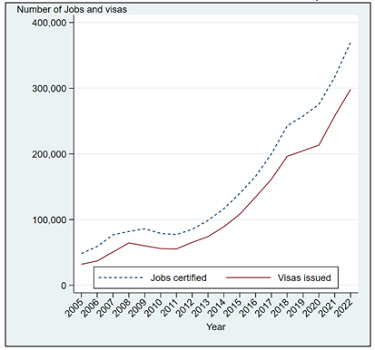
For the first 20-25 years, the H2-A program was hardly used, as it was cheaper and easier for farmers to hire undocumented workers. As a result, in the first 20-25 years of the program, H2-A issued only 30,000 to 40,000 visas nationwide each year.
Around 2010, due to stricter border enforcement and demographic changes in Mexico, the cheap, undocumented labor supply started to dry up. It forced farmers into the H-2A program as the “labor of last resort.”
As H2-A program costs have risen, it has once again created a financial incentive for growers to automate as much of the harvesting process as possible to reduce costs and stay competitive with other parts of the world, such as Mexico and South America. My friend and fellow AgTech Alchemist, Walt Duflock, has written extensively about these challenges, and you should follow him on LinkedIn.
As you can see from the images below, harvesting lettuce requires speed, keen observation, precision, and stamina. Harvesting lettuce across Salinas, California, and Yuma, Arizona, is a 6-day-a-week, 52-weeks-a-year, around-the-clock operation.
Humans are very dexterous and versatile in their skill sets. Picking romaine or iceberg lettuce is not straightforward.
For example, lettuce picked for shed packing for value-added products like salads has to be cut at the right angle and placed on the lettuce stem; a few leaves have to be removed, and the core is stabbed with a coring knife.
This lettuce is then put into large bins, which are sent to the cooler for further processing.
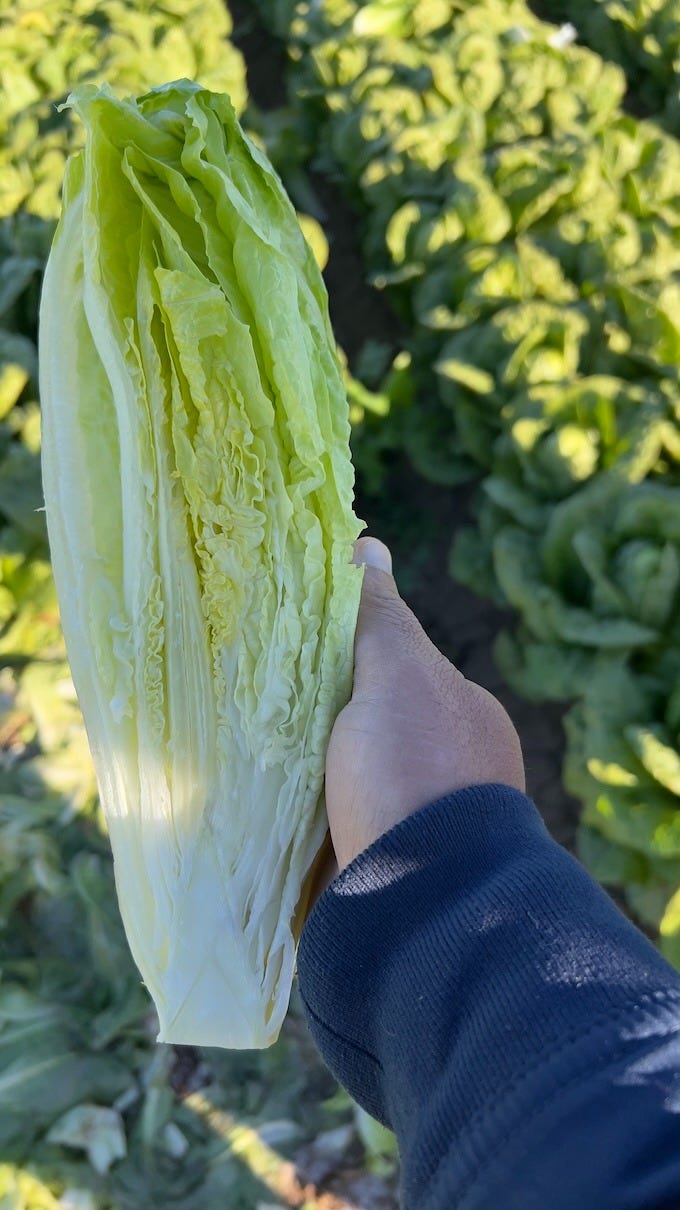
For a product like romaine heart lettuce, the human has to discern which lettuce to pick and which to leave behind, cut it at the right spot, and then remove the right amount of leaves to leave a beautiful-looking heart, which is then immediately packaged.
This is a bit of a consumer expectation problem: consumers expect beautiful-looking produce that stays fresh for at least a reasonable amount of time in their refrigerator before it is used.
Romaine Heart (Photo by Rhishi Pethe)
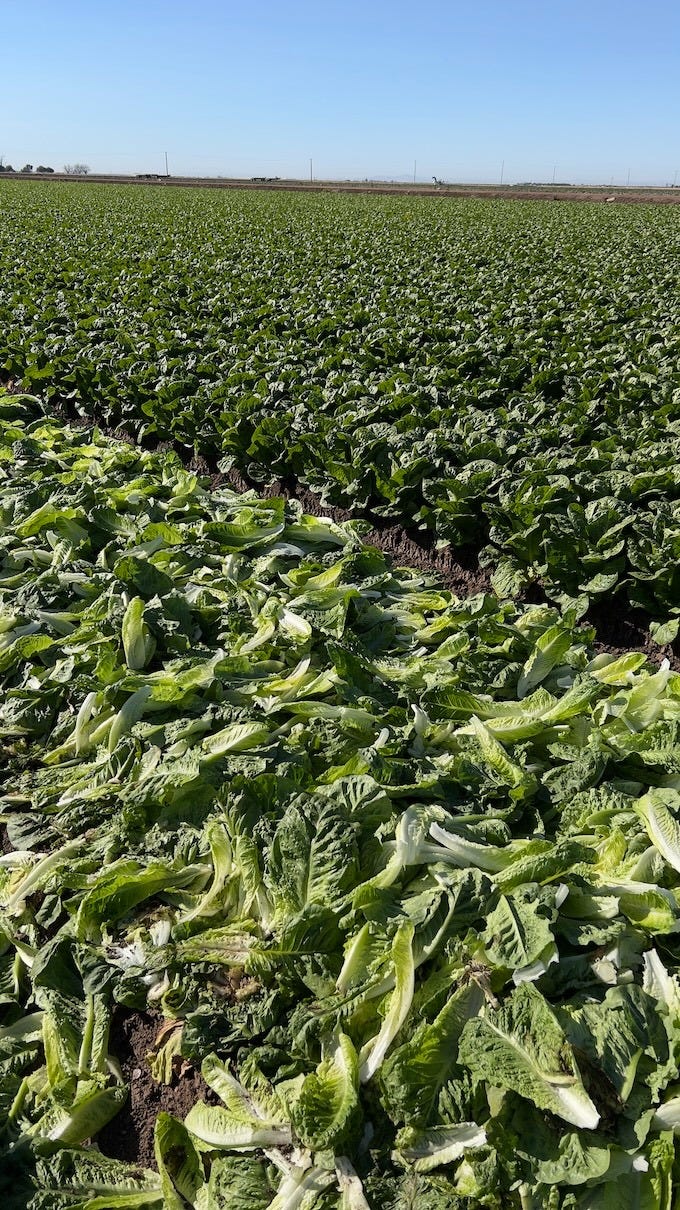
As a result, a large amount of potentially usable product is left behind (by some estimates, 40-50%). This is plowed back into the ground before the next crop goes in, providing some nutrients to the soil.
The bottom part of the field in the image above has already been harvested by the machine. The top half is yet to be harvested. (Photo by Rhishi Pethe)
As you can see from some of the examples here, it is challenging for a machine to completely replace a human, as it must match the speed, quality, and cost of the human crew. The harvesting crew has to perform the following three main operations for lettuce.
There are 5 different buckets of capabilities that an automated machine should be able to meet to reduce the amount of human labor used or almost eliminate it.
These required capabilities will illustrate why, even though the ecosystem has been working for more than 64 years, we still have not fully automated lettuce harvesting.
Though with powerful vision systems, sophisticated AI algorithms, edge processing, advances in materials engineering, and rising H2-A costs, it might be feasible to address this problem.
Performance and Throughput
The system must match or exceed the efficiency of manual labor crews to justify the capital expenditure. Current crews work fast and move through fields quickly, easily processing thousands of heads per hour.
The crew has to maintain the quality of the cut, the cleaning, and the packing while maintaining a high throughput.
The image above shows the precise cut needed to be made by the human operator. If the operator cuts above or below the ideal cut point, it results in wasted product. (Photo by Rhishi Pethe)
As I said earlier, lettuce harvesting happens 6 days a week, all year round. The system must be capable of near-continuous operation during the harvest window of April–November in regions like Salinas, CA, and November through March/April in Yuma, Arizona. The changeover time between fields has to be kept to a minimum.
Economic and Commercial Viability
The machine must reduce the human workforce requirement over a longer time period, and it should have a reasonable and acceptable ROI timeline for adoption.
Obviously, any new machine will not meet these requirements on Day 1, and so there should be a plan to go down the cost curve by learning with enough reps in the field.
Food Safety and Hygienic Design
The machine must adhere to the Produce Safety Rule (PSR) under the Food Safety Modernization Act (FSMA). The Produce Safety Rule has specific requirements around agricultural water, biological soil amendments, sprouts, domesticated and wild animals, worker training and health and hygiene, and equipment, tools, and buildings.
Food safety is absolutely critical. All the operations I saw took food safety very seriously. We always had to wear gloves, hair nets, and beard nets (whether you had a beard or not)!
Machines are washed, and surfaces are cleaned regularly. Everyone has to constantly wash their hands to maintain a hygienic environment.
One of the growers had a pet peeve about birds! Birds can be a nuisance as they can damage the crop. If birds do their “business” while flying over the field, it makes harvesting the product challenging from a food-safety standpoint.
I heard stories about how 100s of acres of crops had to be abandoned due to excessive bird excrement! This particular grower had hired an 8-person crew with the sole responsibility to scare the birds away. Innovative attempts to scare the birds away include drones chasing birds, specific frequency sounds, etc.
Product Quality and Grading
The cut must be made exactly at the “collar” (where the leaves meet the stem) to prevent a reduction in shelf life. The automated system must identify and reject heads with visible defects. Mechanical damage should be kept to a minimum and meet USDA standards for different grades of produce.
Operation and Environment
Meeting operational and environmental requirements is one of the most challenging aspects for these machines. The harvesting environment and the time period are characterized by mud, dust, and high heat.
Furrows might be wet and muddy. Machines have to turn around at edges, which may have different characteristics. It should be able to enter a field and be easy to transport from one field to the next.
Growers are very passionate about how they grow their crop. Some growers are extremely passionate about their bed width, and it would be very hard to get them to change it if it meant an easier operation for their harvesting machine.
Due to this, a harvest machine should be flexible and able to adjust to different bed widths (ranging from the low 30s to mid 80s inches).
Ecosystem Support
For any product, especially a startup, it is impossible to get all of these right in the first version. The product development process has to start with a particular capability and then build experience in the field through a real, growing operation.
Given the number of startups working on robotics, it is often challenging for startups to reach the right type of growers to get feedback on their products and then have the infrastructure to test and iterate on their product.
This is where the ecosystem comes into play. I had the privilege to connect with a few public and private players in the space in Yuma.
For example, YCEDA (Yuma Center of Excellence for Desert Agriculture) under the University of Arizona umbrella is
dedicated to bringing scientific research and industry together to find solutions that bring value to stakeholders by addressing “on-the-ground” needs of Desert Ag production.
YCEDA members can provide technical and research assistance, field acres for testing, and ecosystem support to startups and other players working on bringing innovation to market.
An organization like The Reservoir provides support, office space, field testing infrastructure, and grower connections.
Reservoir helps founders build, test, and scale technologies that farmers can put to work—faster, fitter, and with lasting impact.
The Western Growers Association serves as a voice for specialty crop growers and provides important connections, expertise, and perspectives on technology adoption, policy, and industry needs.
A private organization like Axis Ag provides “Technology services for the agricultural community.”
Axis Ag empowers farmers with innovative agricultural solutions that drive sustainable growth, optimize productivity, and foster environmental stewardship. We are dedicated to advancing technology and partnerships that enhance the future of farming, building resilient food systems, and supporting the communities we serve.
Axis Ag has an interesting model. They have years of experience in specialty crop agriculture, strong grower connections, and the expertise to field-test different AgTech solutions, provide feedback to startups, and find the right set of early adopters to test and scale them.
They have partnered with multiple AgTech companies to help them bring their products to market and to scale.
The services and support provided by YCEDA, The Western Growers Association, The Reservoir, Axis Ag, and many others are critical to bringing these very much needed AgTech innovations to market and scaling them.
The normal conversations within AgTech can feel depressing. The farm economy is definitely in trouble, but my trip to Yuma, Arizona, showed me that the AgTech ecosystem is working hard, is collaborating, and is focusing on solving the right type of problems with rigor.
It might take longer than sending a human to the moon, but many of the existing problems, will get solved in the near future!
Next week’s edition
I will write about the amazing irrigation infrastructure in Yuma, Arizona; how Yuma became the winter salad bowl of the US; the challenges the region faces; and the role AgTech can play.
Happenings
I will be leading a two-and-a-half-hour session during the “AI in Agriculture Forum” at World Agritech San Francisco on March 16, 2026. The focus of the session will be on AI benchmarking. I hope to see many of you in San Francisco in March.
AgTech Alchemy will host an event in Monterey, California, on February 17th, in collaboration with AgSafe. The AgTech Alchemy team will share more details shortly.
At a time when we’re all blaming digital devices for ruining our attention spans, our children’s mental health and even the future of democracy itself, let’s give credit where it’s due: my cheap fitness watch has changed my life.
Three and a half years ago I started running at my local Parkrun, taking more than half an hour to limp around the 5k course for the first few weeks. After a few months of consistently showing up I made the kind of progress one might expect. But when I bought an entry-level runner’s watch, things really started to change.
Urged on by the watch, I began training several times a week and lengthening the runs to 10k, 10 miles and beyond. My wife got the bug — and her own watch. Our daughter described us as “running mad”. You be the judge: mad or not, I’m running the London Marathon in April next year. As a stubborn non-runner for the first 49 years of my life, there’s no way I’d have signed up for that sort of insanity without the watch.
These fitness trackers are not without their downsides, and I’ve become fascinated by the way they’re a microcosm of our increasingly quantified lives. The most obvious objection is that they are a privacy nightmare. They track our location and make sharing it easy and tempting. Stanislav Rzhitsky, a Russian submarine commander, was assassinated while going for a run in his local park; he was in the habit of posting his running routine on Strava. In the US, a man was convicted of murdering his wife after her Fitbit data contradicted his account of events.
And it is not just location: Carissa Véliz, the author of Privacy is Power, warns that with the right technology, heartbeat data can be as distinctive as a fingerprint. It’s unclear how much is already up there in the cloud, waiting to be abused by someone or other.
Fitness watch manufacturers would rather focus on these trackers as tools for performance. Even in this respect, there is a mixed picture. Like any good performance metric, my watch provides me with structure and helps me optimise my running. I can feed in a goal — a distance, a time — and it will generate a training program. Once-difficult tasks, such as running at a consistent pace, become straightforward.
Yet like many performance metrics, the watch can also nudge me into counter-productive activity such as overtraining to the point of injury. The sleep-tracking function tempts many people into thinking too much about sleep, which is the sort of thing that can make it hard to drift off. There’s a term of art, “orthosomnia”. It means that you’re losing sleep because you’re worried that your sleep tracker is judging you.
There is another subtle effect at work, something called “quantification fixation”. A study published last year by behavioural scientists Linda Chang, Erika Kirgios, Sendhil Mullainathan and Katherine Milkman invited participants to choose between a series of two options, such as holiday destinations or job applicants. Chang and her colleagues found that people consistently took numbers more seriously than words or symbols. Whether deciding between a cheap, shabby hotel or an expensive swanky one, or between an intern with strong management skills or one with strong calculus skills, experimental subjects systematically favoured whatever feature had a number on it, rather than a description such as “excellent” or “likely”. Numbers can fixate us.
“A key implication of our findings,” write the researchers, “is that when making decisions, people are systematically biased to favour options that dominate on quantified dimensions. And trade-offs that pit quantitative against qualitative information are everywhere.”
They may or may not be everywhere, but they are certainly in my fitness regimen. My watch takes walking, cycling and running seriously — especially outside rather than on a treadmill — but a hard session at the gym barely registers. It will count my steps for me, but I have to count my own pull-ups. The result is an incessant tug away from exercise that may be good for my body or my spirit, but which doesn’t “count” — and towards the kind of aerobic, trackable activity that the watch rewards.
Management theorists have long known about this problem. Steve Kerr’s essay in the Academy of Management Journal, “On the Folly of Rewarding A While Hoping for B”, is 50 years old and the folly seems more common than ever, perhaps because we now have an ever easier selection of automatically generated metrics upon which to fixate.
Quantification fixation may explain an early, infamous study of using fitness trackers for weight loss, published in 2016, which found that the trackers made it harder rather than easier to lose weight. That might be a statistical fluke, but it might also reflect the fact that when you exercise more you may be inclined to eat more. The fitness tracker monitors and therefore encourages extra exercise, but turns a digital blind eye to extra calories — this is quantification fixation in automated form.
A different aspect of the same problem is when I face a choice between the run prescribed by my watch, or an opportunity to run with a friend — possibly over the wrong terrain, for the wrong distance, at the wrong pace. “Wrong”, of course, being defined by the sensors in the watch. It is almost always better to seize the opportunity for a sociable run, but do I always seize it? I do not. It’s a shame to let down a friend, but it’s a disaster to let down the watch.
We live in a quantified world and in many ways our lives are better as a result, whether the metrics have been used to create more effective medicines or more efficient delivery vans. My watch may be a punctilious little wrist-worn box of tricks, but my running, and indeed my overall fitness, is far better than it was before I bought it.
Still, we would do well to keep the quantification revolution in its proper place. I never would have started running in the first place without the friends who encouraged me to show up at Parkrun, a movement that relies on community spirit, deftly seasoned with just the right amount of quantification.
And I’m not running a marathon because my watch told me to do it; I’m running in memory of a young woman who died of cancer at the age of 20. The fitness watch is a means to an end, not the end in itself. All I need to do is to remember that.
Written for and first published in the Financial Times on 11 Sep 2025.
oh you have to eat your produce the moment it leaves the store or the fuckin Hungering Dust will get it. and. poison your food
I ran into this post years ago and to be honest, it has completely reoriented the way I engage with food.
Like. I’ve always sorta understood that things grow moldy or stale or sour or such if left out, but I never really internalized it in a meaningful way.
But now I’m just like.
Yeah. The hungering dust. There exists omnivorous dust in the air that will eat my food if I don’t.
Those bagels have been sitting there for a week. Are we going to eat them soon or are we leaving them for the hungering dust?
Pizza’s been sitting out on the counter for an hour. Everyone’s enjoying the pizza, but if we don’t want “everyone” to include the hungering dust then we should probably put it away soon.
That’s just. That’s how food works to me now. There exists an invisible predator in the air that hungers for your yummies, and it will not hesitate to eat your food if you don’t make the effort to protect and preserve it. And eat what can’t be preserved before the dust can.
 Log in