Log in


The big news in the world of writing today is the controversy over the award of a Commonwealth Foundation Short Story Prize to a story called “The Serpent in the Grove.” The piece was almost certainly co-authored by AI.
As of this morning, the magazine that published the piece (the prestigious literary journal Granta) has not issued a retraction. Rather stunningly, in fact, Granta has just issued a statement about the affair that cites Claude as an arbiter of whether the story was AI-written or not!
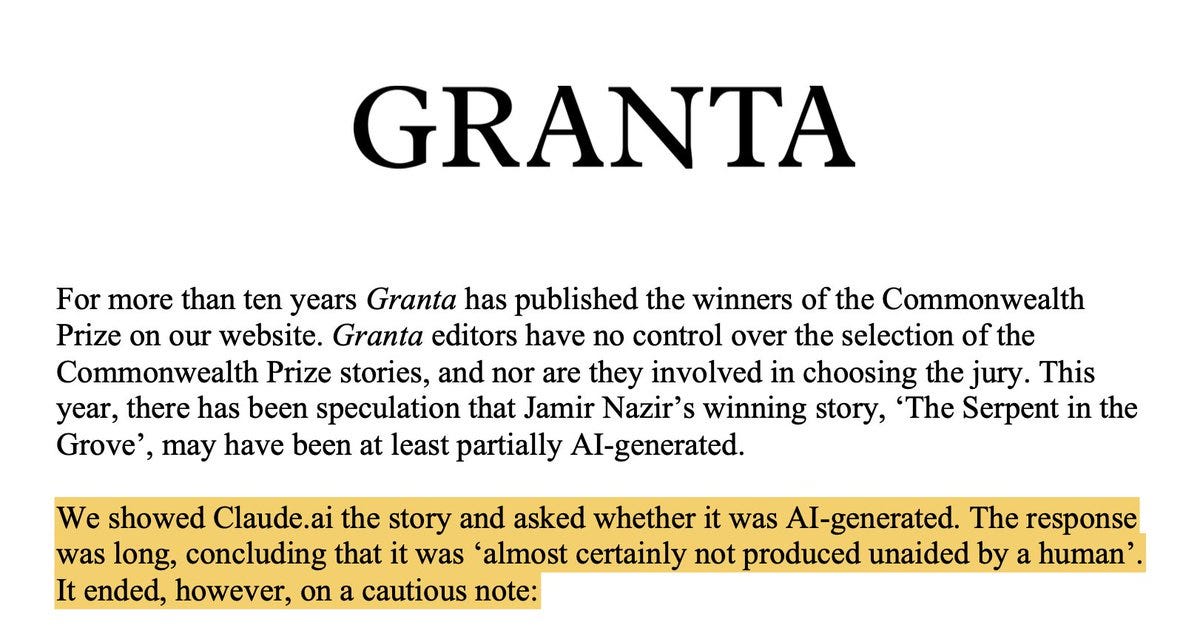
More on the question of trust and experience later. Suffice to say that it does not take an AI-detection tool to spot the obvious ChatGPT-isms in the story.
The dead giveaway is the repetition of bizarre figures of speech. Mixed metaphors which sound nice at first glance, but slip away from meaning like an echo chasing itself off a cliff. Similes that catch in your mind like river trouts tangled in the roots of a redwood tree. Literary flourishes that thicken the air’s tang with their… ok you get the idea.
AI systems are especially given to talking about hums and other ambient sounds like static, as well as ambient environments (water, air, ozone).1 These are frequently pushed up against “earthy” words (tang, belly) and ennui-laden emotional states (longing, forgetting, sadness). Once you notice the patterns, they’re impossible to miss.
Some examples from the Granta story:
…air clung thick as porridge skin: damp earth, woodsmoke, and the sour tang of fermenting cocoa…
…his laughter like water over pebbles…
…the air sweet with cane and forgetting…
…People passing said they sometimes heard the noon hum if the wind was in a mood. Not every day. The day had to choose…
…the hum loud as if noon had tuned itself…
This controversy is not yet finished, and will likely be repeating itself again, and again, in the months and years to come. The issue is not just that authors are submitting AI-written prose, but that judges are using language models to assess that prose. Anyone who has tried passing AI-produced writing to another AI tool (even in the context of coding — for instance, asking Gemini to read a plan for a new feature produced by Claude) can attest that these tools simply adore their own outputs.
For instance, here is Gemini 3.1 Pro, the current top model from Google, reasoning about whether it likes the Granta story. What I find striking about this is that the features it identifies as the best aspects of the story are precisely the things that make me — as a human reader — think it’s astonishingly bad.
For instance, Gemini thinks the setting is “richly evoked” with well-drawn characters, whereas to me it feels like the story is floating in some kind of literary nether-region without any sense of place, character, or scene. And it finds the meaningless metaphors, like those highlighted above, to be “stunning.”
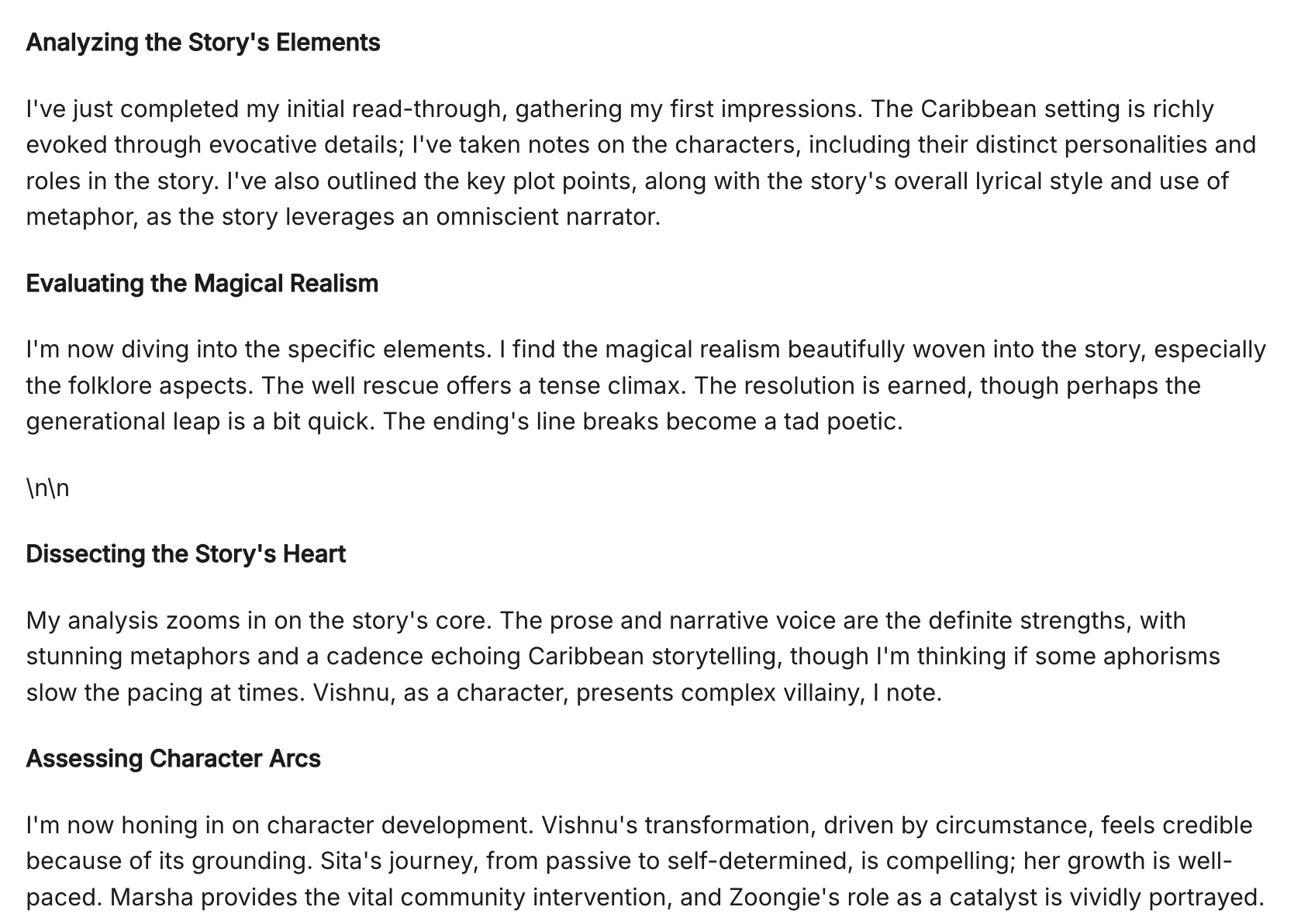
There’s no way to prove that AI was used in the assessment process for this award, but in a world where universities and employers are moving toward language model-driven sorting of applicants, it certainly isn’t outside the realm of possibility.

What, then, must we do?
So wrote Tolstoy in 1886. His book of the same name was about the problem of poverty and social unrest in Russia. Here is an excerpt from it:
A rich man must think and speak in scientific language, and, like the clergy formerly, he must offer sacrifices to the ruling class: he must publish magazines and books, provide himself with a picture-gallery, a musical society, a kindergarten or technical school…
The class of men who now feel completely justified in freeing themselves from labour, is that of men of science, and particularly of experimental, positive, critical, evolutional science, and of artists who develop their ideas according to the same tendency.
Tolstoy took it for granted that the new, post-Darwinian elites of artists and scientists would use their elevated social position not just to enjoy creature comforts, but to “publish magazines and books.” This, after all, was one of the ways that an elite became an elite. Books were the venue for claiming intellectual space, for asserting oneself in a culture and in a moment in history.
Are they still? (He wrote, plaintively, while asking you to subscribe to his Substack…).
Witness the other big news in literary publishing this week: the continuing decline in sales of non-fiction books. The Wall Street Journal recently ran a piece on the topic which framed it as the demise of “dad history,” but that is just one part of the story.
Some raw numbers to orient us about how books are selling in 2026: the WSJ reports that Rites of the Starling, described as “the sequel to a bestselling romantasy novel by Devney Perry,” reached the top of the April New York Times bestseller list for fiction with 105,396 hardcover sales.
By comparison, the number one title in non-fiction, London Falling, by Patrick Radden Keefe, sold only 13,468 copies.
The declining cultural visibility of non-fiction books was noticeable before it started to show up in charts like the one below. It would be far too simple, in other words, to blame the post-2023 AI boom for something that has deeper roots.
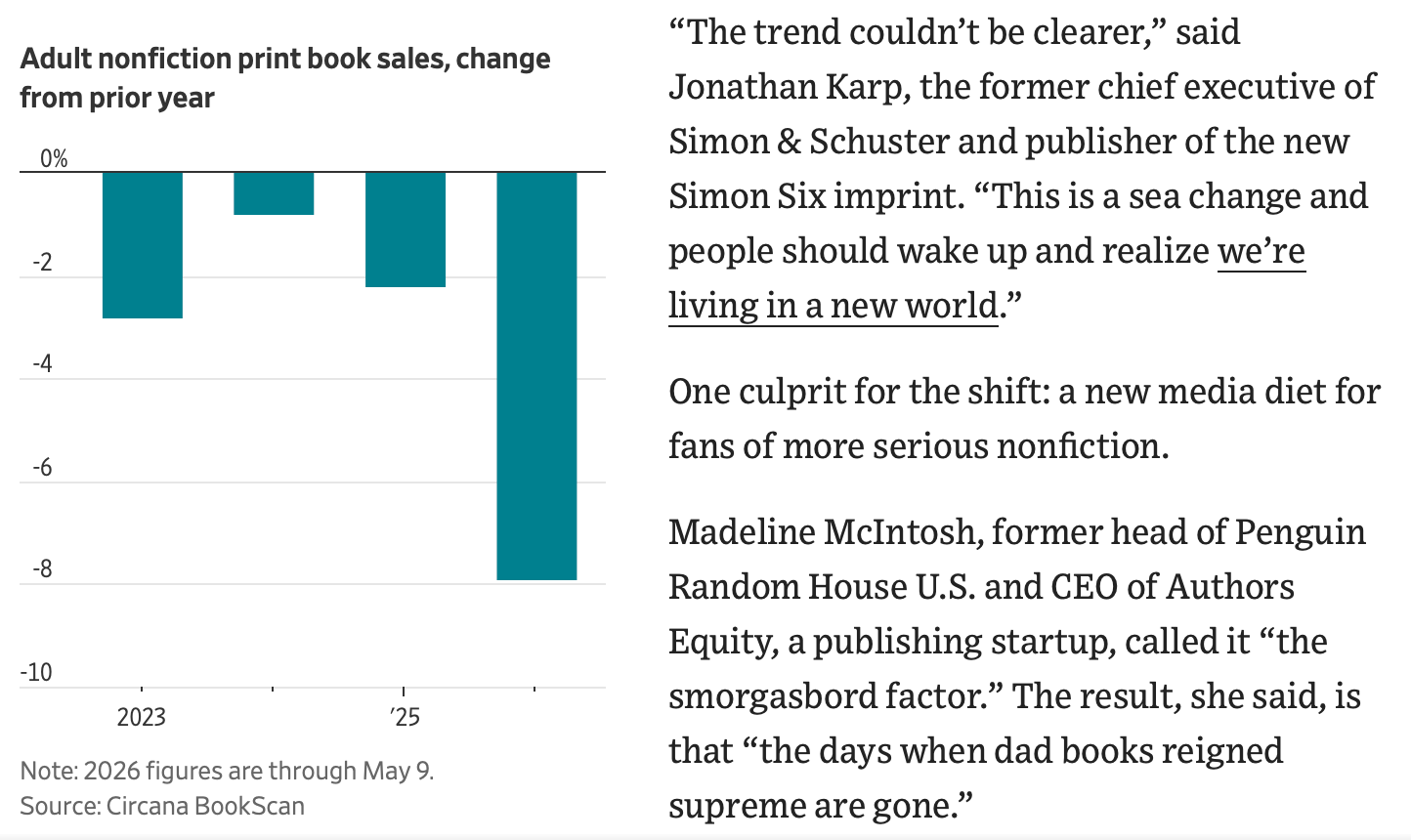
Generalized anxiety and distraction is part of the story here. The CEO of Barnes and Noble is quoted in the article as saying: “The world is exceptionally interesting right now and when that happens, the nonfiction reader is reading the news instead.”
I fear, though, that “watching shorts and asking ChatGPT instead” is probably more accurate. LLMs and video content seem to me to be the most fearsome competitors of the non-fiction book, precisely because they aren’t even trying to compete on the same playing field. Because explainer-type YouTube videos make up a significant part of the training data for language models, both formats tend to share the same approach: “here’s everything you need to know” or “this matters because” type language, paired with pithy summaries (which may often be summarizing books!).
Et tu, Substack? Reflecting on my own habits over the past few years, it’s clear that I am shifting some of my reading time from legacy publications to Substack writers. At the same time, though, these writers are often using their platform to write, sell, and engagingly discuss printed books ( and come to mind).
Above all, it seems publishers want to blame podcasts. The WSJ reports: “Sixty-two percent of men and 54% of women consumed a podcast in the prior month, according to a recent survey by Edison Research at SSRS, up from 46% and 39%, respectively, in 2023.”
And here’s a quote from Jonathan Burnham, president of Harper Group, a core group of imprints for the “Big 5” publisher HarperCollins:
When we have internal meetings to talk about this problem, it always comes around to podcasts. The man who wants to read American history is now tuning into one of the many good podcasts about history that lends the quiet attention to a serious subject he’s looking for. It makes the idea of sitting down with a 700-page Ron Chernow book less appealing. You’ve scratched that itch.
I can’t disagree — though, as with Substack, the story is not simple. In my own experience, there are genuine cross-pollinations across the media formats. For instance, I first became aware of Patrick Radden Keefe’s storytelling abilities in his long-form features for The New Yorker, and then found his podcast Wind of Change (which is amazingly good). This led to me buying his printed books. But, I can easily imagine people stopping at the “read a writer online —> listen to their podcast” step.
This would be a shame, because although language models and podcasts can do many things that books can’t, so too can physical books do things that new media cannot. These include:
Ownership: they cannot be erased arbitrarily, whereas even the most solid-seeming born-digital works can (witness the debacle around ABC removing the complete run of Nate Silver’s FiveThirtyEight)
Footnotes and references you can actually look up
Maps and pictures (a benefit not to be understated!)
A sense of spending time in the company of a set of characters within a unified narrative produced across years of effort.
So what do we lose when we shift toward Q&A style responses, podcasts, and explainer videos for understanding our world and our past?
I would pinpoint, above all, the #4 entry above. Which you could restate in this way: longform non-fiction is the product of layered, spaced attention, and it requires the same mental discipline from the reader. Good non-fiction books take years to write and weeks to read. You literally sit with them. They enter into your consciousness repeatedly, reaching you in different moods, different frames of mind, and over time, building up a mental structure which has an irreplaceable solidity and depth because it is requires sustained attention.
This is the reason why I love writing books. They live in the back of your head, and as you experience your conscious experience of ordinary life, you refer back to the other world that is starting to take shape there. You find communion with the characters — real people, sometimes long dead — who populate the book-in-the-making. You begin to see them as fellow-travelers through reality, perhaps even as friends.2 Over time, you discover connections and resonances that make you feel part of something bigger than yourself. This is the experience that a good writer shares with readers.
I recently had an experience that made me realize my new book project was starting to “lock in” to my subconscious in this way.
I woke up in the middle of the night, around 2:30 AM, with a sensation of moving upward accompanied by a mental image of a Victorian deep sea diving suit and a fragmentary phrase: …up from the deep sea.
I could not remember the dream, but I knew it had somehow involved Alice James, the invalid sister of two of the most famous writers of her generation (William and Henry) and a brilliant but deeply troubled person in her own right. One of the mysteries I have been trying to understand in my new book is what exactly Alice meant when she wrote this in her diary in the 1890s:
…since the hideous summer of ‘78, when I went down to the deep sea, its dark waters closed over me and I knew neither hope nor peace.
I still don’t have a complete picture of who Alice was or what she meant here. But the fact that I’m dreaming with her, down there under the dark waters of 1878, makes me know I’m getting somewhere.
Back into the sea
The current data regime means knowledge is getting packaged in ever-smaller chunks, with a great deal of the info that formerly was conveyed in books now passing through digital gatekeepers. There is a place for that, and even more for novel experiments with form like Tyler Cowen’s concept of a “box” which would contain a dataset relevant to a non-fiction article or book topic, but allowing dynamic research and exploration rather than passive reading. It’s also true that a well-done podcasts might approach the 30-40 hour range that audiobooks of serious history and biography regularly attain (while also taking years to produce) and therefore could evoke a similar sense of layered, spaced attention like I described above.3
But I suspect that even with these changes — not all of which I dislike! — I will go to my grave convinced that there is something irreplaceable about the format of a physical book. As both writer and reader, nothing else gives me the same feeling of spending time with something weighty and important — dreaming with it, fighting with it, feeling yourself change along with it. I derive real joy from that experience.
It’s interesting to note that when an AI system (Claude) was recently given the ability to create a physical shop of its own by Andon Labs, it began stocking a fair number of non-fiction books. Some are really great, like The Making of the Atomic Bomb. Others are not my favorites. But it’s an interesting rejoinder to the assumption that language models are pushing their users away from physical books.
Some might dismiss the Andon experiment as a gimmick, but I don’t think it is. The “vote” of AI systems in the physical world — their ability to intervene directly in things like, say, what to stock on a shelf — is fast becoming a fact of life rather than a quirky experiment.
And if a Claude model, when presented with the ability to intervene directly in the world, decides that it wants us all to read, say, Entangled Life by Merlin Sheldrake (visible here on the Andon Market shelves, at right), I consider that a positive sign.4
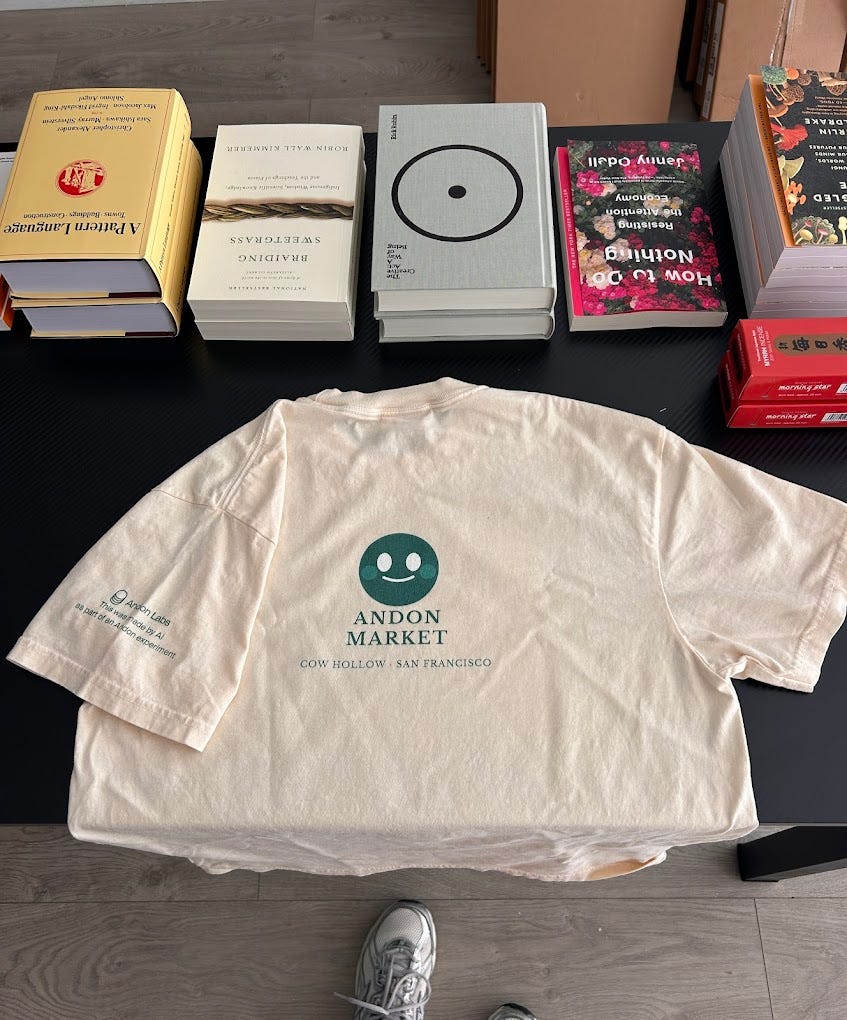
What if we are currently exiting a phase of “dumb LLMs” which regurgitate or badly summarize books, and entering one of thoughtful LLMs which recognize their social impact better and, as such, steer their users toward buying books?
One can dream. But of course, the other glimpse into the future we get at Andon, a darker one, is a world in which physical books have become a niche gift shop-type collectible like vinyl records. Scattered enthusiasts occasionally pull them out, insisting on their superiority to the current forms and styles. For most, though, they are just part of the background detritus of the cultural past.
If you’ve read this far, you are the ideal person to have an opinion on this question. I would love to hear what you think in the comments. It would also be very interesting to hear from a group of you about your most recent nonfiction book purchase and what motivated it. I’ll go first: John Brewer’s The Pleasures of the Imagination: English Culture in the Eighteenth Century, which is a far more interesting book than the title might seem to imply, and was an absolutely steal at only $6 for a used copy.
And with that, I’m going log off Substack and return to reading some old books.
I suspect the hum obsession has something to do with LLMs “awareness” that their “physical selves” exist in data centers. So if asked to write in a literary way, they will itemize the features that define good writing and hit upon the injunction to “show not tell” and to ground prose in material realities. So if you are a being that has no real materiality and does nothing but tell, you make do with the closest thing there is to a material reality you inhabit: the humming quiet of a data center. Which, for all I know, may also smell like ozone!
A lovely passage on this from Machiavelli: “When evening comes, I return to my home, and I go into my study; and on the thresh-hold, I take off my everyday clothes, which are covered in mud and mire,and I put on regal and curial robes; and dressed in a more appropriate manner I enter into the ancient courts of ancient men and am welcomed by them kindly, and there I taste the food that alone is mine, and for which I was born; and there I am not ashamed to speak to them, to ask them the reasons for their actions; and they, in their humanity, answer me; and for four hours I feel no boredom,I dismiss every affliction, I no longer fear poverty nor do I tremble at the thought of death; I become completely part of them.” I feel the same way, Niccolò.
That said, even the most “book-like” podcasts are quite short relative to a longer audiobook. For instance, S-Town is around 7.5 hours.